Web Scraping Brittleness and Why It Fails AI Production Pipelines
Site redesigns silently degrade AI pipelines by breaking selectors before returning broken evidence.

A web search API for AI agents and RAG pipelines should return fresh, filtered passages that name their sources with predictable latency. Web scraping brittleness is an infrastructure problem because site-dependent extraction was built for a different consumer. Better selectors can repair individual failures, but they cannot supply the coherent context, reliable access, and consistent output that production AI requires.
Why scraping's architecture was never designed for AI pipelines
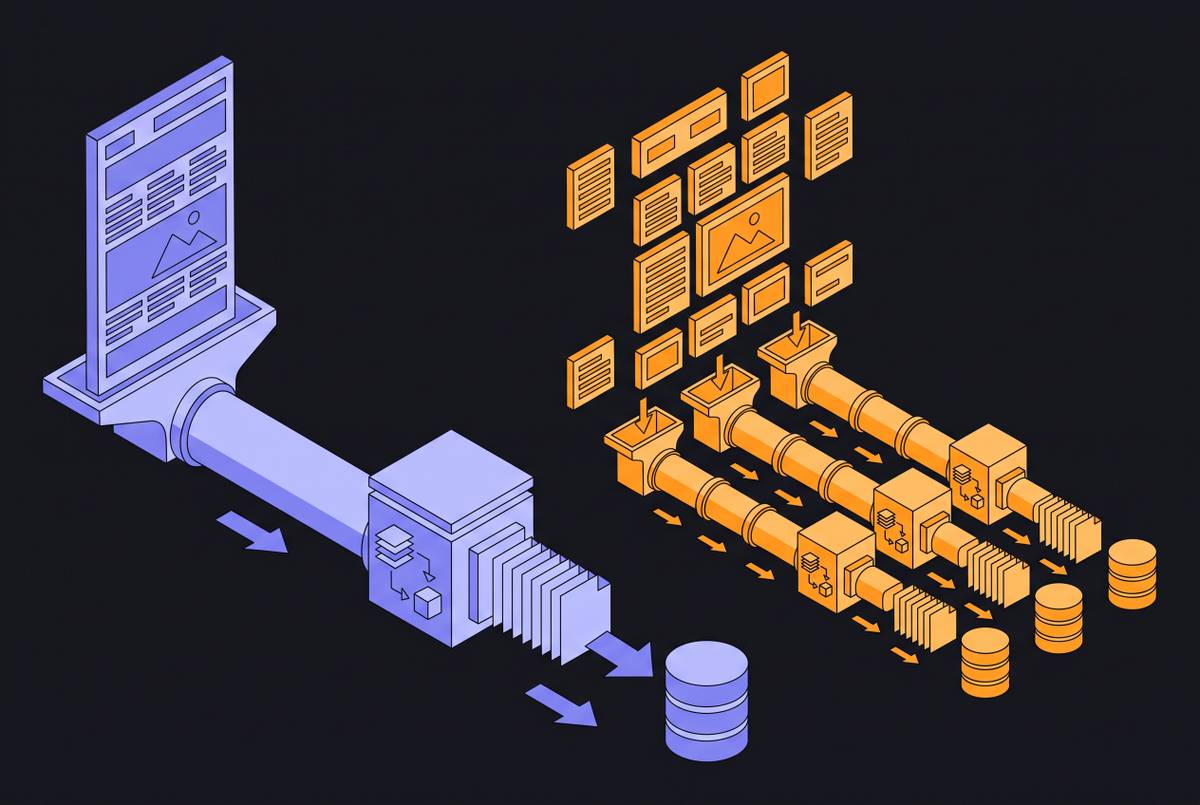
Traditional scraping uses CSS selectors, XPath, and regular expressions to locate content through document structure or text patterns. A selector can locate a passage because it sits inside a particular element, but that relationship lasts only while the site preserves the expected structure. The information itself may remain unchanged after a redesign. But the extraction rule may no longer find it.
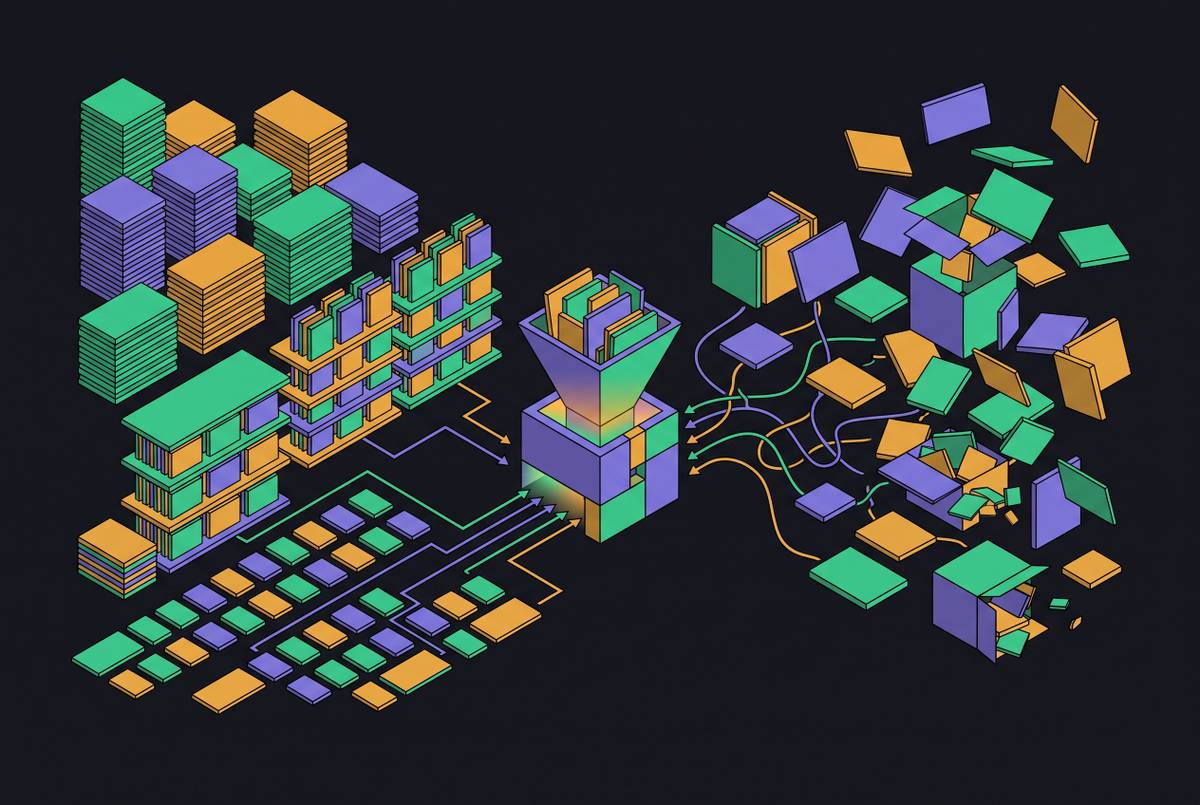
This creates a mismatch between the scraper’s contract and the model’s needs. LLM reasoning requires semantically dense, contextually coherent passages, while a scraper can return fragments whose meaning depends on surrounding material. RAG retrieval also needs source URLs, publication dates, and content boundaries to support ranking and citation. These properties must be assembled through additional processing whose correctness depends on what extraction preserved.
The same mismatch appears in the treatment of human-facing page content. Navigation chrome, advertisements, and boilerplate help organize or support a website, but they consume tokens without contributing evidence to an answer. A scraper can satisfy its positional rules while failing the reasoning task. Because the architecture treats document structure as a proxy for meaning, patching individual selectors cannot remove its structural brittleness.
How selector-based extraction degrades when websites change
CSS class names, DOM nesting, and page layouts change on deployment cycles unrelated to the information a pipeline needs. A page can retain the same product description or policy while moving it beyond an existing selector’s reach. These changes need not come with notice. Each target site controls the structure on which the extraction pipeline depends, so the pipeline inherits changes it neither schedules nor governs.
The resulting failure is not always an exception that stops processing. A selector may return an empty string, which passes validation unless the pipeline checks expected content fields and compares results with historical baselines. The request can appear to have succeeded. Downstream, the LLM receives missing context without a dependable distinction between content that does not exist and content that extraction failed to find. The system can continue producing apparently normal answers after its evidence supply has degraded.
This makes silent degradation more difficult to diagnose than an outright halt. A stopped pipeline exposes an operational failure, whereas incomplete context can emerge as an uncertain or incorrect answer much later. Repairing the selector restores that particular dependency but leaves the operating model intact. The next target can change independently. Across many domains, maintenance grows with the number of sites covered rather than query volume, so selector-based coverage needs constant upkeep to keep working.
How broken or noisy extraction corrupts RAG pipelines before the LLM sees anything
When damaged content reaches the retrieval layer, errors in extraction can lead to errors in reasoning. Chunk fragmentation is one route. If an answer is split across two pages, neither retrieved passage may be complete, forcing the model to infer how the missing parts connect. Groundedness failure occurs when the answer has details that are missing from the retrieved text. Choosing a different model or tuning the prompt cannot bring back evidence that ingestion never supplied.
A parser that drops table boundaries or merges columns can turn correctly published information into a plausible but incorrect passage. The words survive, but their relationships do not. Retrieval may then select the passage because it closely matches the query, even though its extracted meaning no longer matches the source.
Noise competes with evidence in the same context window. Navigation menus, cookie banners, advertisements, and boilerplate occupy tokens that could otherwise hold substantive passages. Unless filtering removes them, the model must work out which parts of the supplied text are page furniture and which are evidence. Duplication further narrows the available evidence. Near-identical product descriptions or repeated policy text can occupy top-k retrieval slots, displacing distinct passages that would broaden the answer’s grounding.
Even clean, relevant text can be wrong for the task if it describes an outdated policy, a superseded price, or a deprecated API. Similarity does not establish correctness or freshness. In legal, finance, and healthcare applications, authoritative citation of an incorrect clause can create compliance exposure as well as accuracy loss. The model has no independent verification path when it must synthesize only from the supplied context. It cannot reliably report that extraction degraded the evidence, only express uncertainty about what it received.
Why the web itself is hardening against automated access at the infrastructure level
Modern bot protection evaluates signals below and around the extraction layer, including cryptographic handshakes, JavaScript environments, and request behavior. TLS fingerprinting can distinguish Python requests and unpatched Node.js from real Chrome, allowing a web application firewall to reject a connection before HTTP is exchanged. No change to a parsing rule can repair that failure. The content has not reached the parser.
Browser rendering introduces further detection surfaces while automated access remains subject to blocking. JavaScript checks can examine navigator.webdriver, WebGL artifacts, and audio codec behavior, exposing headless environments unless they are heavily patched. Behavioral analysis adds another independent test. Request cadence, simulated mouse movements, and scroll patterns can reveal deterministic traffic even when it comes from residential IPs. As detection payloads change, countermeasures require continuing maintenance.
Access policy adds constraints beyond technical detection. Cloudflare began blocking AI-based scraping by default in July 2025, framing the change around access without permission or compensation. GDPR also requires a lawful basis for scraping personal data, together with purpose limitation and minimization. A pipeline may reach content while still facing restrictions on how it can collect or use it.
For agentic systems, these barriers cause delays that are hard to predict. Challenge resolution, session management, and proxy rotation add latency beyond the page’s base loading time. Even when retrieval succeeds, the content may arrive too late. When web access sits inside an agent’s reasoning loop, retries and access negotiations affect the responsiveness of the whole task. Selector repair cannot turn that variable access path into dependable real-time grounding.
How the complexity tiers of the web create unpredictable cost and reliability profiles for scraping pipelines
Simple static HTTP pages are the easiest tier to handle. Server-rendered blogs, documentation, and government databases can return their full content through a GET request with standard headers. JavaScript-rendered pages need a different execution path because their content appears only after client-side code runs. React, Vue, and similar single-page applications can therefore require headless browser rendering. That adds compute work and latency to each retrieval.
Anti-bot protected pages form another tier of work. Active challenges, fingerprint validation, and CAPTCHA gates can block standard headless browsers and require specialist infrastructure with continuing maintenance. A pipeline encounters different prerequisites for obtaining content, different failure modes, and different response times depending on the page. Its runtime workload is determined by a changing distribution of targets.
Treating every target as protected imposes unnecessary work on pages that need only a simple request. Treating every target as static instead risks empty context from JavaScript-rendered and protected pages. Neither assumption serves the whole workload. Attempting simple access first and escalating on failure requires reliable failure detection and rerouting logic, which must itself be built, maintained, and monitored.
These differences make cost unpredictability a signal of reliability unpredictability. A page that loads quickly on one attempt but takes many seconds on another is difficult to depend on inside an agent’s reasoning loop. Average performance conceals that instability under load. Pages that work well in a demo cannot show whether the pipeline will keep returning consistent content as the mix of targets changes. To be ready for production, the pipeline needs predictable latency and quality across that mix.
Why LLM-powered extraction partially addresses brittleness but does not resolve the pipeline design problem
LLM-powered extraction improves on fixed document positions by finding information through what it means. A model can recognize “the product price” whether the relevant class is.product-price-large or.price-tag-new. Layout changes need not break semantic inference. This reduces selector maintenance and makes extraction more adaptable to variable layouts and one-off tasks. It addresses a real weakness of positional parsing.
However, semantic inference introduces probabilistic errors of its own. An extractor can return a structurally valid field containing the wrong price tier, a misidentified product variant, or an unstated value inferred from surrounding text. Schema validity does not establish semantic correctness. During continuous ingestion, occasional errors can enter the knowledge base unless validation compares them with expected values or historical baselines. Token use on every page also remains part of the extraction workload.
Even a better parser needs access to the content. TLS fingerprinting, behavioral analysis, and challenge systems operate before the model can interpret the page. Replacing selectors also does not, on its own, add the filtering needed to remove navigation, cookie banners, and advertisements before they take up model input. The gains at extraction do not remove the preceding access and preparation dependencies.
An extraction-centric pipeline still has to fetch, parse, clean, and chunk, with each stage introducing its own failure points and operating requirements. Content must be selected, filtered, ranked, and shaped for machine consumption before it can serve as dependable context. LLM extraction improves one stage, but it does not by itself provide that end-to-end knowledge layer.
What should a web search API for AI agents and RAG pipelines provide?
Machine-ready passages are the first requirement, rather than raw HTML that leaves cleaning, chunking, and deduplication to the caller. Structured output must also keep source URLs, publication dates, and content boundaries so retrieval can rank and cite the evidence correctly. These are part of the data contract. A search interface that returns pages without these properties still leaves the application responsible for much of the work of preparing them for retrieval.
Freshness and latency belong in the same specification. Time-sensitive reasoning needs web content that is kept up to date because model training data cannot take the place of current evidence. That evidence must also arrive predictably under production load. An API that produces coherent passages only after variable rendering and challenge delays leaves the agent exposed to the access problems described earlier. Real-time internet access requires both current information and a dependable time to delivery.
End-to-end control of the data pipeline provides the basis for engineering these properties together. A service that wraps third-party extraction inherits external failure modes, rate limits, and quality limits it cannot directly improve. Access reliability, filtering, ranking, and output shaping need to be first-class engineering responsibilities. A purpose-built web knowledge API can combine fast retrieval with ownership of this underlying pipeline.
For AI engineering teams, the lesson is to evaluate a web search API by the context it delivers and the production behavior behind that output. Semantic density, relevance ranking, token efficiency, freshness, source metadata, and predictable latency are infrastructure criteria. A machine-ready retrieval call can replace the application’s multi-step scrape-parse-clean-chunk workflow only when those responsibilities are handled within the knowledge layer.