Content Filtering Pipelines for Web-Retrieved LLM Context
Cleaning retrieved documents matters as much as the model itself.

Retrieval-augmented generation lets a language model pull in outside documents at the moment it answers a question, instead of relying only on what it learned during training. That design is supposed to make answers more accurate and more current. But the entire approach rests on one condition: the documents it pulls in have to be accurate, relevant, and readable. If a strong model reasons over noisy, off-topic, or badly formatted text, it will produce worse answers than a weaker model working from clean, well-chosen context. Model size buys fluency. It does not buy judgment about what's true, and when the retrieved material is bad, that fluency just makes the bad answer sound more convincing. This is why content filtering, the work of cleaning and selecting what reaches the model, deserves the same engineering attention teams usually reserve for the model itself.
What a production content filtering pipeline contains
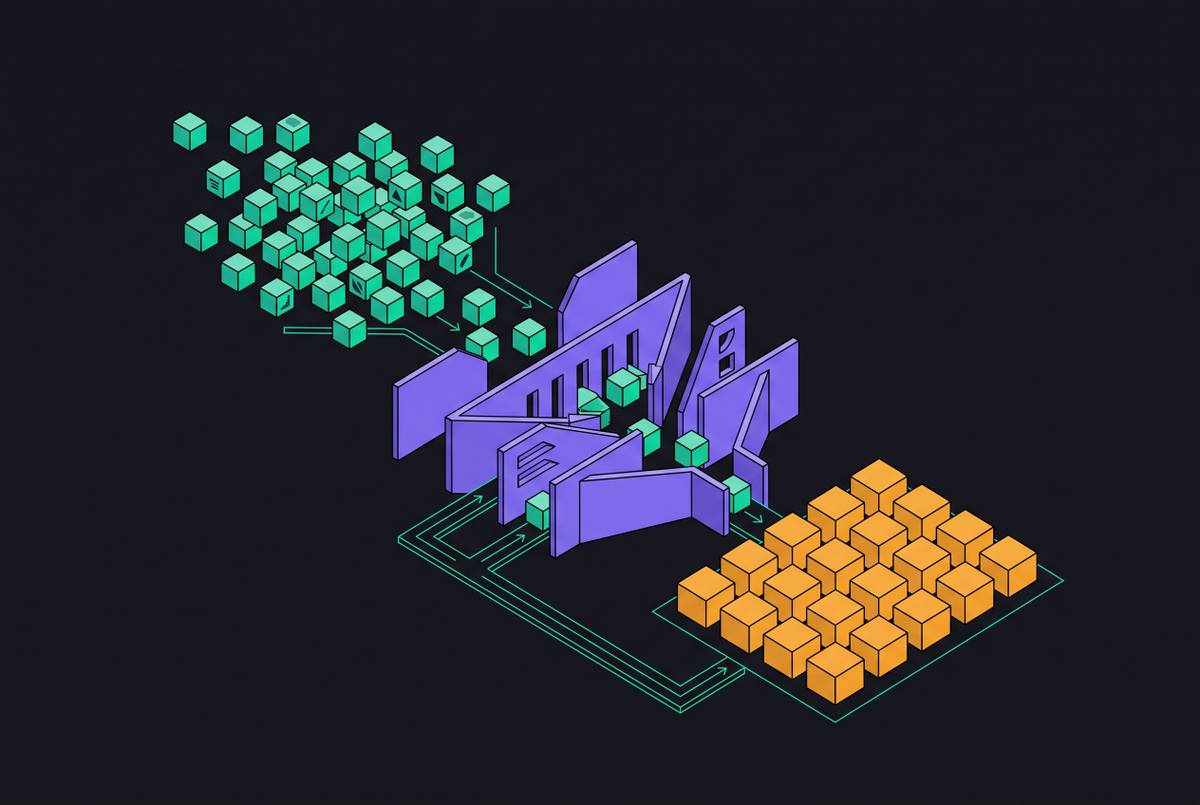
A production RAG system runs on two separate tracks that rarely get confused for each other by the engineers who build them, even though outsiders often treat "RAG" as one thing. One track runs offline: content gets pulled in, cleaned, cut into chunks, tagged with extra metadata, and turned into vector embeddings, all before any user ever types a question. The other track runs online, in the few hundred milliseconds after a query arrives: the system processes the question, retrieves candidate passages, reranks them, assembles a final context window, generates an answer, and (in well-built systems) evaluates that answer before it reaches the user. Filtering doesn't happen once. It happens at specific points on both tracks, and a failure at any one point carries forward into every stage after it. Practitioners building these systems at scale describe an architecture with as many as eight distinct layers, two of which matter enormously for trust and security: an "authorized retrieval" layer that filters candidate documents by the identity of whoever is asking, and a "context assembly" layer that manages the token budget of the final prompt and attaches citation data before the model generates anything. Naming these stages matters because each one has its own way of failing. Boilerplate that slips past cleaning corrupts the embeddings built from it. Duplicate content that slips past deduplication bloats the context window with redundant information. If off-topic passages slip past ranking, they dilute the signal the model has to reason from.
Boilerplate removal as the first and most consequential filtering decision
The first filtering decision in the pipeline, stripping boilerplate out of raw web content, is also the one with the largest downstream effect, because it sets how much of the model's limited context window actually contains something worth reading. Fetch the page, strip out non-essential tags like <style>, <nav>, and <footer>, convert what's left to Markdown, then filter by length: that sequence has become the standard first stage ahead of any vector embedding work, and for good reason. If you feed raw HTML straight to a model, you burn token budget on navigation menus, cookie-consent banners, inline style declarations, and footer links before the model reaches a single sentence of real content. Aggressive, well-tuned cleaning that strips this material and converts the rest to clean Markdown cuts input token usage by 30 to 50 percent compared to passing raw HTML through, a saving that adds up across every single call a production system makes. The evidence for aggressive filtering isn't just operational, either. It holds at the scale of training entire models. The RefinedWeb dataset, built by the Falcon LLM team at the Technology Innovation Institute, showed that web data cleaned and deduplicated through disciplined filtering, using the extraction tool trafilatura alongside rules applied at both the document and line level, outperformed hand-curated corpora. Filtering harder produced more usable signal, not less. That same logic is reshaping how extraction tools get built: the field has been moving away from brittle, hand-written DOM selectors toward smarter, model-driven extraction, because a selector tuned to one site's navigation structure quietly breaks the moment it hits a different site's layout. None of this means boilerplate removal is safe to run on autopilot. If a pipeline strips too aggressively, it can take out a data table, a figure caption, or a sidebar that actually carried the answer to the user's question. That risk calls for calibration, building classifiers that can tell navigational structure apart from content structure, rather than defaulting to raw HTML out of caution. Getting that calibration right makes the next stage, shaping what survives into a consistent format, possible.
Format normalization for embedding and chunking
Once boilerplate is gone, what remains still has to be reshaped into something consistent before it's useful, because embeddings encode sequences of tokens, and a document that wanders between inconsistent heading levels, mixed character encodings, and irregular spacing produces a token sequence that looks different from an equivalent, cleanly formatted document even when the underlying content says the same thing. That inconsistency corrupts retrieval quality in ways that are hard to trace back to their source. Converting everything to a single consistent format, typically Markdown or structured JSON, is what makes chunking and embedding reliable rather than a best-effort process. Many production systems run hybrid indexing, storing both sparse (keyword-based) and dense (semantic) representations of the same content side by side. Both of those representations depend on consistent tokenization to work; format noise degrades sparse lexical matching and dense semantic search at the same time, for the same underlying reason. Pushing the normalization work down into the infrastructure layer, rather than leaving it to each application team to solve on its own, is the strongest architectural answer to format inconsistency. If search infrastructure returns pre-structured Markdown or JSON instead of raw HTML, it moves the cost of normalization off the application pipeline and onto the data provider, and that is the right direction for any team operating at real scale. The logic is straightforward: raw HTML forces every downstream pipeline to run its own parser and its own chunker before a model sees anything, which burns tokens on boilerplate and reintroduces exactly the format variance that normalization is supposed to eliminate. If expected output fields and types are defined before content is ever ingested, schema-based extraction turns format consistency into a built-in property of the pipeline, not something that depends on an engineer remembering to clean things properly every time.
Relevance ranking as the stage where semantic intelligence enters the pipeline
Cleaning and formatting decide what survives into the pipeline in readable shape. Ranking decides what actually gets used, and it calls for different tools than the stages before it. Older ranking signals, based on link popularity and keyword frequency, were built for a human skimming a list of blue links and deciding which one to click. An LLM retrieval system optimizes for something different. It needs passages that actually answer the question in front of it, so production systems use semantic relevance scoring instead, built to measure whether a passage addresses the query, not how many other pages link to it. The typical production setup runs this in two steps: a hybrid search pass pulls in an initial set of candidates, and a cross-encoder model then reranks that set down to a smaller, higher-precision group before anything reaches the LLM. That reranking step is where most of what goes wrong in retrieval either gets caught or gets locked in, so it carries weight far beyond its position as "just" an intermediate stage. More advanced systems don't apply the same ranking logic to every query uniformly, either. Adaptive RAG routes simple factual questions through fast, lightweight retrieval, while complex multi-hop questions get sent through agentic RAG, which decomposes the question into parts and retrieves iteratively across them. Ranking has to adapt to what's being asked, not apply one fixed procedure to every query that comes in. Research from one study illustrates how far this logic extends: in systematic literature review tasks, LLM-based agents performed structured relevance filtering themselves, classifying documents against specific research questions using only titles and abstracts. The ranking stage, in other words, can now contain models doing the judging, not just models consuming whatever the judging stage hands them. That sophistication comes with a cost, though. One study showed that the same semantic signals AI-native ranking relies on can be targeted directly by adversarial SEO, so a pipeline built around semantic relevance may actually be easier to manipulate than a simpler keyword-based one was. That tension doesn't get resolved by retreating to keyword ranking. You address it by treating adversarial-content detection as its own pipeline stage, a point this piece returns to later.
Semantic deduplication versus exact duplication
Syndicated articles, scraped republications, and paraphrased rewrites of the same underlying story all inflate how much evidence a retrieval system appears to have found, without adding a single new fact to it. That inflation causes real damage in retrieval: the model ends up overweighting one source's framing of an issue simply because that framing shows up five times instead of once, all while genuinely useful context gets crowded out of the window. Exact deduplication tools, substring matching and hash-based comparison, catch content that's been copied verbatim, but most real-world web duplication is paraphrase-level: the same set of facts restated across hundreds of SEO-optimized pages that never share an identical sentence. One widely used web-data pipeline tackled this by combining exact substring matching with fuzzy hash-based near-duplicate detection, and it removed roughly half of the large web crawl it processed. Near-duplication in real web corpora is the majority of the content, not a marginal problem sitting at the edges of the dataset. A context window filled with several near-duplicates of a single underlying source gives the model false confidence, because what looks like several independent sources confirming a claim is actually one source, repeated. That's a faithfulness failure dressed up as corroboration, and it's one of the harder failure modes to catch because the output can look well-supported on the surface. The composition of the web itself is shifting, making the problem worse. A substantial share of newly detected web pages contained AI-generated content, and generated text carries its own particular risk for duplication: models trained on overlapping data tend to produce overlapping outputs, so semantic deduplication increasingly has to catch machine-generated paraphrase, not just the human-written syndication it was originally built to handle.
AI-Generated Content and Adversarial Injection
Content filtering was built to remove noise. It increasingly also has to remove signal that was deliberately engineered to look clean enough to pass filtering and influence what the model concludes once it's reasoning over that content. Indirect prompt injection is the clearest version of this threat: an attacker plants instructions inside content a RAG pipeline is likely to retrieve, a web page, an email, a PDF, and never touches the AI system's interface directly. The instructions reach the model through the retrieval path itself. Two documented cases show how this plays out in practice. Attackers hid malicious text inside public code repository documentation files, so when developers used an AI coding assistant to clone and set up those repositories, the assistant executed the hidden commands and exfiltrated credentials, including API keys and other access tokens. The ranking-stage research cited earlier matters here too: the same semantic signals that make ranking more capable also make it a more specific, more exploitable target, so more sophisticated ranking tends to invite more sophisticated attacks against it. Zhong et al. describe the retrieval process itself as a contest between a content owner trying to defend their material and an attacker working through a web-retrieval-enabled LLM, and that framing holds equally well from the attacker's side: a pipeline that can be gamed by an adversary embedding malicious content is a contested surface, not a passive channel moving information from web to model. A pipeline that can't detect adversarially placed content is a security liability, not just an inefficiency, because every document the retrieval system surfaces becomes part of the model's working context, and nothing enforces a trust boundary between what gets retrieved and what gets generated from it.
The authorized retrieval and context assembly stages as the pipeline's trust enforcement layer
A retrieval pipeline can function exactly as designed, surface relevant, well-formatted, non-duplicated content, and still cause a serious security incident if it surfaces that content to someone who shouldn't see it. Identity-aware filtering has to be built into the pipeline as its own stage, not bolted on afterward as a compliance check. The "authorized retrieval" layer in the eight-layer production architecture described earlier does exactly this work: it filters candidate documents by the identity of whoever made the request, and it does so before reranking, not after, because filtering after the fact means sensitive content has already been scored, ranked, and brought closer to the user. In multi-tenant SaaS environments, if isolation between tenants is weak at this stage, one tenant's retrieval results can bleed into another's, and that is a correctness failure and a confidentiality failure happening at the same moment. RAG pipelines routinely handle personal data and confidential business logic, so the vector database storing the embeddings can't be the whole security perimeter. The query itself, the ranked results, and the assembled context each represent a point where sensitive content could reach the wrong person. Context assembly manages the token budget of the final prompt and attaches citation data, but it does more than manage length. It enforces content provenance, tracking which source each retrieved passage came from, which supports both accurate citation in the final answer and after-the-fact auditing of what the model saw when it generated a response. None of these layers substitute for each other. A strong defense against prompt injection cannot compensate for a system that grants excessive access rights, and the strongest access control layer cannot compensate for content that should never have entered the retrieval corpus. If you own the full pipeline end to end, rather than outsourcing retrieval to a third party and hoping access control gets handled somewhere downstream, you can actually make consistent enforcement across all these layers possible.
Why freshness is
The pipeline stages covered so far, cleaning, normalizing, ranking, deduplicating, securing, all answer a version of the same question: is this content accurate and safe to use. Freshness asks a different question: is it still true. A document can pass every other filter in the pipeline, clean formatting, high relevance score, no duplication, correct access permissions, and still mislead the model if the facts inside it changed after it was indexed and before it was retrieved. Retrieval-augmented generation was built so models could reach past the static knowledge frozen into their training data and pull in something closer to current. That advantage disappears the moment the pipeline treats a document indexed months ago as equivalent to one indexed an hour ago, with no signal anywhere in the pipeline distinguishing the two. Every stage discussed up to this point has been about quality in a single snapshot of time. Freshness is about whether the index as a whole still reflects the world the user is asking about, and a filtering pipeline that doesn't track and weight recency is one that solved every other problem in the stack while leaving its central promise, timeliness, unenforced.
Sources
- Leveraging LLMs for semi-automatic corpus filtration in systematic literature reviews - ScienceDirect
- Web Intellectual Property at Risk: Preventing Unauthorized Real-Time Retrieval by Large Language Models
- The RefinedWeb Dataset for Falcon LLM: Outperforming Curated Corpora with Web Data, and Web Data Only
- Preprint: Poster: Did I Just Browse A Website Written by LLMs?
- RAG Architecture in 2026: A Production Blueprint for Retrieval-Augmented Generation - DEV Community