Why SERP APIs Return Insufficient Context for LLM Reasoning
SERP APIs return search metadata, not the reasoning-ready context that LLM agents actually need.

Large language models carry a fixed store of knowledge, sealed at the moment training ends, and that seal is what makes them stumble the instant a task requires something that happened afterward. A model can't reason about a price that changed last week, a regulation that passed last month, or a news event from yesterday, because that information simply isn't in its weights. The fix is retrieval: a live web layer that grounds model outputs in current, verifiable information. That's the reason the web search API became a required part of production AI stacks rather than an optional add-on.
This matters most in domains where the ground shifts constantly: market intelligence, financial analysis, news monitoring, competitive research. In each of these, a model working from stale memory doesn't produce a slightly outdated answer. It produces a wrong one, delivered with the same confidence as a correct one. The rest of this piece covers what happens once that retrieval layer is in place, and why the specific kind of retrieval a system uses matters as much as whether it retrieves.
How the agent loop consumes retrieved content
An agent doesn't read search results the way a person skims a webpage. It runs a loop: observe what a tool returns, reason about what that means, decide on the next action, and repeat. Every piece of retrieved content becomes an input to that cycle, and whatever the agent pulls in at one step shapes what it's capable of concluding at the next. There's no step where bad retrieval gets quietly corrected before it reaches the model's reasoning.
This loop is now common in production. Deployment of LLM agents picked up sharply after OpenAI shipped its function-calling API, and it picked up again after Anthropic introduced the Model Context Protocol in late 2024, which gave agents a standard way to call external tools. Promethium.ai found that 51% of enterprises already had AI agents running in production as of 2026. At each tool call, the agent reads what came back, decides whether the result is good enough to act on, and either moves forward, corrects course, or tries something else. A retrieval error at this point doesn't stay contained. It becomes the premise for every reasoning step that follows.
This is the core mechanic behind retrieval-augmented generation: a user asks a question, the system pulls relevant documents from some knowledge source, and the query plus that retrieved material gets handed to the model, which answers based on content it never saw during training. The retrieval step is where the whole pipeline either holds up or breaks. Everything downstream, summarization, citation, multi-step planning, depends on what lands in that first fetch. The shape and quality of retrieved content is the input the rest of the system is built on top of.
What SERP APIs were built to do
SERP APIs exist because a very real, very large market needed them: rank tracking, SEO auditing, competitive keyword monitoring, and any workflow where a human needs to see how a page performs in search results. They were built to serve rank tracking and human-facing results, and that purpose is baked into every layer of what they return. That purpose built into every layer of what they return makes the product work exactly as designed, for the audience it was designed for.
What a SERP API hands back is structured search-engine metadata: titles, URLs, snippets, and ranking positions pulled from Google, Bing, and other engines. For a human analyst checking where a client's page ranks, or an SEO dashboard tracking movement over time, that's exactly the payload needed. Getting the actual content of a page is a separate job that happens afterward: take the URLs the API returned, crawl each one, render any JavaScript the page depends on, strip out the markup, and only then hand text to a model. That sequence was built for a human clicking through search results one at a time, not for a model reasoning over multiple sources.
This design choice made sense given how the market shaped up. For most of the past decade, when someone said "search API," they generally meant Bing's REST endpoint, or a scraping layer sitting in front of one search engine or another, and the surrounding tooling grew up around that assumption. None of this makes SERP APIs bad tools. It makes them tools built for a different job than the one agents now need done.
Token bloat: what agents receive from a SERP API call
Once an agent follows the links a SERP API returns and pulls in full page content, the context window fills with everything that page contains, including material that never answers the question. Navigation menus, cookie banners, footer links, ad placements, related-article widgets, all of it rides along with the actual text, diluting the signal the model has to reason over and costing tokens the system still has to pay for.
Picture what a single search result actually looks like once it's been crawled and rendered: a news article might carry three paragraphs of substance surrounded by a header bar, a newsletter signup prompt, a sidebar of "related stories," and a comment section. A SERP API pipeline captures all of that indiscriminately, because it returns what a browser would render for a human, full page furniture intact, rather than the specific passage that actually answers the query. The model has no way to distinguish the signal from the surrounding clutter without first spending reasoning capacity to filter it out.
That filtering cost isn't trivial, and it doesn't shrink just because the context window is larger. Feeding a model more tokens doesn't mean it reasons better with them; empirical testing on coding tasks shows performance degrading as context windows fill, with the decline starting well before the model hits its stated limit and varying depending on the type of task. Noisy retrieval persists regardless of window size. It just gives the noise more room to spread. Irrelevant or redundant fragments sitting in memory don't just sit there quietly, either: they can actively pull reasoning off course or raise the computational cost of producing an answer, forcing the model to spend cycles working out what to ignore instead of working out what to say.
Truncated snippets and the blind-decision problem
Token bloat is one failure mode. The opposite failure appears when an agent works from a SERP snippet instead of full page content. When agents rely on those snippets alone rather than pulling the full page, they make decisions on fragments that may be missing the exact context needed to reason correctly, and the decision that follows is built on incomplete information from the start.
A snippet can leave out the qualifying detail, the exception, or the number that changes the answer entirely, and once an agent needs to do real research rather than a quick lookup, it has to abandon the snippet and go get the underlying document anyway. Recall the loop described earlier: the agent's next move depends entirely on what the previous tool call handed back. If that fragment is incomplete, the agent's next reasoning step gets built on a false or partial premise, and there's no downstream mechanism that catches the gap before it propagates.
This same truncation occurs at the ingestion layer, in how retrieved text gets chunked before an LLM ever sees it. Splitting documents at fixed token boundaries, the standard approach in classic RAG pipelines, breaks paragraphs mid-thought, separates a question from the answer that follows it a few lines later, and destroys the structure that made the original document coherent. The net effect across both failure modes is that agents built on SERP APIs have no reliable way to land at the right level of extraction. Agents either over-retrieve and drown the signal, or under-retrieve and reason from a gap, with no mechanism for finding the point in between.
Parsing overhead as compounding latency in multi-step agent workflows
Beyond the quality of what comes back, how long it takes to get it matters too. Everything a SERP API requires after the initial call, crawling the returned links, rendering JavaScript, stripping markup, chunking the resulting text, adds time at every single search step. In a workflow where an agent runs several searches in sequence to answer one question, that added time doesn't stay isolated to one step. It accumulates across the entire chain.
An agent's reasoning loop pauses every time it waits on a search call, and slow APIs create a drag that compounds across multi-step tasks, especially when an agent chains several searches before producing an answer. The SERP API pipeline is built from several distinct stages by design: call the API, get back URLs and snippets, crawl each URL, render the page, strip the markup, chunk the result, embed it, then retrieve from that embedding. Each of those stages adds its own slice of wall-clock time, and each one is also a place where something can fail.
This matters more once a system moves from a demo into production. A pipeline that looks fine with a handful of test queries can become the bottleneck once agent concurrency scales past what the pipeline was tested against. And the crawling layer carries a maintenance cost of its own: search engines change their page layouts, add anti-bot protections, and rate-limit aggressively, all of which turns the scraping step into a piece of infrastructure that needs ongoing upkeep just to keep functioning as traffic grows. None of this is a claim that any particular product runs slow. It's a structural consequence of a pipeline that was built to serve a human clicking through results one at a time, now being asked to serve a machine that needs to run that process dozens of times per task.
How temporal staleness makes the context problem worse
Even a system that retrieves full, well-formed content can still mislead a model if that content isn't filtered by how recent it is. When a retrieval system pulls documentation for features that behave differently across versions or configurations, the model has to spend extra tokens determining which conflicting source is correct. That resolution work is pure overhead. It doesn't improve the answer; it just costs tokens to arrive at the answer a well-filtered system would have reached immediately.
Relying purely on a model's pretrained knowledge already risks producing outdated or hallucinated answers, but poorly filtered live retrieval can land in the same place by a different route, mixing deprecated information in with current information and leaving the model to sort out which is which. Elasticsearch has pointed to temporal filtering as a fix, using date-based query capabilities so a RAG system prioritizes recent, relevant material and avoids serving deprecated content to the model in the first place.
What counts as "recent" isn't fixed, though, and that's precisely the kind of nuance a SERP API has no way to apply. News and market data go stale within hours. Regulatory material needs to be current within a day or two. Technical documentation can often stay useful for weeks before it needs refreshing. A retrieval layer that can't adjust its freshness window to the domain it's serving will either surface expired information as though it were current, or discard genuinely relevant older material that hasn't actually gone stale. SERP APIs provide no built-in mechanism to make that distinction, leaving the filtering job entirely to whatever's built downstream of them.
Why the Bing API retirement made this a live engineering problem
In August 2025, Microsoft forced the issue for anyone still treating this as an abstract architecture debate. The retirement of the Bing Search APIs exposed, in concrete terms, how fragile it is to build production infrastructure on top of a single search provider, and the scramble that followed pushed teams toward AI-native retrieval faster than any architectural argument on its own could have.
Microsoft retired the Bing Search APIs on August 11, 2025, and pointed developers instead toward "Grounding with Bing Search" inside Azure AI Agents, a replacement usable only within the Azure ecosystem and priced well above what teams had been paying before. Teams running production workloads on the old Bing endpoints had only weeks to migrate, and that timeline is the clearest case anyone needs for why a retrieval layer shouldn't depend on one upstream provider that can change its terms without warning. A retrieval pipeline built on someone else's API is only as stable as that provider's roadmap, and in this instance the roadmap changed with very little notice.
That single deprecation is a large part of why the AI-native search category grew as fast as it did through late 2025 and into 2026. The market didn't expand because of a marketing push. The market reorganized around the specific gap that deprecation created.
What AI-native retrieval does differently at the architecture level
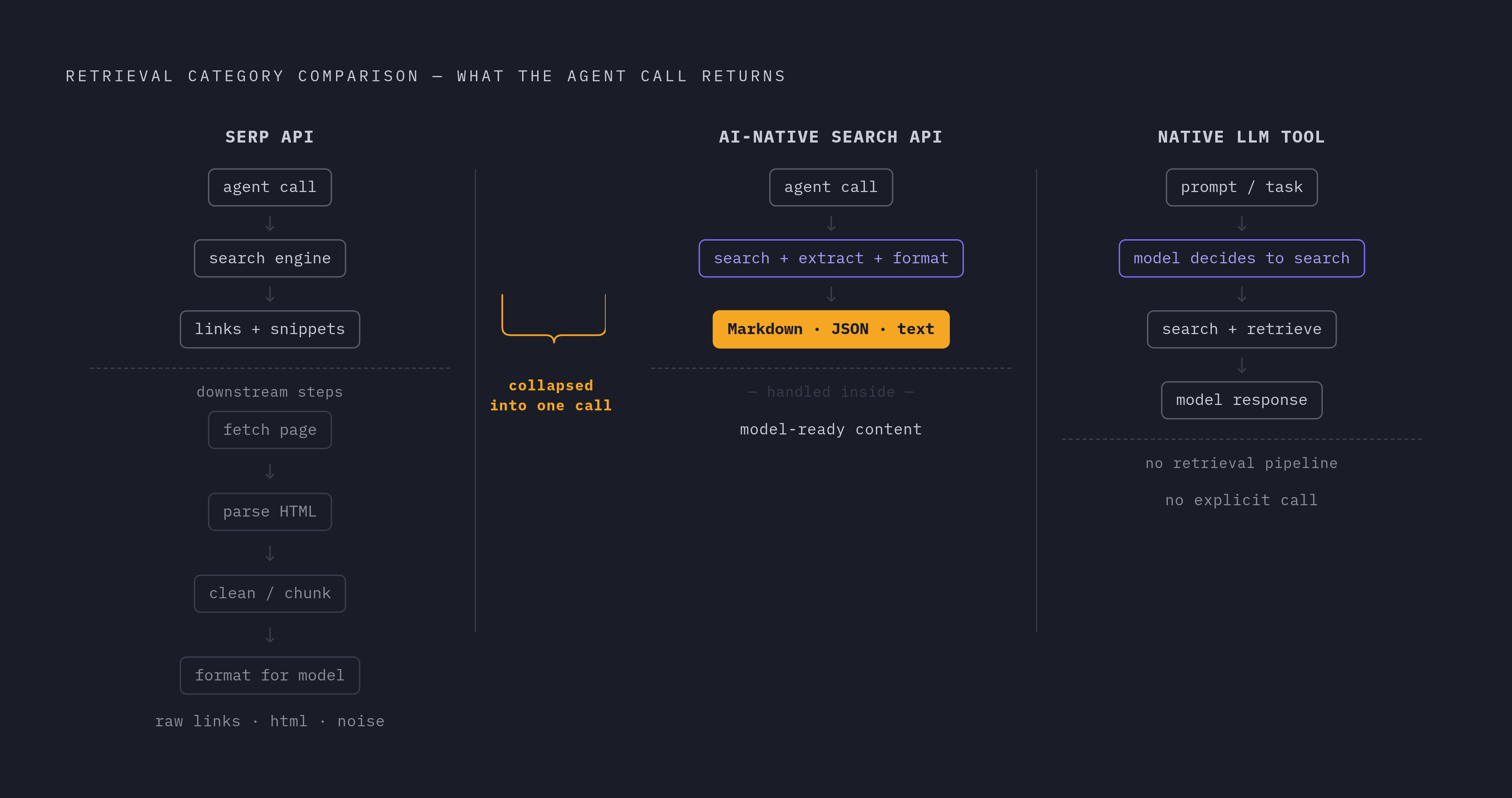
AI-native search APIs address the SERP mismatch by folding the entire extraction pipeline, crawling, rendering, stripping, and chunking, into a single call that returns ranked results with extracted text, Markdown, or structured JSON already shaped for a model's context window. The category isn't a single approach wearing different labels, though. The differences between how individual products handle indexing, ranking, and formatting carry real consequences for what ends up in front of the model.
Many of these systems run their own proprietary index rather than sitting on top of Google or Bing, and many use semantic search to read what a query actually means rather than matching on keywords alone. Both choices cut down on the noise that would otherwise reach the model's context window.
It helps to think of the market as three distinct categories rather than a single spectrum, the way a 2026 comparison from Parallel frames it: SERP APIs, which return metadata and links and leave content extraction as a separate step; AI-native search APIs, which return content ready for a model in one call; and native LLM-provider tools, where the model itself decides when to search and there's no separate retrieval pipeline to manage at all. Picking the wrong category for a given use case costs more than picking the wrong vendor within the right one. The native tools built into OpenAI's and Anthropic's own platforms make the most sense for teams already committed to a single model provider who want grounded answers without standing up and maintaining a retrieval pipeline of their own, though that convenience comes paired with model lock-in and retrieval logic that stays hidden from the developer building on top of it. Each of the three categories solves a real problem. The task is matching the category to the reasoning job the agent actually has to do, not assuming that any search API is interchangeable with any other.