What a Web Search API Must Do Differently When the Client Is an AI Agent
AI agents need retrieval APIs optimized for grounding, not human discovery.
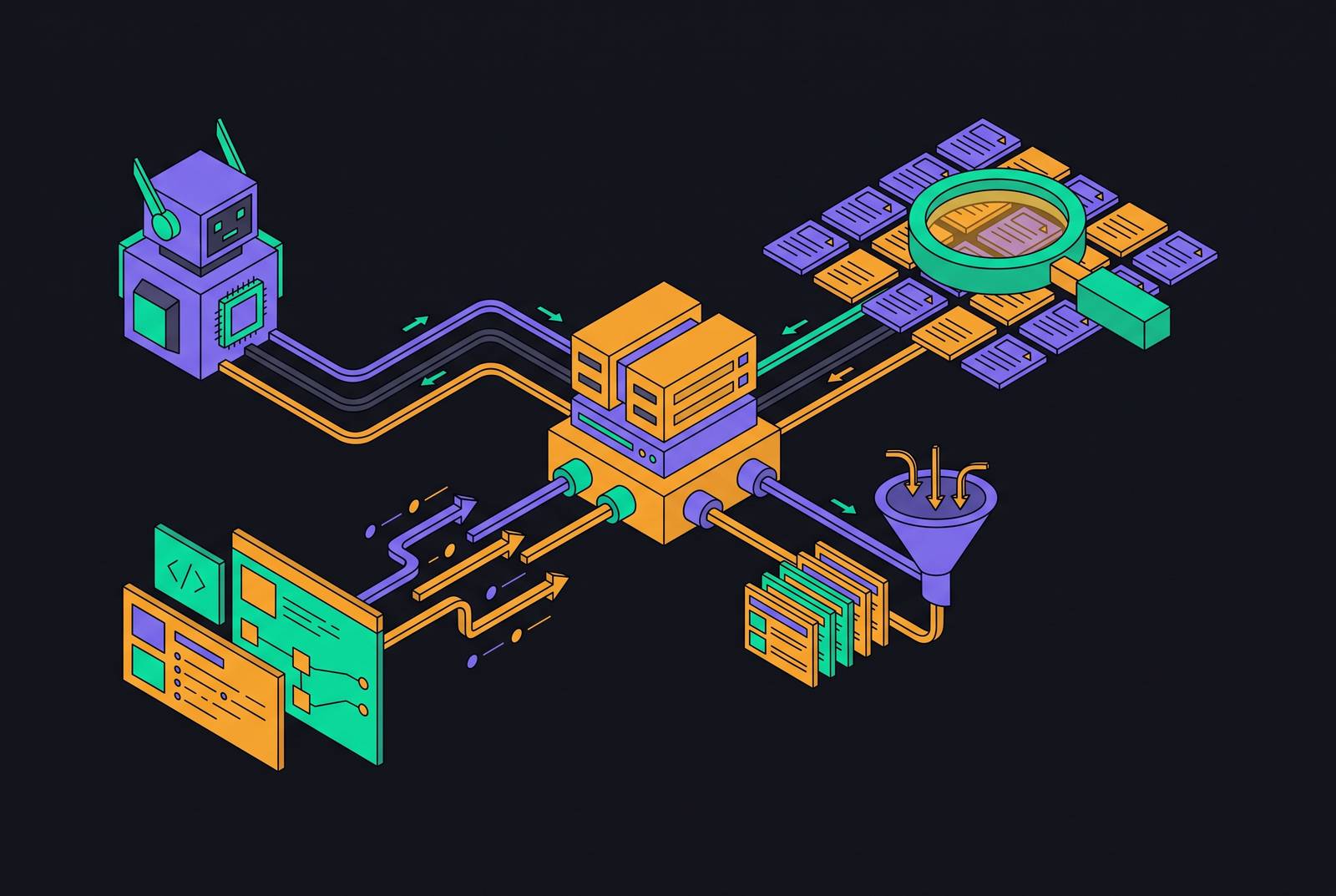
A web search API for AI agents and RAG pipelines must function as a grounding engine. It must deliver current, semantically coherent content with source provenance, shaped for downstream LLM reasoning without a separate fetch step. The defining requirement is an end-to-end retrieval contract that combines evidence quality, predictable performance, and data control.
Why the human-oriented search model breaks when an AI agent is the client
Conventional search APIs return ranked URLs and snippets optimised for click-through relevance. That response assumes a human will open pages, skim their contents, and judge which sources support an answer. An agent needs the evidence inside the response. Returning links instead leaves fetching, extraction, and source assessment to the agent’s application, so the API leaves its main job undone.
A snippet helps a reader choose a destination, but it is not necessarily a complete passage that supports a claim. Meanwhile, an LLM’s training cutoff limits its access to recent facts, and recent or specific questions expose it to hallucination. The retrieval layer must supply live, citable evidence that the model can use immediately. The task is not discovery but grounding.
How agents actually consume web knowledge, and why that consumption pattern compounds every infrastructure demand
An agent may retrieve many times during one task, using each result to work out what it needs next. Yingxuan Yang and colleagues’ Agentic Web: Weaving the Next Web with AI Agents describes the broader shift toward autonomous, goal-driven interactions in which agents plan, coordinate, and execute tasks. For retrieval, that shift replaces an isolated search with a dependency chain. A knowledge agent can interpret intent, traverse related concepts, resolve conflicting sources through confidence scoring, and generate a cited answer. Each stage may require another search call.
A slow call holds up later reasoning, while a result with missing information can leave the next query based on weak evidence. Each call also adds to the cost of the same task. Agentic RAG makes this pattern explicit by letting the agent decide when retrieval is needed. On-demand context keeps outputs current without inflating the context window, but it requires the search layer to serve useful evidence reliably throughout the reasoning process.
Why the knowledge and memory layers in agent architectures must be kept separate, and what that means for retrieval design
Michaël Roynard’s 2026 arXiv paper, The Missing Knowledge Layer in Cognitive Architectures for AI Agents, argues that CoALA and JEPA lack an explicit Knowledge layer with its own persistence semantics [34][17][15][35]. This category error leads the system to apply cognitive decay to factual claims or update facts and experiences in the same way. A paper’s findings do not become less true simply because time passes. What fades is their relevance to current attention, a memory concern.
The retrieval consequence is indefinite-supersession semantics. A factual claim stays available as it ages until newer authoritative evidence takes its place. This distinction also prevents retention from becoming an excuse to preserve outdated facts. To support it, a web search API must attach explicit fetch timestamps and source provenance to retrieved content. Those fields help the knowledge layer judge how current and authoritative sources are when they disagree. Without them, the agent cannot apply supersession deterministically, however well its memory system organises prior interactions.
What chunk-level retrieval requires that URL-and-snippet APIs cannot provide
The useful retrieval unit for an LLM is a short, semantically coherent passage selected for the downstream task. A URL and a two-sentence snippet serve a different purpose. When the passage is absent, the application must request the page separately and extract its contents, adding latency, cost, and another point of failure. A purpose-built API integrates full-page extraction into the search response and returns clean markdown or other token-efficient content. This leaves less raw HTML for the prompt to carry.
The passage boundary is itself a design decision. Dense documents can suit smaller overlapping chunks, while policy and reference documents benefit from semantic chunking that preserves section boundaries. An arbitrary split can separate the evidence from the context needed to interpret it. Enrichment at ingest time must therefore accompany the resulting chunk, including its source URL, title, author, last-modified date, and classification. Embedded metadata makes filtered retrieval, freshness checks, and access control possible at query time without a second lookup.
Why hybrid retrieval is now the baseline, and what it demands of the search layer
Semantic similarity does not establish factual correctness. A passage can resemble the query closely while being outdated or wrong for its context. Finding exact facts takes keyword precision, while queries that use related concepts need dense vector search. Hybrid retrieval brings those modes together in the search layer, so the application developer has no need to join them. The API must own both forms of matching because neither alone covers the range of queries an agent issues.
In regulated domains, coverage of regulatory filings, peer-reviewed research, patents, and financial data is a correctness requirement. Even a strong model cannot fix an answer based on low-quality pages just by reasoning more carefully. Combining search and extraction in one request further reduces the services that developers would otherwise have to connect. That consolidation removes integration failure modes, but its value depends on retrieving authoritative evidence.
Freshness as a correctness requirement, not a performance nicety
A cached page from last quarter can produce an answer that looks entirely successful. The request completes, the text reads coherently, and the model cites a real source. Yet the underlying fact may have changed. Unlike a visible request error, stale grounding can pass unnoticed by both the agent and its user. Regulatory guidance, pricing data, and news show especially clearly how an answer depends on whether its information is still current.
Freshness is therefore a data integrity requirement. Query-time web grounding corrects the limits of frozen training data only when the retrieved content is itself current. A fetch timestamp must survive every layer of the pipeline so the knowledge layer can assess the evidence and apply supersession. The timestamp makes the retrieval’s age visible, while the infrastructure must provide the freshness guarantee. Crawl frequency alone is not an adequate substitute for a contract governing the currency of delivered evidence.
Context shaping: why filtering, ranking, and formatting web content for LLMs is core engineering, not post-processing
The context window is a constrained reasoning input. The quality of that input depends on how content is filtered, ranked, and formatted before the model sees it. Raw HTML consumes tokens on page noise, while careless extraction can discard headings, lists, and metadata that establish meaning. Because extraction determines what remains available for reasoning, this work belongs inside the retrieval layer rather than in a cleanup step delegated to each application.
Tags, certification, ownership, and quality metadata help retrieval choose evidence that fits a task in a given domain. Citation contracts then connect that evidence to the response through schema-enforced citations rather than leaving the model to invent references freehand. These contracts address fabricated or unsupported citations, though formatting alone cannot establish the truth of a claim. The context contract also needs per-query budgets and hard cost caps because an agent may search dozens of times during a multi-step task.
Why latency and throughput guarantees matter differently when the client is an autonomous agent running at scale
Sequential retrieval places search latency directly on the agent’s critical path. Parallel calls create a different demand by requiring throughput across concurrent requests, often from many agent instances. A dropped request or slow response interrupts a larger task. Performance must therefore be defined for the workload the agent actually generates.
AI scraper traffic grew 597% over the past year, illustrating the scale of programmatic web access. That pressure makes sustained-load behaviour more useful than an isolated demonstration of fast retrieval. Agents in production need high rate limits, predictable latency, and a contract that guarantees reliability under real-world load. Scraping-first approaches face additional delays and failures from anti-bot measures, dynamic JavaScript rendering, session-gated content, and paywalls. When these dependencies sit outside the API operator’s control, a promise about response speed cannot remove the underlying fragility. The performance contract has to be supported by the infrastructure that obtains and delivers the evidence.
Data pipeline ownership as the only reliable path to quality, performance, and control at production scale
An API that wraps third-party retrieval inherits limits it cannot independently remove. Its upstream service constrains source quality, sets a latency floor, and establishes a boundary around data control. Better response formatting cannot overcome all three. Nor can a wrapper guarantee current evidence if it does not control how that evidence enters the pipeline.
End-to-end ownership makes those constraints addressable within one system. That system must control crawl and extraction through ranking, context shaping, and delivery, because each stage affects what the next can guarantee. The quality of a chunk depends on extraction, freshness depends on how content is acquired, and useful ranking depends on the index’s sources and metadata. Ownership is the structural precondition for guaranteeing quality, performance, and data control across the full path. A research-driven, full-stack design treats context engineering as part of that path rather than an attachment to an existing search index.
Enterprise security and compliance requirements that a production search API must treat as first-class concerns
Akamai’s Enterprise AI Usage Risk Report 2026 identifies sensitive business data shared with AI as the central enterprise risk. Its leakage channels include prompts, conversational context, source code snippets, screenshots, and copied text. Search queries can transmit that context beyond the application. Prompt injection, model memory misuse, API logging, and third-party SaaS integrations can therefore expose data in ways that need safeguards beyond the model layer. Retrieval design must account for what enters the service and how it is handled.
The enterprise requirement is zero data retention at the retrieval layer, with explicit contractual data-processing terms and no use of customer data to train another party’s model. Audit logs, identity controls, encryption, retention rules, and vendor oversight must be designed together before deployment. Regulatory timing reinforces the need for traceability. The EU AI Act entered into force on August 1, 2024, with general-purpose AI obligations from August 2, 2025 and general applicability, including transparency and enforcement powers, from August 2, 2026. The timeline following the Digital Omnibus on AI places full applicability on August 2, 2028. These dates make source traceability a compliance concern as well as an operational one.
What does a web search API purpose-built for AI agents and RAG pipelines look like?
The resulting architecture is a pre-processing layer for evidence. It selects authoritative sources through hybrid retrieval, extracts coherent passages, and delivers those passages with provenance and temporal metadata intact. Context shaping preserves useful structure while enforcing citation and budget contracts. The agent receives material prepared for reasoning without requiring another retrieval workflow. This is what separates a grounding engine from a modified ranked-link API.
Freshness, predictable latency, sustained throughput, and enterprise data controls depend on an owned pipeline that can support them together. None of these requirements is independently exotic. Meeting all these requirements at once is hard when agents retrieve on their own, over and over, at production scale. The design principle is to treat machine-ready evidence as the API’s product and the agent’s reasoning process as its primary workload.