Training Data Cutoffs and Why Live Web Retrieval Is Not Optional for LLMs
Live web access through retrieval-augmented generation is the only fix.
A training data cutoff is not a gap that better data or a bigger model closes. Stopping a deployed LLM from citing stale facts, or giving it access to live web data, requires an engineering layer added on top of the model, specifically retrieval-augmented generation fed by real-time web content. This piece lays out why the cutoff is architectural, where it bites hardest, and what it actually takes to build retrieval infrastructure that closes it.
Training data cutoffs as an architectural constraint, not a knowledge gap
A large language model learns a static picture of the world from a fixed corpus, and that picture doesn't move again unless someone retrains it. The gap only grows from there. Training itself takes time, and evaluation and safety testing take more time after that, so by the time a model actually ships, the real distance between "what the model knows" and "what's true today" is already larger than the stated cutoff date suggests.
Even inside the training window, coverage is far from complete. A cutoff date marks a ceiling on what could have been included, not a floor on what actually was. Two pages published on the same day, months before the cutoff, can have very different odds of showing up in a model's training data depending on which crawlers reached them and whether permission was granted to collect them.
None of this is a flaw that gets fixed with a cleverer prompt, a longer context window, or a fresh round of fine-tuning. The cutoff is a structural property of the training paradigm itself, and the only way to address it is to add something the architecture doesn't natively have: a live connection to information that exists after training ended. Everything that follows in this piece is about what that connection actually requires.
The gap between cutoff and deployment date across the model landscape today
The size of this gap is not uniform across models, and the variance matters because it determines how much post-cutoff knowledge an application has to supply on its own. Llama 4 Scout and Maverick sit further back, with an August 2024 cutoff and the same lack of built-in internet access. For both, any fact that postdates the cutoff has to come from whatever system is built around the model, because the model itself has no way to reach for it.
Anthropic draws a useful distinction that most vendors don't bother to make explicit: a training data cutoff and a reliable knowledge cutoff are not the same date. In practice, this means the headline cutoff date overstates how much a model can be trusted to know near the edge of its training window, even before any post-cutoff query comes into play.
Google's documentation for Gemini 3.7 Flash makes a similar point from a different angle. A single cutoff date, in other words, is a simplification Google itself acknowledges doesn't hold domain by domain.
Models with built-in browsing tools don't escape this pattern either. And the risk compounds for teams that didn't build their stack recently: an integration pointed at an older API endpoint may still be calling a model with a cutoff that's well behind current events, and nobody notices until the model gets a question it can't answer correctly.
Why the cutoff produces silent failures, not visible errors
The dangerous part of a training cutoff isn't that the model refuses to answer a question it shouldn't know the answer to. Models rarely refuse. They answer with the same confident, fluent tone whether the underlying fact is three years old and correct or three years old and quietly wrong, and nothing in the output format distinguishes the two cases for the person reading it.
The model generates every token by predicting what's statistically likely to follow, with no built-in mechanism for flagging when it has crossed past the edge of what it was trained on. The HALLMARK benchmark found that most LLMs over-flag papers published after their training cutoff, a sign that model behavior degrades specifically near the knowledge boundary, even on a task as structured and checkable as citation verification.
Citation fabrication shows how far this can go before anyone catches it. GPTZero identified 53 papers with hallucinated citations among NeurIPS 2025's accepted papers, fabrications that had already passed peer review. That's a setting where the model's output looked authoritative enough to get past expert reviewers, and the errors stayed invisible until someone specifically audited the citations.
In production systems, this failure mode tends to follow a predictable arc. The practical consequence for anyone building on top of these models: the model's own output can't be used to flag when a query has crossed into post-cutoff territory. That detection has to be built into the pipeline itself, upstream of generation, not inferred after the fact from how the answer reads.
What domains suffer most when post-cutoff knowledge is missing
The cost of a stale or fabricated answer isn't the same everywhere. It concentrates in domains where facts change fast and where getting one wrong carries real consequences, where the cutoff problem moves from abstraction to liability.
Legal research is near the top of that list. Scientific publishing shows the same underlying risk in a different field: GPTZero found 53 hallucinated citations in NeurIPS 2025's accepted papers, each generated reference looking completely legitimate, in the right format, attributed to a plausible source, while being invented or outdated.
Fast-moving scientific fields face a version of the same exposure. The HALLMARK benchmark result, that most LLMs over-flag post-cutoff papers, points at the same underlying mechanism: the model's grip on recent, fast-moving scientific literature weakens right at the boundary where getting it right matters most.
What ties these domains together is how fast the ground underneath the answer moves, not how complicated the subject matter is. The distance between a model's cutoff and the date of the question being asked is the variable that decides how much risk is in play, and in law, in biomedical research, and in any field where the facts shift month to month, that distance is large enough, often enough, that it can't be treated as background noise. It has to be addressed directly, with infrastructure that goes and gets what the training data never had.
Why retrieval-augmented generation addresses the cutoff where it lives
Retrieval-augmented generation is the correct response to the cutoff because it changes where knowledge comes from at the moment of answering, pulling it from a live, external source instead of asking the frozen weights to produce something they were never given. That's a structural fix aimed at the actual location of the problem, not a workaround applied around its edges.
Prompt engineering, fine-tuning, and chain-of-thought reasoning all improve how a model works with knowledge it already has inside its weights. Only a retrieval step, one that fetches something from outside the model at the moment a question is asked, actually solves that problem.
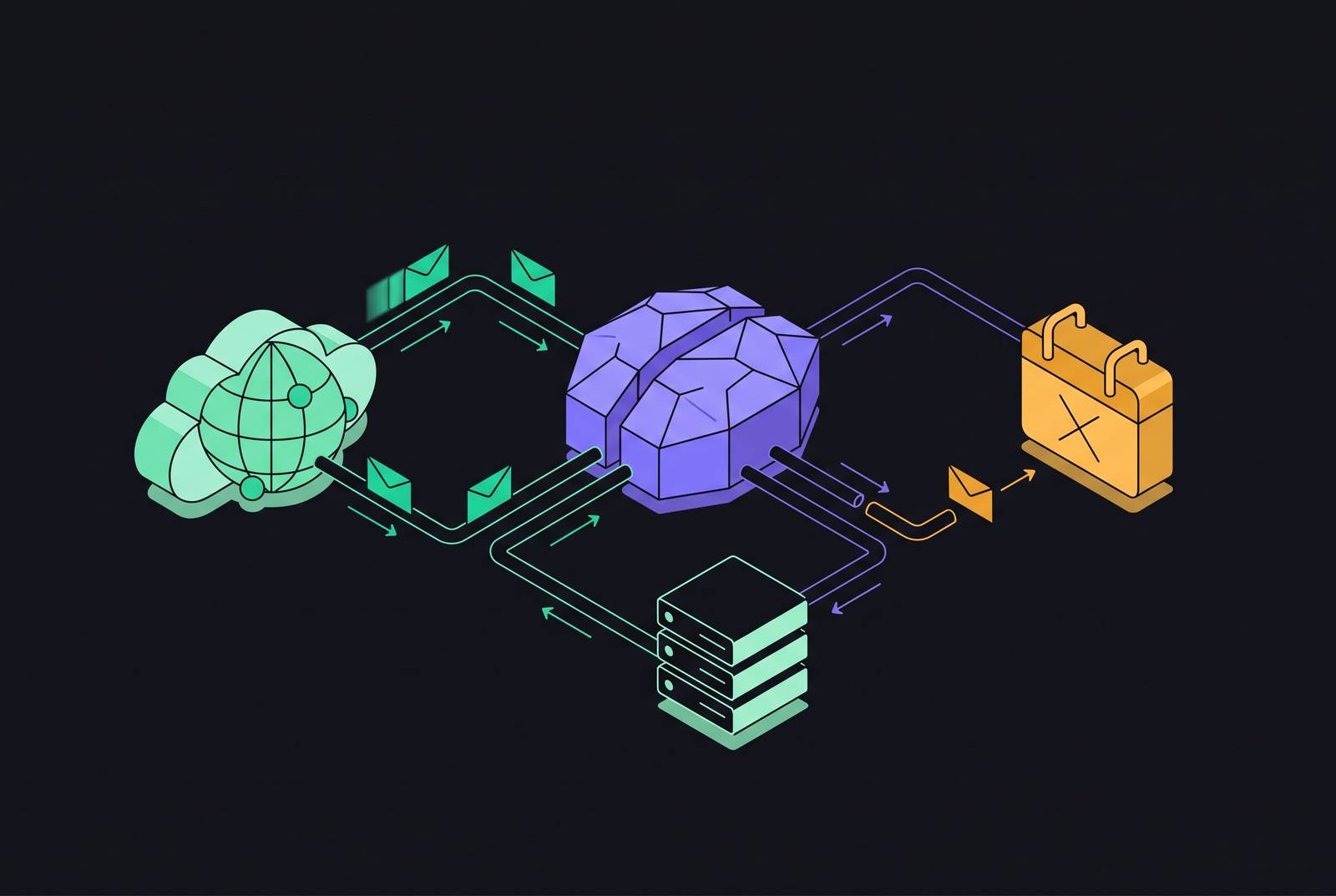
The mechanics follow directly from this. At query time, a RAG system pulls relevant documents, whether from the open web, an internal database, or some combination, and places them directly into the model's context window, so the model is reasoning over material it can see right now rather than relying solely on what it absorbed during training. This also matches how modern AI agents are actually built: an agent's tool integration layer is made up of APIs and external functions it can call to take action, and retrieval belongs in that layer as a tool the agent invokes deliberately, not as an afterthought stapled onto the end of a generation pipeline.
The more mature production systems don't retrieve on every single query. They give the model a search tool and let it decide when to use it, since a 2026 analysis of production RAG systems found that roughly 20% of user queries need no retrieval at all; forcing retrieval on those queries adds latency and feeds the context window with noise it didn't need. Retrieval, handled this way, becomes something the system adapts dynamically, rather than a mechanical step that runs the same way every time.
Naive RAG pipelines break under production retrieval demands
A production RAG system is usually described in four stages: ingest, index, retrieve, generate. The retrieval stage is where most of the real risk hides, and a naive implementation of it fails often enough to make the whole system unfit for production use.
A naive retrieval step pulls the wrong documents at a high rate, and the model doesn't know the difference, it generates a fluent, well-structured answer grounded in whatever it was handed. The wrong answer now looks grounded, backed by retrieved sources, which makes it harder to catch than an answer that was obviously just invented.
Several fixes address specific points in this failure chain. Hybrid retrieval, combining sparse keyword search methods like BM25 with dense vector search, improves recall over dense-only retrieval with little added latency, and it closes the single most common failure point in the pipeline. A reranker tends to be the highest-return addition to the system: the standard pattern retrieves a wide candidate set using hybrid search, then reranks that set down to a small group of the most relevant documents before anything reaches the model, and a 2026 evaluation of production RAG pipelines found this step improves answer quality by up to 30% on RAGAS metrics. Corrective RAG, or CRAG, adds a self-checking loop: retrieve, grade the retrieved chunks for relevance, rewrite the query and retrieve again if the grade is low, fall back or refuse if it's still low, and only generate once the retrieved material passes the check. That turns retrieval into a process that can correct itself instead of running once and hoping the first pass was good enough.
The same principle governs citation verification in the HALLMARK benchmark: what made a verifier usable wasn't how much it caught but how often it was wrong when it said something was fine. Grounding quality depends entirely on retrieval quality. A pipeline with weak chunking or poor vector similarity will pass a confidently grounded, completely wrong answer straight through to the user, unchanged and undetected, which is a harder failure to catch than a model simply saying it doesn't know.
Limits of shallow SERP APIs and general scraping tools for production RAG
Once the retrieval source is the open web, how that content gets fetched and delivered becomes just as important as everything discussed above about ranking and chunking. The two tools most commonly reached for, SERP APIs and general-purpose scraping tools, weren't built for this job, and both fail at the depth and reliability production RAG actually needs.
A standard SERP API hands back short metadata snippets, a title, a URL, maybe a line or two of description, nowhere near enough text for a model to reason from directly. And the boilerplate problem isn't cosmetic: when that chrome makes it into the model's context un-stripped, the model can ground an answer in a cookie notice or a nav bar instead of the article's actual content, producing a response that looks sourced and reads confidently while reflecting nothing of substance.
General scraping tools carry a different set of problems. Search platforms actively work to restrict this kind of mass scraping, and a change to an API's parameters or access rules can quietly degrade a pipeline's retrieval quality without any error message telling the team something changed.
Neither category of tool was built with autonomous agents or high-throughput LLM systems in mind. SERP APIs were built for search analytics and SEO work. Neither does the job production RAG actually requires: fast, reliable, clean delivery of real content to a machine reading at scale.
Purpose-built web knowledge infrastructure for AI agents
Closing the cutoff gap for good means building, or buying, an infrastructure layer that owns the whole path from crawling the web to delivering content into a model's context window, built from the start for a machine reader rather than adapted from tools meant for a person with a browser.
A few capabilities separate this kind of system from the SERP-and-scraper approach described above. And the output itself needs to be shaped for direct injection into a context window, not reformatted after the fact by whoever built the pipeline.
Context engineering, the discipline of deciding what enters a model's context window and in what form, matters directly here. A retrieval infrastructure layer doesn't just hand off raw material and leave shaping to whoever's downstream; it has to participate directly in that discipline, because what gets delivered and how it's structured determines how well the model can actually use it. Freshness belongs in this same category of non-negotiable requirements. Since the entire cutoff problem is a problem of time, a retrieval layer that falls back on cached or stale results under heavy load has quietly reintroduced the exact gap that live retrieval was supposed to close.
Enterprise deployment adds its own list of requirements that general-purpose search tools rarely address: predictable latency under real production traffic, transparency into how the data pipeline works and who owns the data moving through it, permission-aware retrieval that limits content to what the requesting identity is cleared to see, and security practices that keep sensitive queries inside controlled infrastructure. Infrastructure like Seltz, which supplies fresh, context-engineered web content directly to the application layer, reflects this shift in how the problem gets treated: cutoff closure becomes a systems design question requiring continuous access to live web knowledge, not something left to the model to solve on its own. Built as a Web Search API aimed specifically at AI agents and RAG pipelines, Seltz owns its data pipeline end to end, delivering web content that's been selected, filtered, ranked, and shaped for a model to reason over, with enterprise-grade security and data ownership built in as core design requirements from the start. Production systems that layer in real-time web retrieval this way, delivering time-sensitive, factual content at the moment of inference instead of relying only on what's baked into the weights, can detect and flag when a query has crossed beyond the model's reliable knowledge boundary, turning what used to be a silent failure into something the system can catch and act on.
The retrieval layer is a core architectural dependency, not a commodity piece that any search API happens to fill well enough, and the choices made in building it decide whether a system actually closes the gap left by a training cutoff, or just wraps that same gap in a more expensive, more complicated version of the original failure.