Full-Page Web Content Extraction vs. Snippet APIs for AI Pipelines
Full-page extraction delivers reasoning-ready content in one call.
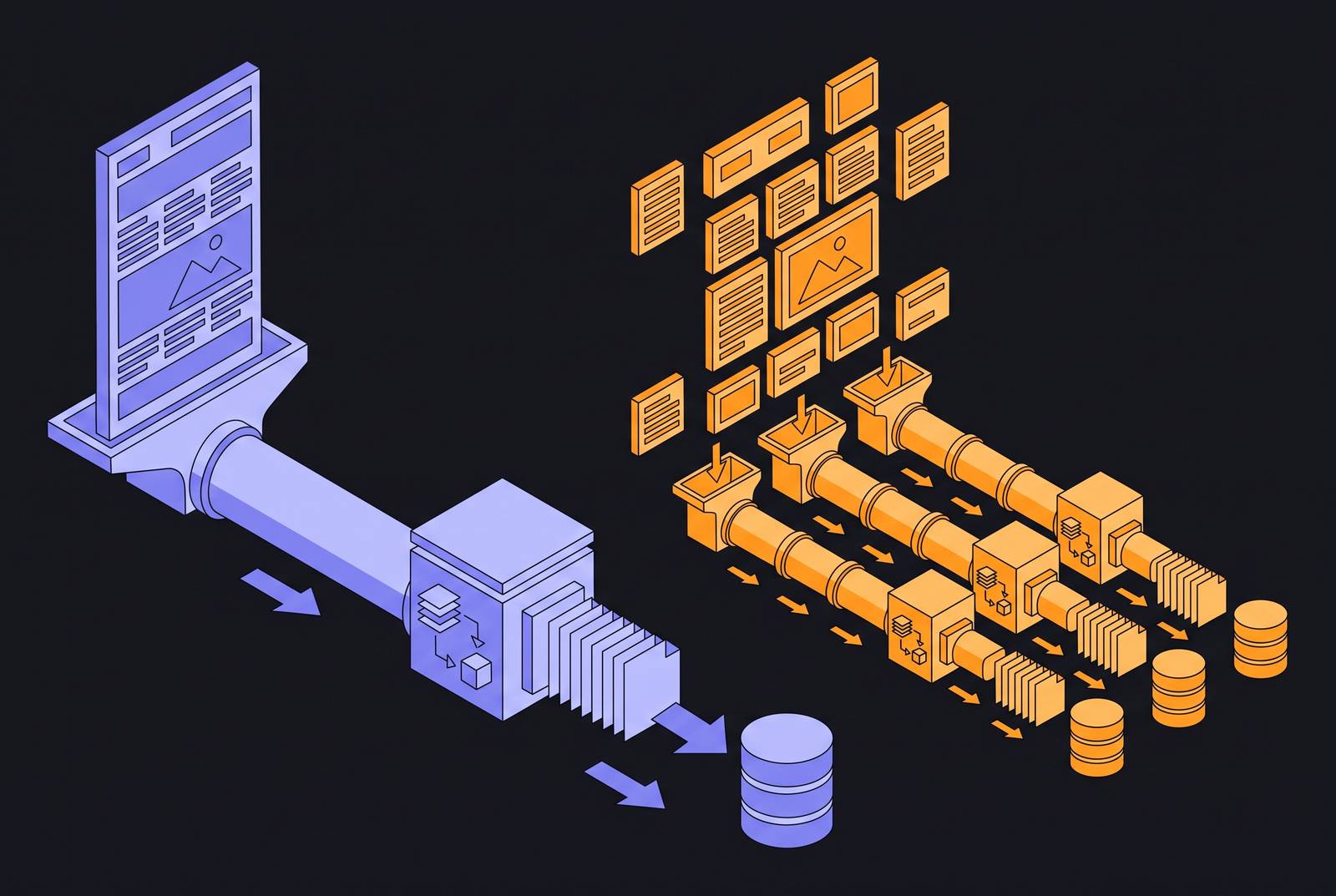
Whether an AI agent receives a URL and a two-line snippet or a complete, reasoning-ready document is one of the most consequential architectural decisions in retrieval pipeline design. The distinction traces directly to what search APIs were built for. Most were architected for human browsers navigating to destinations, not for machine systems that must reason over content. Snippet APIs hand off navigation. Full-page extraction hands off knowledge. The gap between the two shapes every failure mode this article traces.
Why the architectural origin of snippet APIs matters
A SERP API returns titles, URLs, metadata snippets, and paid placements. Pointers to content, not content itself. It is the design premise. These tools were optimized for a human who clicks through, reads the page, and decides relevance with a lifetime of interpretive context. The API was never asked to deliver knowledge. It was asked to deliver a map.
When an AI agent consumes that output, the pipeline does not end at the API call. The agent must parse results, select URLs, issue secondary fetch requests, handle JavaScript rendering or anti-bot walls, and sanitize raw HTML into usable text. Each of those steps is work the agent performs badly and expensively, for reasons the next section makes precise. A 2026 guide from Vellum states the distinction plainly: some tools give a URL and a snippet, and only full-page tools give the page itself.
The wrapper problem compounds the mismatch. Many search MCP servers marketed at AI agents are just thin layers over the same underlying index. Call a Google-wrapped MCP server, and you get the same ten results an agent with a Google tool already configured would receive. The architecture changes. The payload does not. Teams adopt what looks like an AI-native retrieval layer, but they still end up fetching and cleaning downstream.
How the multi-hop cascade turns one API call into a compound failure surface
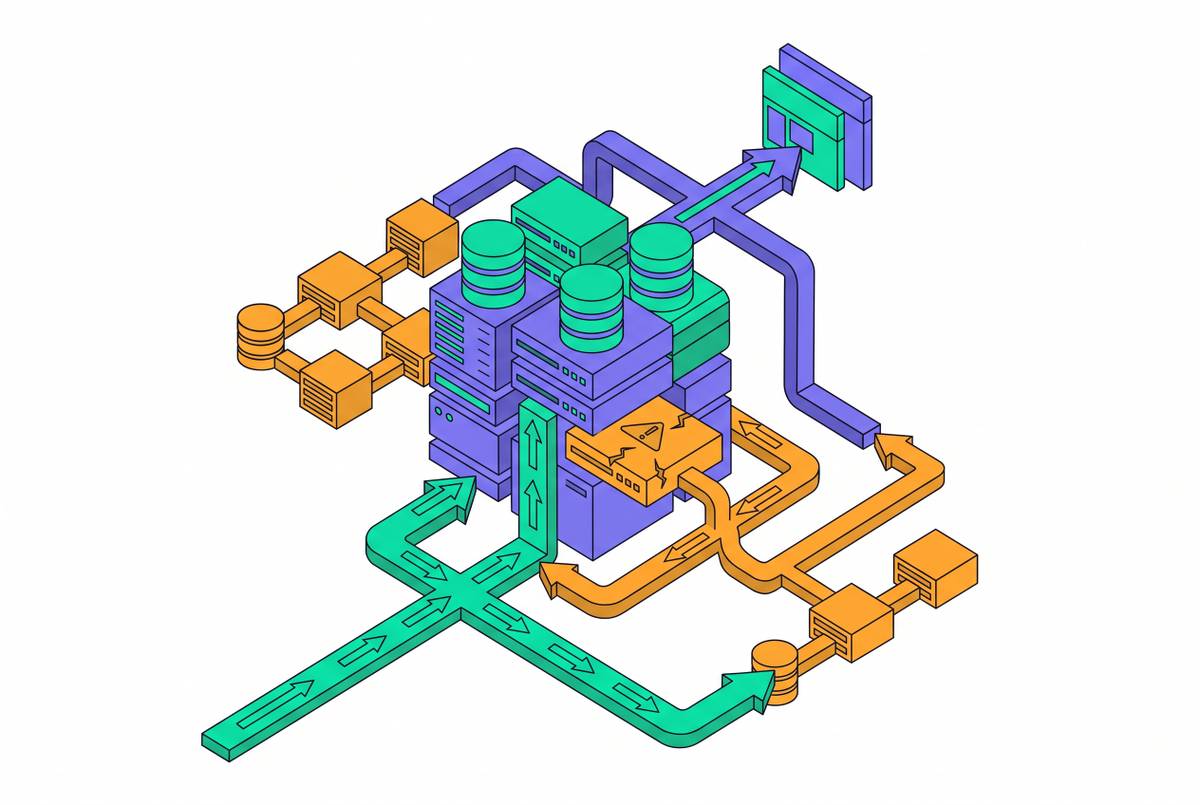
The gap between a snippet and a reasoning-ready document is not bridged by one additional step. It is bridged by a chain of steps, each with its own failure probability and latency cost. The anatomy of a SERP-dependent agent pipeline runs as follows. The API call returns titles, URLs, and snippets. The agent selects candidate URLs, a reasoning step that consumes tokens. It then issues a secondary HTTP fetch per URL, multiplied by however many the agent deems relevant. Client-side-rendered pages require JavaScript execution in a headless browser. Anti-bot and WAF evasion may fail silently, returning incomplete or blocked content. HTML-to-Markdown sanitization strips boilerplate imperfectly. What finally lands in the LLM context is potentially still noisy.
SERP scrapers such as SearchAPI.io are explicit about this design. Scrape.do, by contrast, is a general-purpose scraping API that can fetch and render any destination URL, including through a headless browser with Markdown output. Inspecting five URLs per query means five additional HTTP requests, each with independent latency and each capable of hitting an anti-bot wall. At that point the agent stalls or reasons over incomplete context.
Tail latency accumulates at every hop. If secondary fetches, rendering, and sanitization are included, a sub-50ms first call balloons to seconds. The secondary extraction pipeline every agent actually needs is not in the number. The headline latency reports the cheapest step and ignores everything the system must do afterward.
Why raw web pages are structurally hostile to LLM reasoning
The content problem is not that snippets are short. It is that raw pages, when fetched without extraction, deliver a large proportion of tokens that carry no reasoning value. Not the article body or factual content an agent needs. That is the payload a secondary fetch returns.
Boilerplate inflating the context window is not neutral overhead. It displaces substantive content, dilutes attention, and forces the model to reason over a lower-density signal. The model has the information and still fails to use it.
Expanding context windows do not resolve this. They shift the cost rather than eliminate it. Frontier hosted models now support very large context windows, but compute costs grow faster than context length because attention is quadratic, and KV cache memory costs grow linearly. More context is not always better. Braintrust's 2026 guide treats context budget as a first-class concern: it recommends that teams limit enabled tools and control returned content length so the window does not fill with unnecessary text.
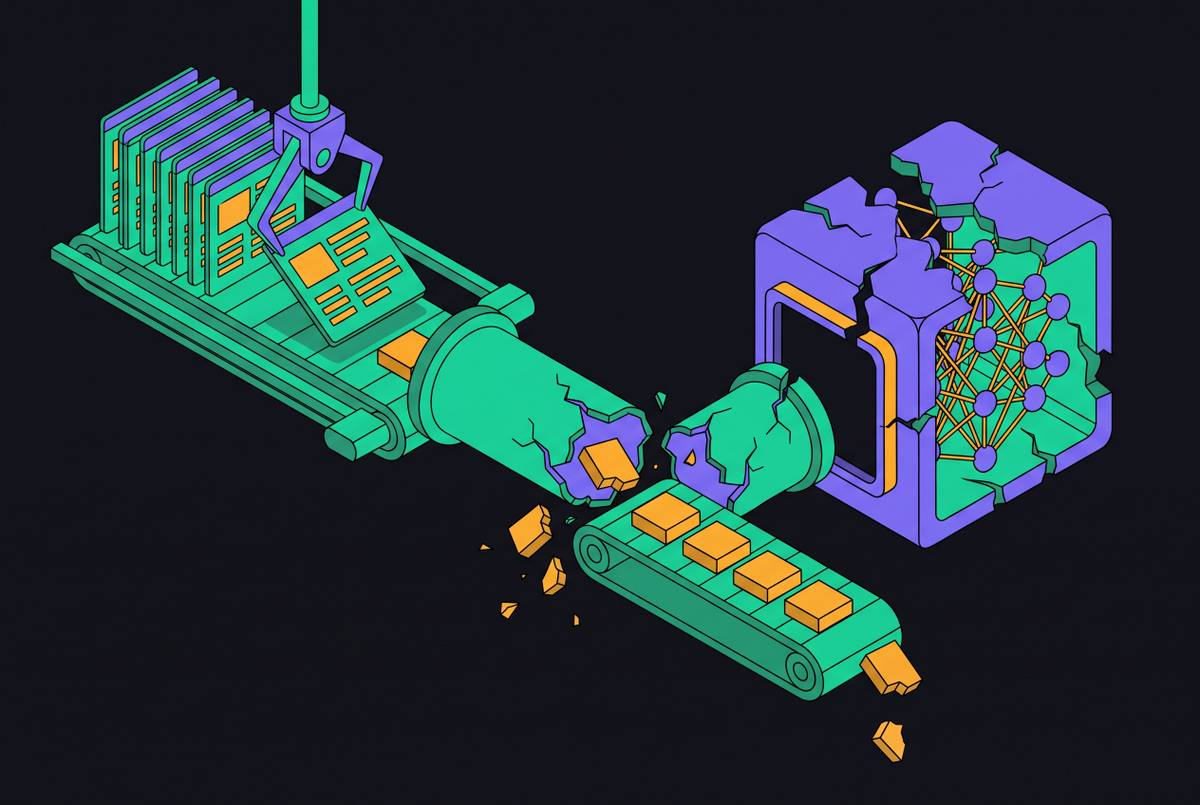
Full-page extraction resolves this by running the HTML-stripping, boilerplate-removal, and Markdown-structuring step before content reaches the agent. The pipeline takes a noisy multi-stage process and collapses it into one clean output. Seltz, a web knowledge API purpose-built for AI agents and LLM applications, exemplifies this alternative architecture: rather than wrapping a search index designed for human navigation, it owns the full data pipeline end-to-end, delivering context-engineered content already shaped for machine reasoning instead of requiring agents to parse and fetch downstream.
Token quality as an infrastructure cost, not a model preference
Wasting context-window capacity on navigation menus and ad copy is not a minor inefficiency. At production inference prices across frontier models, it is a material cost defect that scales with query volume. So the proportion of tokens that carry useful signal hits your spending directly.
The cost argument is not about any single query. It is about what the aggregate looks like at production throughput. Payload structure is an architectural decision that determines cost, not a convenience feature.
Seltz was purpose-built for this: it returns cleaned, reasoning-ready content in one call and collapses the whole multi-stage pipeline. That eliminates the secondary fetch, rendering, sanitization, and anti-bot steps that compound latency and failure probability in SERP-dependent architectures. A basic search call and a search call with full content extraction consume different credit amounts, and the difference reflects real work done before the content reaches the model, not at inference time.
How agentic RAG patterns expose the snippet gap most severely
Agentic RAG is where the quality and format of web API responses most directly shapes what the model can reason over. In this architecture, the agent holds a toolbox of retrieval methods, including vector search, keyword search, SQL queries, web search, and API calls, and selects among them conditionally mid-task. Web search is a live, conditional tool call, not a preprocessing step. The API response lands directly in the reasoning loop. Braintrust's 2026 guide identifies provider selection as the key design dependency, affecting answer accuracy, citation quality, latency, and cost, especially when agents perform multiple searches within a single task.
Iterative retrieval systems amplify the quality of every individual step because errors compound across iterations. A snippet that truncates the relevant evidence forces the agent to issue another retrieval call, burning latency and tokens. Full-page content resolves the question in one pass. The four core agentic RAG patterns place different retrieval demands on the web API. Snippets answer none of these demands well.
A two-step retrieval pattern has emerged for high-frequency reasoning loops. The second call fetches only that document. So this pattern requires the extraction API to support selective, on-demand full-page fetch. Snippet-only SERP APIs cannot fill the second step. The architecture implies the infrastructure.
Where snippets remain the rational choice — and what that boundary looks like
The case for full-page extraction is not universal. Snippet-only results suit simple, shallow lookups where the snippet itself contains the answer: entity resolution, price checks, routing decisions, factual spot-checks with unambiguous answers. For latency-critical, high-frequency, shallow-lookup workflows, traditional SERP scrapers deliver fast responses that are fit for purpose.
The boundary condition is whether the agent needs to reason over the content or merely route on its existence. Braintrust's 2026 guide frames this as a context-budget decision: snippets reduce token usage, query-relevant excerpts provide focused evidence, and full-page Markdown supports tasks requiring longer passages or detailed content. The right choice depends on what the agent must answer.
The latency objection is real. With extraction, you pay a fixed latency per retrieval, not a cost per token of reasoning quality delivered. For production agents doing multi-step research, a slower but complete first response can need fewer total retrieval calls than a fast but incomplete one.
Production reliability requirements that snippet pipelines structurally cannot meet
The failure modes of snippet-plus-secondary-fetch pipelines are not edge cases to be patched. They are structural properties of multi-hop architectures, and they surface under real production load. Client-side-rendered pages need JavaScript execution in a headless browser, and that adds latency, resource cost, and a failure mode the SERP call itself does not have.
You need predictable latency under real-world load in production, but compound-hop architectures undermine it. Braintrust's 2026 guide identifies freshness controls, including publication-date filters, recency windows, and cache-age settings that trigger a live fetch, as a distinct evaluation criterion for production agent pipelines. Every LLM has a knowledge cutoff, and time-sensitive queries require grounding in content published after that cutoff.
Full-page extraction APIs that own their data pipeline end-to-end collapse search, fetch, and extraction into one managed call, and that eliminates the secondary-fetch failure surface. The reliability guarantee comes from pipeline ownership. A provider that controls crawling, rendering, extraction, and delivery can instrument and defend every stage. A wrapper around a third-party index cannot. Braintrust's 2026 guide notes that external search APIs leave retrieval configuration to the team and expose retrieved passages for tracing and evaluation, but only if the pipeline is transparent enough to instrument.
Enterprise security and data-lineage requirements that snippet APIs leave unaddressed
For enterprise AI teams, the retrieval pipeline is not just a technical component. Every data source it touches is a potential SOC 2 finding, and snippet-only SERP APIs usually run on standard proxy infrastructure terms with no audit-grade guarantees. Enterprise vendor-risk teams in 2026 write model versioning policies, prompt-logging retention, training-data lineage, hallucination handling, LLM subprocessor chains, and AI-literacy training records directly into their AI-vendor questionnaires.
A pipeline that relies on a SERP scraper for retrieval passes third-party data through an unaudited subprocessor. The lack of auditable data lineage is a SOC 2 finding risk, not a theoretical concern. You should at least keep company data that goes through a retrieval pipeline out of any underlying model's training data. When you run generative AI under HIPAA and SOC 2, audit trails become a strong compliance expectation for AI-generated decisions and customer interactions with regulated data. Immutability and tamper-evidence are auditor best-practice requirements rather than explicit mandates.
Full-pipeline ownership, where a provider controls crawling, extraction, and delivery under documented data-handling terms, is the only architecture that can support the subprocessor chain documentation enterprise vendor-risk teams now require. When infrastructure is designed from the ground up for machine reasoning rather than human consumption, as with context-engineered web knowledge APIs, the extraction and filtering process itself becomes part of the serving layer. Boilerplate removal and signal concentration happen before content reaches the LLM context window, so token density is preserved where it matters most. An API that wraps a third-party index cannot provide lineage for data it did not collect.
What full-pipeline ownership means in practice for AI teams evaluating retrieval infrastructure
The choice between snippet APIs and full-page extraction is ultimately a question of which failure modes an AI team is willing to own. The evaluation questions that follow are direct. Braintrust's 2026 guide recommends testing providers under consistent conditions, same agent tasks, same evaluation set, because vendor benchmarks use different models, prompts, and question sets that make direct comparisons unreliable.
Seltz answers these questions in the affirmative. It owns its full data pipeline end-to-end, delivers context-engineered, machine-ready web content selected, filtered, ranked, and shaped for AI reasoning, and treats enterprise-grade security alignment as a first-class concern rather than a retrofit. The architectural stance of rebuilding web knowledge infrastructure from the ground up for AI consumers rather than human browsers is the direct response to the compound failure modes this article traces. If an AI engineering team moves past demos into long-lived, high-throughput production systems, the retrieval infrastructure layer is no longer a commodity choice. Depth, speed, and reliability requirements that snippet APIs and general-purpose scraping tools were never designed to meet are the criteria that actually distinguish one backend from another. The decision comes down to which failure modes a team is willing to own, and whether the retrieval layer was built to reason or merely to route.