Web Source Attribution and Citation in LLM Agent Outputs
Source attribution in AI agents must be built into retrieval pipelines, not added after generation.
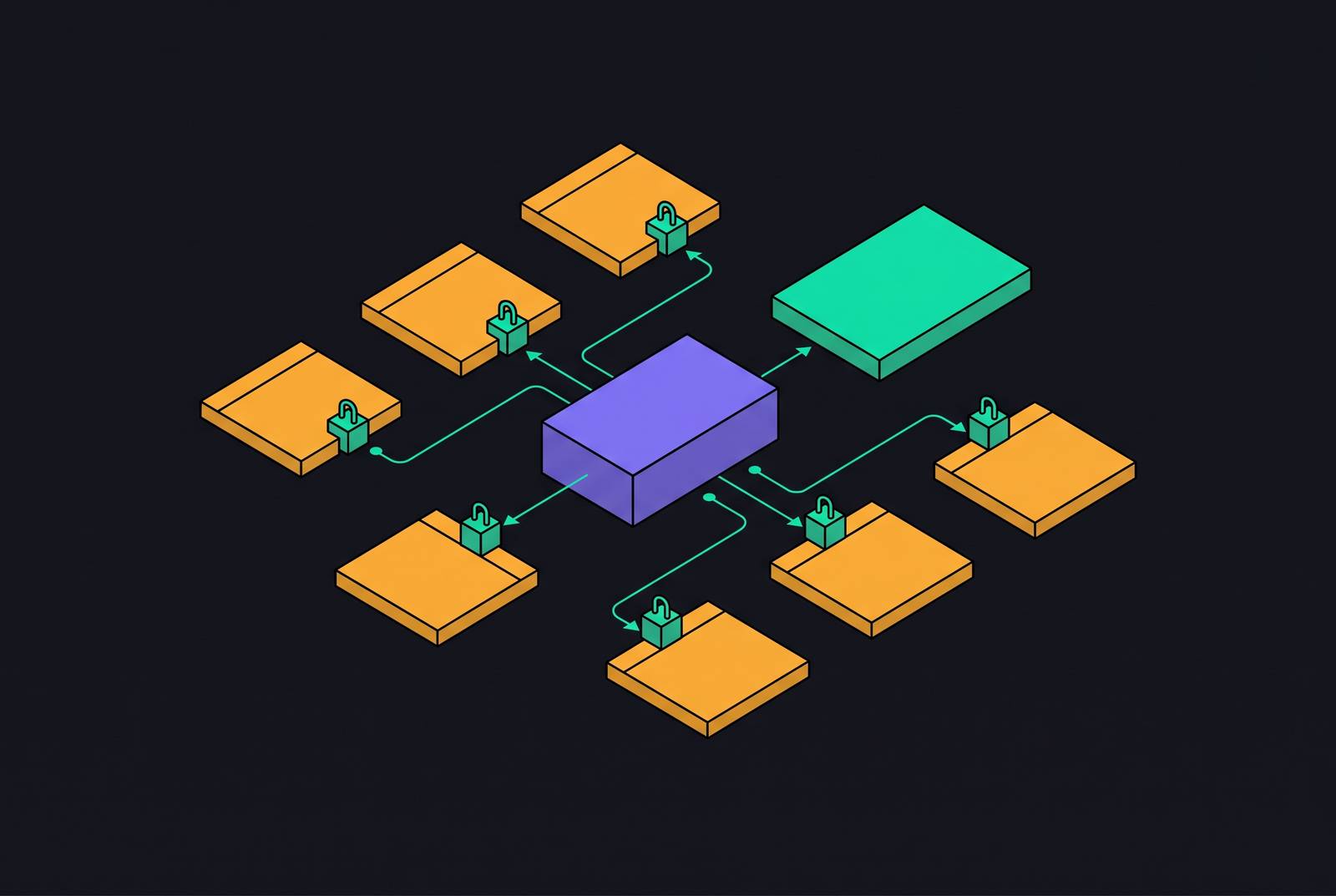
Web source attribution in an LLM agent's output is not a formatting choice made at the end of a response. It's a property of the retrieval pipeline that either gets built in from the first API call or is absent for good. By the time a model writes the words "according to," the chain of custody between claim and source is already fixed, upstream, in decisions made about schemas, chunking, and message formats.
That distinction matters more now than it did even a year ago, because research agents that search, read, reason across dozens of sources, and produce cited reports have moved from demo to default deployment. Getting attribution wrong at that scale is a trust problem, and increasingly, a regulatory one. It's a trust problem, and increasingly, a regulatory one.
Web sources in modern agent architectures and the entry point of provenance
Most production agents run on some version of a four-layer stack: a reasoning layer that decides what to do next, an orchestration layer that sequences steps, a memory and data layer that stores what's been learned, and a tool integration layer that actually goes out and fetches things. Attribution metadata, when it exists at all, lives almost entirely in the last two layers. The reasoning layer just works with whatever it's handed.
According to the EICTA guide and MLflow's developer guide, five architectures now account for most production agent systems: ReAct, Plan-Execute, Reflexion, Tree-of-Thoughts, and Multi-Agent setups built around supervisor-worker hierarchies. Each handles source information differently, and each breaks it in a different way.
In a ReAct loop, the agent alternates between reasoning and acting, calling a tool, reading the result, deciding what to do next. Source attribution has to survive every one of those iterations as an intermediate tool output, which means it has to be re-injected into context each time rather than mentioned once and forgotten. Plan-Execute architectures split the work differently: a planning phase gathers sources and sets a strategy, then execution steps, sometimes running in parallel, carry out the plan. If the metadata collected during planning doesn't get explicitly passed to each execution branch, the branches that actually touch the source have no idea where it came from.
Multi-Agent systems are the hardest case, because provenance has to survive not just a loop but a boundary between agents. Worker agents retrieve; supervisor agents synthesize what the workers found. Nothing about that handoff is automatic.
This isn't a hypothetical concern. LangChain's State of Agent Engineering survey found that 57.3% of developers already have agents running in production, and per LangChain's survey data, research and summarization tasks make up 58% of individual agent use cases, one of the leading categories. The use case that most needs a defensible citation trail is also the most common one being shipped.
All of which points to the same conclusion: the tool integration layer, the place where a web search or page fetch actually happens, is where the fate of attribution gets decided. What that tool returns, and whether the return value carries structured provenance or just a blob of text, determines everything that happens after it.
Retrieval layer requirements for attribution
Traditional search APIs return a title, a URL, and a snippet, usually somewhere in the 150 to 300 character range. That's enough to describe a search result. It is not enough to support a citation on a specific claim, because a snippet tells you where something ranked, not which sentence in the underlying document actually backs up what the model just wrote.
Call this the attribution gap. A model that only has access to a snippet is being asked to cite a source it never really read.
Closing that gap requires a minimum payload: a canonical URL that doesn't dead-end in a redirect or tracking string, a publication or last-updated timestamp, the document's title and any available authorship signal, the specific passage that was actually retrieved (not a generic top-level snippet), and metadata describing where in the document that passage sat. That last field is what lets a system trace a claim back to a specific sentence rather than a vague "somewhere in this page.""
Retrieval platforms built for AI consumption have started addressing part of this by combining search and full content extraction into a single call, returning clean structured text instead of raw HTML. That distinction, structured content versus raw markup, is not cosmetic. Raw HTML forces the model to parse and interpret markup before it can reason over the content at all, and that parsing step is exactly where passage-level provenance gets destroyed. Once a model has flattened a page into plain prose to make sense of it, there's no reliable way back to "this specific claim came from this specific paragraph."
The lesson generalizes: provenance has to be a first-class field in the response schema of whatever retrieval tool an agent uses. If it isn't in the schema, nothing downstream can be expected to preserve it, because there's nothing to preserve.
How the context assembly step degrades or destroys provenance
Context engineering, the discipline of deciding what to put in front of a model and in what form, has become the dominant failure surface for agents in production. Most agent failures at this point aren't model failures. They're context failures.
Chunking is the first place things go wrong. Retrieval systems work in chunks, not whole documents, and if a chunk's meaning depends on the paragraph before or after it, a model reasoning over that isolated chunk can misjudge what claim it actually supports. The chunk survives; the context that would have made its meaning unambiguous does not.
Token budgets compound the problem. Research from Anthropic has shown that contexts beyond roughly 100,000 tokens start to degrade reasoning quality, and empirically, coding performance often drops once a context window passes roughly the halfway point of its capacity. Faced with that ceiling, teams prune aggressively, and provenance metadata, URL, title, timestamp, is exactly the kind of thing that looks safe to cut. It isn't carrying the "content," after all. Except it is the only thing standing between a claim and its source.
Position matters too. It is broadly observed that LLMs tend to underuse information placed in the middle of a long input, favoring what appears near the start or end. Source metadata that gets appended in some low-salience spot in the middle of a chunk block may simply get ignored during generation because it never really registered during generation.
Doing this correctly looks specific, not vague. Provenance fields need to travel with each chunk as structured metadata, not as inline prose a model might paraphrase or quietly drop. Retrieval results need ranking and filtering before assembly, so irrelevant chunks get pruned before they eat into the token budget rather than after the fact. Where contextual compression is applied, filtering content down based on what's relevant to the current turn, it should apply to the content, not the metadata sitting alongside it. And provenance needs a consistent, high-salience position within each chunk block, so that position bias works for the system instead of against it.
Teams treat the context window like a junk drawer. Retrieved content goes in, metadata structure gets lost along the way, and then the model gets told to "cite your sources" as if that instruction alone could conjure back what was already thrown out. It can't, because the metadata structure is already lost by the time the model is told to cite its sources. The model hallucinates a citation because the real one is gone.
Provenance across multi-agent boundaries: the handoff problem
Supervisor-worker systems add a second layer of risk on top of everything context assembly already puts at stake. A worker agent retrieves and synthesizes at the level of its own sub-task; the supervisor then re-synthesizes across multiple workers. Each one of those transitions is a place where the paper trail can quietly disappear.
MLflow's 2026 guide describes a composite pattern: a ReAct loop running inside a supervisor-worker hierarchy, where the supervisor handles decomposition and routing and each worker runs its own internal ReAct loop underneath. A citation generated deep inside a worker's loop has to survive that loop, then survive the handoff to the supervisor, then survive whatever synthesis the supervisor does across multiple workers' outputs. Three separate points of failure, not one.
The most common way this breaks: a worker returns a prose summary to the supervisor with sources woven into the sentences as inline text. The supervisor paraphrases that summary to fit it into a larger synthesis, and the moment it does, the inline citations become untraceable, absorbed into language that no longer maps cleanly back to a specific claim. If the schema for agent-to-agent messages has no dedicated field for citations, then citations only exist as natural language, which means no downstream system can extract them programmatically even if it wanted to. Session memory tends to compound both problems because it is built to preserve intermediate findings, not the source records behind those findings. The system remembers the fact. It forgets where the fact came from.
The emerging A2A (Agent-to-Agent) protocol is meant to let agents from different providers talk to each other, but no shared standard currently mandates a provenance field in agent-to-agent messages. That means the burden of enforcing an attribution contract sits entirely with the team building the application, not with the protocol layer. Inter-agent messages need a structured citations array as a required part of the payload, sitting alongside the content, not folded into it. That's a design decision someone has to make on purpose. Nothing about current tooling makes it happen by default.
Memory infrastructure only makes the inconsistency worse. As of 2026, the ecosystem for deploying agent memory spans roughly 21 frameworks and 20 vector stores, and no shared provenance convention spans them. There is no shared standard for how a source record should sit alongside the fact it supports once that fact gets written into long-term memory.
Causes and commonalities of hallucinated and misattributed citations
Two failure modes get lumped together in casual conversation, but they're mechanically distinct. A hallucinated citation is one where the model generates a plausible-looking URL or title for something that was never actually retrieved. It happens when the source metadata simply wasn't in the model's context to begin with. A misattributed citation is different: the source is real and was retrieved, but the specific claim it's attached to doesn't actually appear in it. That usually traces back to chunking that separated a claim from its supporting passage, or to a model summarizing across several sources and then pinning the credit on just one of them.
Different mechanisms, same root cause. In both cases, the model was asked to produce a citation it did not have the structured information to produce honestly.
This mirrors a known failure pattern in retrieval-augmented generation more broadly: production RAG systems fail silently. Retrieval returns a document that looks plausible but is wrong, the model synthesizes a confident answer built on it, and absent evaluation, nobody catches the error. The same silent failure occurs in citation specifically. A wrong source, dressed up with a real-looking URL and title, reads as just as authoritative as a correct one.
Position bias makes this worse in a specific, describable way. Because models tend to weight information that appeared early or prominently in context more heavily, a source that showed up first in the retrieved set can end up credited for a claim that a later, underweighted source actually supports. The credit goes to prominence, not accuracy.
None of this is a job for fine-tuning or alignment training. Hallucinated citations are a retrieval infrastructure problem: if the pipeline cannot hand the model a valid citation, the model will invent one, because it was instructed to produce a citation and inventing one is the only way left to comply.
The EU AI Act's August 2026 enforcement as a compliance floor for citation
The EU AI Act classifies a range of enterprise LLM applications under its high-risk provisions, and Article 10 establishes data governance requirements for the datasets those systems draw on. High-risk enforcement itself has been pushed to December 2, 2027 under the Digital Omnibus on AI (Regulation 2026/1744), but broader enforcement under the Act began August 2, 2026. Penalties reach €35 million or 6% of global turnover, which is not a fine a legal department treats as a rounding error.
Article 10's implication for attribution specifically is direct: if an agent's output rests on retrieved web content and that output has consequences, the data governance obligation extends to being able to show which sources actually informed it. Because an agent's output that rests on retrieved web content and carries consequences must be traceable to what actually informed it, provenance becomes a documentable audit trail, the kind of thing a regulator can ask to see.
The scale of the market makes this a mainstream concern rather than an edge case. Gartner projects worldwide AI spending will reach $2.59 trillion in 2026, with infrastructure making up more than 45% of that total. At that size, "the retrieval pipeline wasn't designed to track sources" isn't a defensible answer to a regulator, or to a customer.
Practically, this means attribution infrastructure has to produce machine-readable provenance records, logs that can actually be audited, not footnotes that merely look reassuring on the page. OWASP's Top 10 for LLM applications now includes a dedicated category for vector and embedding weaknesses, covering risks specific to retrieval-augmented pipelines like vector-store misconfiguration and data poisoning. A misconfigured retrieval pipeline that attributes a claim to the wrong source is a security surface at the same time as a citation failure. It's a security surface at the same time.
Designing attribution into the pipeline from the data layer up: the engineering requirements
Attribution is a constraint that has to hold at every layer of the stack from the start of a build. It's a constraint that has to hold at every layer of the stack, layer by layer.
At the retrieval layer, the response schema needs a canonical URL, a timestamp, a document title, and the exact retrieved passage, each as its own structured field, not buried in a paragraph of prose. At the content processing layer, whatever converts HTML into clean text needs to preserve structural signals, headings and section boundaries, so that passage-level provenance survives the chunking that happens next. At context assembly, provenance fields need to be treated as non-compressible: whatever summarization or pruning happens to the content around them, the source tags stay intact and sit in a high-salience spot in the chunk.
At the orchestration layer, inter-agent messages need a structured citations array as a required field, made up of machine-readable objects, URL, passage, timestamp, not inline sentences. At the memory layer, writing a fact into long-term storage or a vector store means writing its source record alongside it, so that retrieving the fact later also retrieves where it came from. At the generation layer, the model should be instructed to cite from the structured array already sitting in its context, not to construct a citation on its own; that instruction can enforce good use of upstream infrastructure, but it can't replace it. And at the evaluation layer, RAGAS-style metrics need a citation grounding check built in, one that verifies a cited source actually contains the claim attached to it, rather than just checking for the mere existence of a citation.
Between July 2025 and January 2026, the number of websites actively blocking AI crawlers grew to nearly seven times the number blocking traditional search crawlers, a structural bottleneck that is easy to underestimate. A scraper that gets blocked fails silently. It cannot return a valid URL, which means it cannot support attribution at all, no matter how carefully the rest of the pipeline is designed.
This is also where the build-versus-assemble decision matters. Stitching retrieval infrastructure together out of third-party wrappers means inheriting whatever provenance schema those wrappers happen to expose, and a team has no leverage to demand fields an upstream API doesn't return. Owning the full data pipeline is the only way to guarantee provenance metadata is present, consistent, and machine-readable at every single step, rather than hoping some vendor upstream cared about the same things.
A model's training data, frozen at some point in the past, cannot substitute for live retrieval when the claim depends on something current. Cited sources have to be retrievable and verifiable at the moment the output is produced, which means live web grounding, not a cache that quietly went stale.
Gaps in current tooling and evaluation criteria for attribution
Frameworks like LangChain, LlamaIndex, Haystack, Semantic Kernel, and AutoGen give developers modular ways to compose retrieval and generation. What none of them do is enforce a provenance schema. That's a data contract between the retrieval tool and the rest of the pipeline, and orchestration frameworks, by design, stay agnostic about what any particular tool returns.
Open-source web search agent frameworks tend to optimize for something adjacent but different: producing long, comprehensive research reports. That goal often comes with heavy token and API usage, and provenance handling is incidental to the report-writing goal rather than something designed on purpose from the start.
Teams evaluating a retrieval API for attribution capability should be asking a specific set of questions, not accepting marketing language at face value. Does the API return passage-level content, or does it stop at a snippet? Are the provenance fields, URL, timestamp, title, returned as their own structured fields, or are they buried inside a block of prose the application has to parse out itself? Does the API handle conversion of raw markup into structured content natively, or does that burden fall back on the application layer to solve? And can the API hold up under real production load, with predictable latency, rather than the kind of performance that only looks good in a demo?
None of these questions are exotic. They're the same questions any engineering team should ask of infrastructure it plans to depend on. The difference with attribution is that getting the answers wrong doesn't just produce a slower system or a worse user experience. It produces an agent that cites sources it never read, credits claims to the wrong document, and, under a regulatory regime that took effect in August 2026, cannot show its work when asked to.