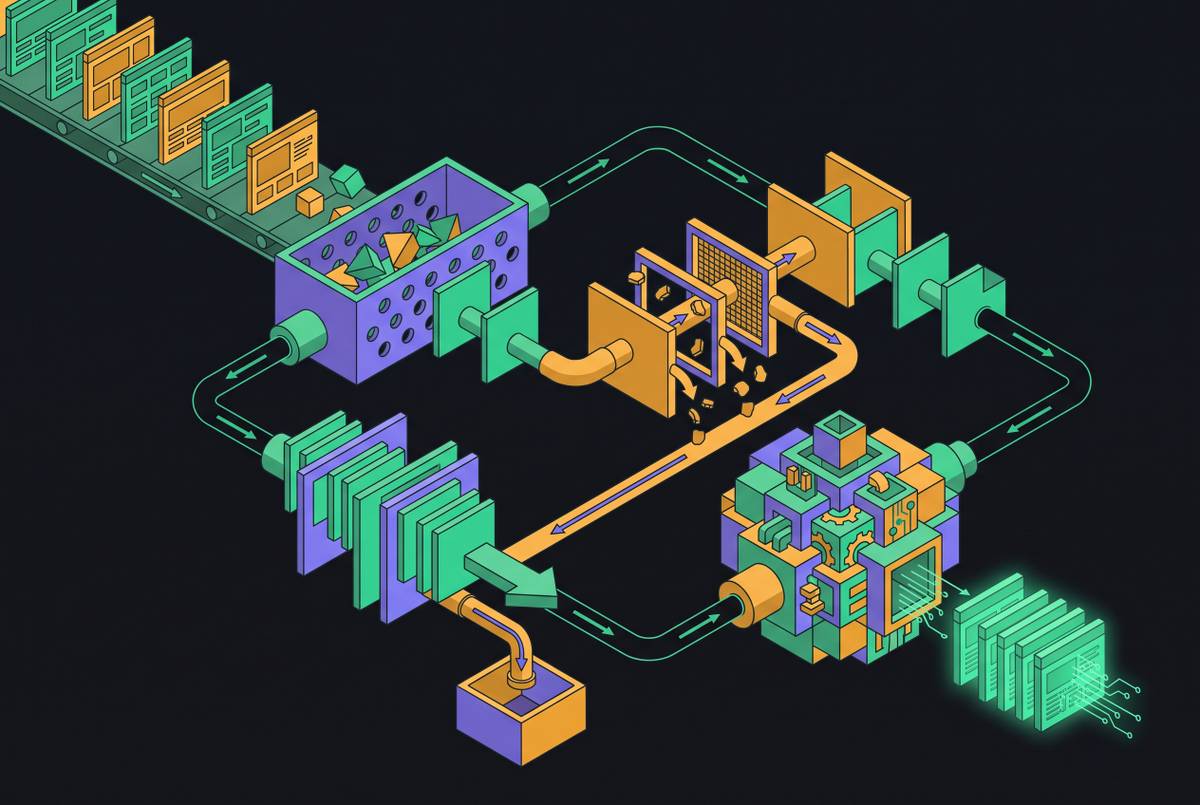
Deduplication of Web Retrieved Content in High-Volume RAG Systems
Removing redundant passages before they reach the LLM cuts costs while preserving answer quality.
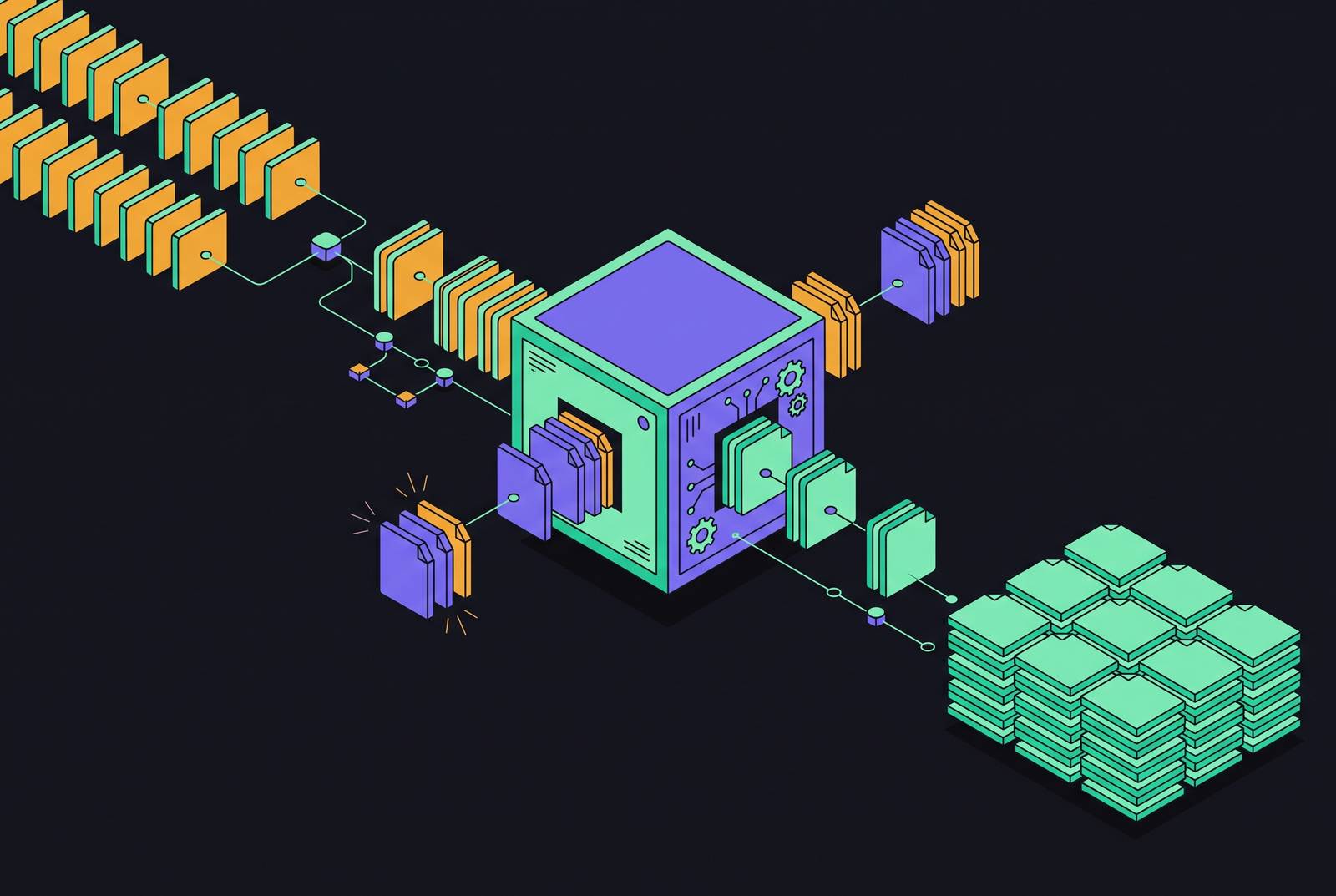
A production retrieval call rarely returns what it appears to return. A pipeline configured to fetch 15 chunks from a vector store will frequently hand back something closer to 5 unique passages, each surfaced roughly three times through different routing paths: once from a sparse keyword match, once from a dense embedding match, once from a reranker that scored a near-identical copy independently. This redundancy comes from how high-volume retrieval against the live web works, and no amount of better sourcing can fix it.
Several mechanisms cause this duplication, and each one acts on its own, apart from the rest. Source corpora compound the problem on their own terms: encyclopedic mirroring, syndicated news content, citation boilerplate, and plain web-scraped copies mean that byte-identical passages exist across documents the system treats as distinct. Vector-store indices built from multi-source ingestion pipelines often carry the same content indexed under separate identifiers. The index itself cannot distinguish one copy from another at query time.
Agentic query fan-out adds a second layer on top of this. Standard retrieval frameworks do little to intervene here: LangChain, LlamaIndex, and comparable tools rank retrieved sets on relevance, and their default single-query retriever configurations do not natively filter for uniqueness before passing context along, though purpose-built retrievers such as LangChain's MultiQueryRetriever do perform deduplication as part of their design. The web delivery layer inflates the surface area before any of this retrieval logic even runs: raw HTML carries navigation bars, ad units, scripts, and footers that multiply the token count of every page fetched, regardless of how much of that page actually answers the query.
The three distinct regimes in which duplication operates
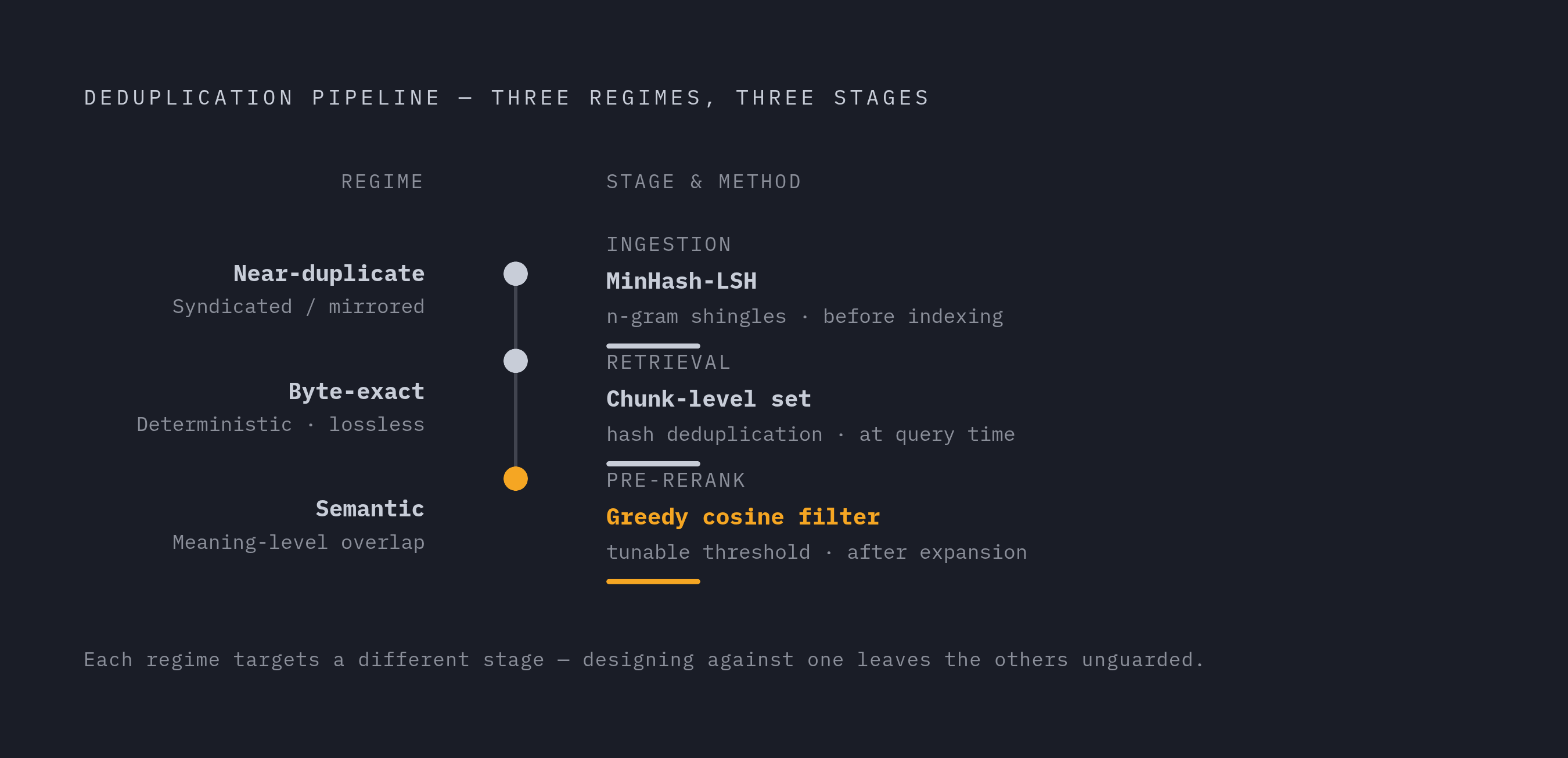
Treating deduplication as a single operation misreads the problem. Byte-exact, near-duplicate, and semantic redundancy arise from different causes, get caught by different detection methods, and each leaves a distinct failure mode behind when ignored.
Byte-exact duplication is the simplest of the three: two chunks are literally identical at the byte level, and chunk-level set construction catches every instance of it, deterministically and without loss. The Byte-Exact Deduplication in Retrieval-Augmented Generation study measured this across three operating regimes and found the scale of the problem varies enormously depending on context. The pattern holds regardless of which tool performs the deduplication: chunk-level redundancy is a property of the input data itself, not an artifact of the filtering implementation.
Near-duplicate duplication sits one level up. Documents can carry text similar enough to be functionally redundant without being byte-identical, a pattern common to versioned documents, syndicated articles, and web mirrors that have been lightly edited or reformatted. Catching this requires establishing equivalence classes through Locality Sensitive Hashing, typically MinHash combined with n-gram shingles, applied across the whole corpus. Left unaddressed, near-duplicates degrade downstream retrieval accuracy and narrow the diversity of documents a system actually surfaces, even when each individual retrieval call looks reasonable in isolation.
Semantic near-duplicate redundancy is the hardest of the three to detect, because it involves no shared bytes and no shared shingles at all: two passages phrased in entirely different language can carry equivalent informational content, and both byte-exact and MinHash methods are blind to that equivalence. The dominant approach here is a greedy cosine-similarity filter: retrieve the top-K candidates, embed every chunk locally, compute the full pairwise cosine similarity matrix, keep the highest-relevance chunk first, and discard any subsequent chunk whose similarity to an already-kept chunk crosses a set threshold. The similarity threshold is a tunable engineering parameter rather than a fixed constant: set it conservatively and only near-exact copies get removed; push it aggressively and the filter risks discarding context that was genuinely distinct. If you design against one of these three regimes, the other two can still get through.
What redundancy costs when it reaches the LLM
Redundant context that survives into the prompt degrades the quality of the model's output while raising the cost of producing that output, and the two effects compound. Prefill compute on most production serving stacks scales close to linearly with prompt length, so if you cut the token count of retrieved context, you cut per-call cost and latency by roughly the same amount. That relationship matters because of where the token budget actually goes: at typical retrieval depths, the tokens consumed by retrieved context outnumber the tokens in the user's actual question by one to two orders of magnitude. Context, not the question itself, drives most of the cost in a retrieval-augmented call.
Redundant chunks don't just waste tokens; they actively dilute the signal the model has to reason over. When the same passage appears several times under different surface routings, the model's limited attention gets spent re-processing a single piece of evidence rather than weighing genuinely distinct material, and the resulting answers tend to be vaguer precisely where distinct evidence would have sharpened them.
The obvious objection to aggressive deduplication is that it risks discarding the one passage that would have resolved an ambiguous question, the single piece of evidence buried among what looked like redundant copies. Human-in-the-loop evaluation under a five-category verdict scheme addresses that concern directly: after aggressive byte reduction, judged output quality holds across both clean and high-redundancy regimes. The deduplication work removes tokens, not the information those tokens carry, so across the tested production vendors, output clears a strict materiality threshold whether the input corpus was clean or heavily duplicated. That finding is the claim underneath the entire argument for building deduplication into the pipeline rather than treating it as an optional cleanup pass: because nothing of informational value is actually lost in the process, the cost savings are closer to free than they first appear.
Applying deduplication regimes across the pipeline
Because the three regimes have different causes, you need to intervene at different stages, so a single post-retrieval cleanup pass catches some of the problem but leaves the rest fully intact.
Corpus-level deduplication belongs at ingestion time, before any document enters the vector store. MinHash-LSH with n-gram shingles, applied at this stage, catches syndicated content, mirrored pages, and versioned near-duplicates before indexing. Doing the work here amortizes its cost across every future query: a duplicate removed at ingestion never again consumes retrieval compute or prompt tokens, no matter how many times the corpus gets queried afterward. Corpus-level deduplication at ingestion is established practice in large pretraining pipelines, and it transfers directly to building a RAG knowledge base, though it carries the same limitation noted earlier: MinHash-LSH is probabilistic and non-deterministic across configurations, so it has to be paired with downstream stages rather than trusted as a complete solution on its own.
Retrieval-time deduplication happens later, after the retriever has returned its candidate set but before a reranker scores it. Byte-exact set construction at this point removes exact duplicates cheaply and deterministically, with no approximation involved. Semantic deduplication, the greedy cosine filter described earlier, operates in the same window: after retrieval expansion has generated a broad candidate set, and before reranking collapses that set down to the final passages passed to the LLM. Deduplication placed between expansion and reranking protects two things simultaneously: the eventual token budget, and the quality of the signal the reranker itself has to work with. Where cross-attention calibrated deduplication is available, it offers a more principled basis for deciding which of two near-duplicates to keep, aligning the decision with the attention pattern of the cross-encoder scoring relevance. Sequencing matters here in a way that's easy to get backward: running semantic deduplication after reranking risks throwing out a passage the reranker has already identified as high-value, simply because a near-duplicate happened to rank just above it.
Conversational, stateful systems need a third, distinct kind of intervention. Multi-turn dialogue re-retrieves overlapping content across turns as conversation history accumulates, and stateful proxy caching with byte-exact deduplication keeps that accumulation from flooding the context window turn after turn. This regime is structurally distinct from the other two: quality preservation here reduces to byte-equivalence of the unique content in each turn, rather than requiring the kind of per-prompt human judgment used to validate corpus-level and retrieval-time deduplication. It is, in practice, the highest-redundancy regime by a wide margin, matching the 80.34% reduction figure cited earlier, with stateful caching alone achieving the asymptotic reduction in communication overhead from quadratic to linear scaling with conversation length.
The web delivery layer sits upstream of all three regimes and shapes how much work each of them has to do. A September 2026 paper makes the case that semantic chunk retrieval should become a first-class network-delivery abstraction rather than something each application rebuilds for itself: a Semantics Delivery Network, or SemDN, that indexes, searches, and caches web content at chunk granularity, amortizing acquisition and processing costs across every agent that needs the same content. Left uncoordinated, agents repeat the same search, the same acquisition, and the same semantic processing against the same underlying pages, work an infrastructure layer could do once and share.
How web delivery infrastructure determines the deduplication burden
What the web delivery layer hands the pipeline largely decides how much deduplication work it has to do before the pipeline ever runs. Infrastructure built for human browsers passes that burden straight through to the application layer, which then has to do the cleanup itself.
Current web infrastructure was not designed with agents in mind. CDNs cache objects addressed by URL, so they have no awareness of which specific passage inside that object an agent actually needs. The mismatch is structural: an LLM consumes short, semantically coherent passages, while an agent working against this infrastructure has to download, parse, and post-process an entire page just to extract the fragment it actually needs. That post-processing is deduplication work, and every agent that wants the same underlying content does it on its own, when a shared delivery layer could do it once.
Probes into agent retrieval behavior back this up: page-first retrieval processes far more content than agents end up using, and agent queries show reusable locality: the same passages get requested by many different agents even though each one currently fetches and processes the full source page on its own. The Semantics Delivery Network concept responds to that locality directly, proposing an origin-authorized, hierarchical edge substrate that indexes, searches, and smart-caches web content at chunk granularity, serving agents on behalf of participating websites and moving deduplication and chunking out of application code and into shared infrastructure. None of this is a speculative future state: the gap between what current search APIs return and what production AI pipelines actually need is an engineering cost teams are already absorbing today, in processing time, latency, and wasted tokens.
Provenance, permissions, and the compliance surface deduplication creates
When deduplication collapses several near-duplicate source documents down to a single surviving chunk, the pipeline inherits a question it rarely has the structure to answer: which document's provenance, permissions, and deletion obligations now govern that surviving chunk. Most pipelines are not built to answer that question, a gap that carries real weight: Synvestable reports that 73% of enterprises cite data security as the primary barrier to AI adoption.
Enterprise permissions rarely reduce to anything simple. They involve nested groups, folder hierarchies, document ownership, and specific sharing relationships layered on top of each other, and flattening that structure into simple key-value metadata tags produces metadata explosion while misrepresenting what is actually a graph-shaped access control structure. Deduplication itself creates the compliance risk: two near-identical chunks drawn from two different source documents can carry entirely different permission scopes, and a deduplication process that keeps one copy and discards the other silently inherits whichever document's access control list happened to survive. If the discarded document carried broader access than the retained one, that is a compliance exposure baked into the pipeline's own design, not an edge case.
Enforcing access control at the vector database level, before retrieval even happens, avoids a specific failure mode that post-filtering introduces: if filtering happens after retrieval, it is possible for every one of the top-k results to get filtered out entirely, leaving the LLM with zero context to work from, though mitigations such as k-inflation or re-query loops exist to soften that failure. Deletion obligations compound the same structural gap. Under GDPR, and more narrowly CCPA, if a source document containing personal data is deleted in response to a data-subject erasure request, every associated vector embedding may need to be identified and purged in turn. In practice, meeting that requirement depends on data lineage tracking that maps raw source records to their corresponding vector IDs, though GDPR does not mandate any specific architecture, such as a centralized lineage graph, to achieve that mapping.
Updates and deletes inside a RAG ingestion pipeline amount to a formal engineering problem in their own right: maintaining a working correspondence between the state of a source document and the state of its indexed chunks, across a pipeline that may have deduplicated, merged, or reused those chunks along the way. An enterprise knowledge base holding multiple versions of the same policy document can return contradictory answers even when every piece of the retrieval technology is functioning exactly as designed, simply because nothing in the pipeline tracks which version a given chunk belongs to. Version control at the chunk level is a prerequisite for retrieval a business can actually trust, not an enhancement to be added once the core pipeline is working.
Sources
- Byte-Exact Deduplication in Retrieval-Augmented Generation: A Three-Regime Empirical Analysis Across Public Benchmarks
- Cross-Attention Calibrated Deduplication for Retrieval-Augmented Generation System
- Byte-Exact Deduplication in Retrieval-Augmented Generation
- Semantics Delivery Network: Rethinking Web Retrieval Infrastructure for LLM Agents