Data Provenance and Lineage Tracking in Web Knowledge Pipelines
Tracking where AI systems source their answers prevents hallucination and satisfies audits.
A support ticket arrives: an AI assistant gave a customer the wrong contract renewal deadline. The engineer pulls the logs and finds a clean response, no error code, green metrics across the board. Latency was normal. Token counts were normal. The API call succeeded. None of it says which document the system retrieved, which chunk made it into the context window, or whether the date in the answer came from a retrieved source at all or was generated without any grounding whatsoever. This is the gap that monitoring was never built to close: it can tell you the system ran, but it cannot tell you what the system read. Provenance solves three distinct problems at once, debugging a specific failure, satisfying a compliance audit, and preserving the user's trust that an answer is traceable to something real, and treating it as only the second of these is what causes teams to leave it unbuilt until a production failure forces the question. Provenance infrastructure has to be designed in starting at indexing, because once a chunk's metadata is discarded at the retrieval boundary, no amount of logging bolted on afterward can reconstruct it.
The three places in a web knowledge pipeline where provenance silently disappears
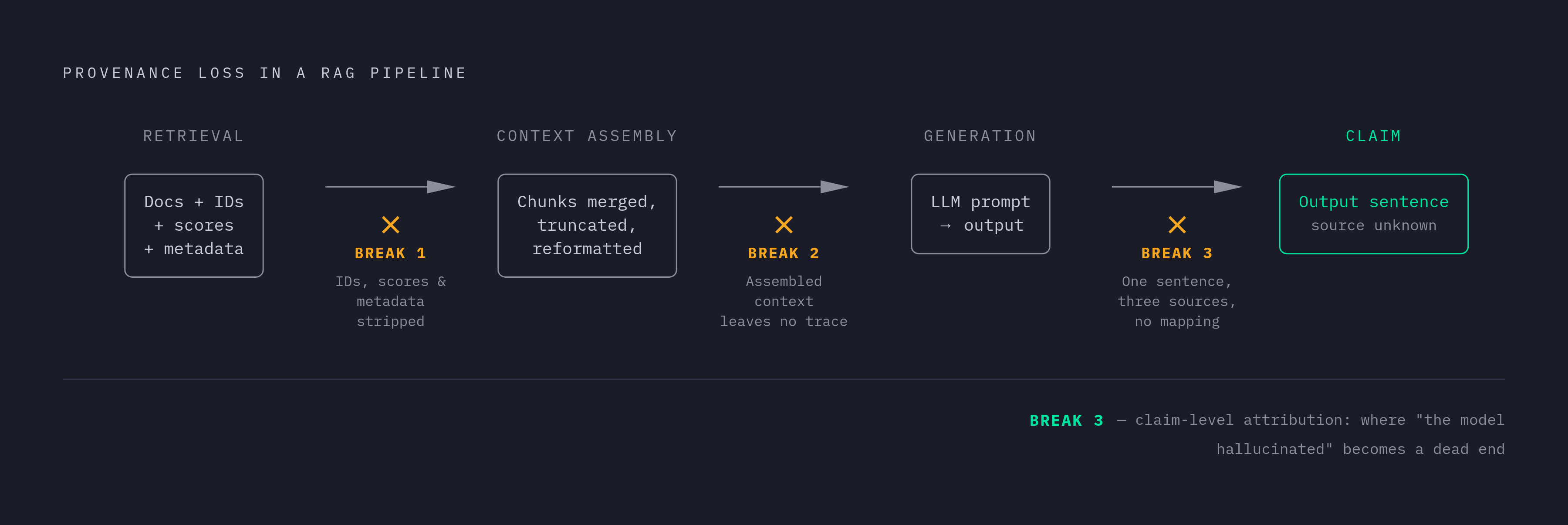
Provenance does not vanish in one place. It disappears at three specific handoffs that exist inside nearly every standard retrieval-augmented generation pipeline, and each handoff fails in a different way.
The first break point sits at the retrieval boundary. When a vector database returns a set of chunks, the application typically pulls out the raw text and discards everything else: document IDs, relevance scores, timestamps, source metadata. What reaches the prompt is a concatenated string of words with no identifying information attached. From that moment forward, even flawless tracing of the LLM call itself cannot connect any sentence in the response back to the document it came from, because the connection was severed before the call ever happened.
Context assembly is the second break point. Multiple chunks get merged, deduplicated, truncated, and reformatted before they reach the model, and if this stage goes untraced, the context the engineering team intended to send and the context the model actually received can diverge without anyone noticing. Truncation order and chunk ordering both shape model behavior, so reproducing a failure after the fact requires knowing the exact assembled context, not the context the pipeline was designed to produce.
The mapping between generation and claim is the third break point. A model can synthesize one sentence out of three separate retrieved chunks, blending information in a way that makes perfect sense as prose but leaves no record of which part of the sentence came from which source. Without claim-level attribution, a provenance record cannot show whether a specific statement in the output was grounded in retrieved material or was fabricated. This is the break that turns "the model hallucinated" into a dead end rather than a starting point for debugging.
What lineage tagging looks like at each stage of the pipeline
A workable lineage pattern does not require rebuilding the retrieval stack from scratch. It requires metadata that travels with every chunk from the moment it is indexed, and a tracing structure that preserves the chain of custody across all three break points described above.
At indexing, every chunk needs a defined metadata contract. That means a stable source ID, built as a hash tied to the document's content rather than its URL, so the identifier survives the document being moved or renamed. It means a version or timestamp marking when the source was last modified. It means a location reference, whether that's a URL, a file path, or a database record ID, and a chunk span recording the character or section offsets that locate the chunk within its source document. This metadata has to be attached at index time and carried through every downstream transformation without being stripped out along the way.
At retrieval, the step should be instrumented as a traced span recording the query sent to the vector store, the document IDs and relevance scores that came back, any metadata filters that were applied, and which source IDs ended up in the final context versus which were retrieved but excluded. OpenTelemetry has semantic conventions for generative AI workloads, currently in Development status, and under that model retrieval steps function as child spans nested within the same trace, preserving the parent-child relationship across the full pipeline. Observability platforms including Langfuse, Arize Phoenix, and LangSmith already support this kind of nested span structure.
At context assembly, each chunk can be wrapped with its source identifier directly inline rather than flattened into plain concatenated text, for instance as a tagged block carrying the document ID, chunk number, and relevance score alongside the text itself. This needs no additional external tooling to set up. When a user or an auditor later asks where a given claim came from, the trace can be searched for the cited document ID, and the original source can be pulled up directly.
At generation, the response can be decomposed into individual claims, each checked against the retrieved context to establish whether it is supported or unsupported. A lightweight version of this check passes each claim and the retrieved context to a smaller model and asks it to judge whether the claim holds up, which captures most of the practical value at a small cost in latency. Token Probability Attribution extends this idea further, mathematically attributing each output token's probability to seven distinct internal sources, Query, RAG Context, Past Token, Self Token, FFN, Final LayerNorm, and Initial Embedding, as a way of detecting hallucination in RAG outputs. That technique is available to teams that want finer-grained detection, though it is not a prerequisite for getting a lineage system working. What matters across all four stages is a single design principle: provenance cannot depend on the model reporting its own sources, because models misattribute their own reasoning. The pipeline itself has to maintain a chain of custody that reconstructs what was in scope at generation time without needing to re-run inference to find out.
Why the training-data lineage problem is structurally different from inference-time provenance
Training-data lineage and inference-time provenance sound like the same concern wearing two names, but they are separate engineering problems, built into different systems, serving different audiences, with different instrumentation needs.
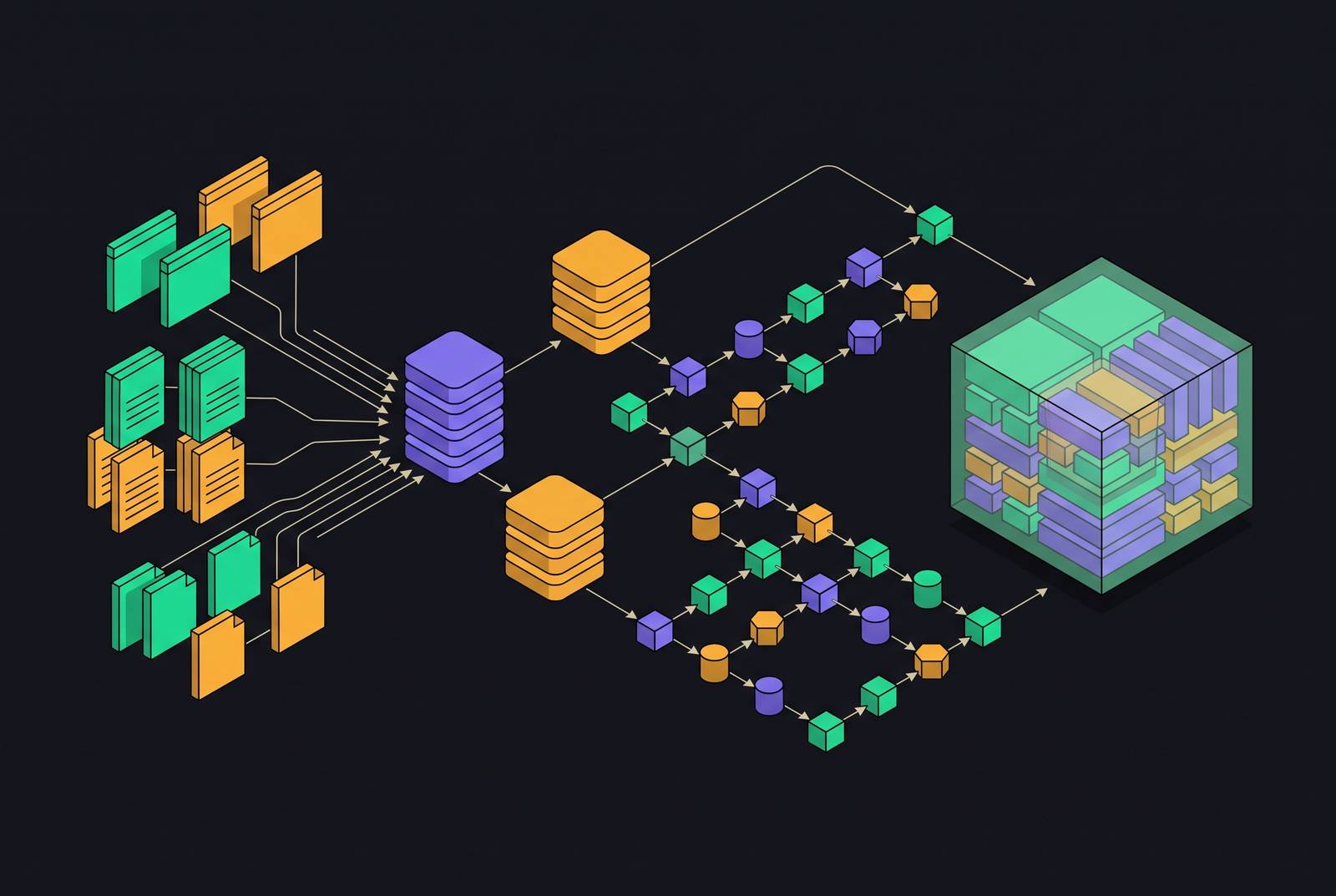
Training-data lineage belongs to model governance. A typical large language model training pipeline draws from many sources at once, web crawls, licensed datasets, internal documents, curated corpora, and pushes each of them through multiple transformation stages: language detection, deduplication, toxicity filtering, quality scoring, domain balancing. These multi-stage pipelines generate lineage graphs considerably more tangled than anything found in traditional data warehousing, with branches, merges, and conditional filters applied at nearly every stage, so that reconstructing what happened to a given piece of data becomes close to impossible after the fact without systematic tracking built in from the start. A complete system for tracking this kind of lineage needs five components: a source registry and provenance catalog recording origin, license, collection date, known limitations, and owner; a transformation log capturing what was applied and with what configuration; dataset versioning that preserves immutable snapshots at each stage; ownership attribution identifying who approved each source and who signed off on the final dataset; and impact analysis that traces which models and which predictions are affected when a given source later changes. Most product teams building on third-party foundation models have limited visibility into any of this. They depend entirely on what the model provider chooses to disclose.
Inference-time provenance belongs to product engineering, and it is the layer this piece has been describing all along. Any team building on top of a language model through retrieval-augmented generation, tool use, or multi-step agent workflows can take ownership of this layer directly, without needing access to the model's training history. Debugging failures happens here. Compliance audits get satisfied here. This is the layer where a product team has direct control over the instrumentation, which is reason enough to focus engineering effort on it rather than waiting on visibility into a training process that sits outside the team's reach.
A related complication appears once data science workflows span multiple libraries and frameworks, since the representation of "lineage" is often tightly bound to the specific data model or manipulation paradigm a given library uses. One proposed solution, called XProv, addresses this by combining low-level physical lineage tracking with a higher-level intermediate provenance representation, annotating library function calls with the types of lineage relationships they could generate, so that lineage can be reasoned about across library boundaries rather than within just one. It illustrates how quickly lineage tracking gets complicated once a pipeline spans more than one system, a complexity web knowledge pipelines will meet again at the tool-call layer discussed below.
Provenance Problems in the Web Source Layer
Internal document corpora are hard enough to track. Web sources are categorically harder, because the content sitting at a given location, and the authority of that content, can both change between the moment it is retrieved and the moment an auditor later asks about it.
The first complication is freshness and mutation. A stable source ID has to be tied to a document's actual content rather than to its URL, because a page at the same address may contain entirely different information a day later. Without hashing the content at the moment of retrieval, a provenance record cannot tell the page that was actually read from whatever page currently exists at that same URL. Web-grounded pipelines exist because a model's training data alone cannot substitute for live, time-sensitive factual information, and that same timeliness makes the provenance burden on these pipelines heavier rather than lighter.
The second complication is authority. Web-search-augmented language models face a trustworthiness problem that internal corpora simply don't present, because a malicious or low-authority webpage can be retrieved and cited by the model as though it carried the same weight as a verified source. Research on endorsement vulnerability in web-augmented language models confirms this attack surface is active rather than theoretical. Provenance infrastructure has to track source authority alongside source identity, recording the retrieval rank, the domain, and whatever quality signals were applied at the moment of retrieval, so that a citation chain can be audited for trustworthiness and not just traced back to a location.
The third complication is compounding across multiple hops in an agentic workflow. A modern AI agent's context draws from system context, session context, memory, artifacts, and on-demand retrieval all at once, and when that agent calls a web search tool several times across a single session, provenance has to accumulate across every one of those calls rather than reflecting only the final result. The Model Context Protocol is emerging as a standard interface for how agents invoke tools, whether those tools reach file stores, databases, or the web, and it complements retrieval-augmented generation rather than replacing it. Lineage instrumentation has to extend out to that tool-call layer. Stopping at the boundary of the context window leaves every earlier hop in a multi-step session untracked.
How SERP APIs and Scraping Tools Break the Provenance Chain
The two most common approaches to pulling web content into a pipeline, search APIs that return search-engine results and tools that scrape pages directly, don't just make provenance inconvenient. They sever the chain of custody at the exact point where retrieval happens, because neither one returns the metadata that lineage tracking depends on.
A search API that returns search-engine results typically hands back metadata like titles, snippets, and URLs, a pointer toward content rather than the content itself. From a provenance standpoint, the chain breaks the moment that pointer is treated as a substitute for the source, because no source metadata travels alongside it through the rest of the pipeline. A snippet carries no stable content hash, no chunk span, no retrieval timestamp tied to the text the model actually saw. It is a reference to a location, one that may no longer contain whatever the snippet originally described.
A scraping tool retrieves the full raw page, which solves part of the problem, but it enforces no metadata contract of its own. The fields lineage requires, a stable source ID, a version, a chunk span, any quality signals, have to be added afterward by whatever pipeline consumes the scraped content, and most teams never build that step. Scraping also breaks under ordinary real-world conditions: a page's layout changes, JavaScript rendering interferes, anti-bot measures trigger, rate limits kick in. Each of these produces a silent gap in the provenance record rather than a clear error a team can catch and investigate.
A newer category of search APIs built specifically for AI consumption tries to close part of this gap by performing context-aware filtering, content extraction, and ranking before results are ever returned. That reduces the integration work a team has to do, but it introduces its own trade-off: when a pipeline can't show which passages were filtered out, why one result ranked above another, or what the original document actually said before processing, it cannot hold up under an audit. The abstraction that makes retrieval easier is the same abstraction that makes lineage harder to reconstruct, unless the API is deliberately built to return provenance metadata alongside whatever processed content it hands back.
Benefits of Owning the Full Data Pipeline
Provenance guarantees at production scale require every stage, crawl, extraction, chunking, ranking, retrieval, to sit under one continuous chain of custody. A pipeline assembled out of wrapped third-party services can approximate parts of this, but each wrapped boundary is a place where metadata has to survive a handoff it was never designed for, and the stable source IDs, chunk spans, and quality signals described earlier in this piece depend on nobody dropping that metadata along the way. The crawl step gives a team control over the exact moment content is hashed and versioned. Owning the extraction and chunking steps means the metadata contract established at indexing can be enforced rather than hoped for. Owning retrieval and ranking means the distinction between what was retrieved and what was actually included in the final context, the detail that debugging a failure depends on, gets recorded rather than discarded. None of this is a preference for cleaner engineering. It is what a lineage system built from indexing through generation actually requires in order to answer, on demand, what the model read before it answered.