Search API Reliability and Fallback Patterns for Production AI Systems
Build fallback stacks and latency budgets to make AI search retrieval production-ready.
A web search API for AI agents and RAG pipelines must deliver reasoning-ready content with predictable latency, verifiable freshness, and stable responses under concurrent load. Search API reliability is therefore an infrastructure engineering problem. Production systems need planned latency budgets, layers of fallbacks, and checks on content quality because even a successful API call can leave an agent without sound evidence.
Why search API reliability is an infrastructure problem, not a provider choice
An agent can work in a demo and fail the first time it needs live information. The model may still produce a fluent answer, but fluency cannot repair weak or stale retrieval. Retrieval is the primary quality determinant because it supplies the premises from which the model reasons. When those premises are wrong, a stronger model can make the resulting error look more convincing.
Three retrieval architectures produce distinct failure signatures, namely raw SERP access, search-plus-extraction, and grounded synthesis. SERP-only systems return metadata and links. Search-plus-extraction can deliver readable content from the wrong documents. Grounded synthesis can produce confident answers while obscuring provenance when synthesis severs the connection between a claim and its source. These differences matter because changing a provider within the same architecture does not, by itself, remove the architecture’s failure mode.
The mismatch is clearest when discovery output is treated as finished retrieval. A list of URLs needs extraction before an agent can use it as evidence, which adds work and another point where retrieval can fail. Seltz owns its full data pipeline and delivers context-engineered content that is filtered and ranked for LLM reasoning. That approach removes the agent’s secondary extraction burden. The architecture determines who is responsible for turning relevant links into evidence the agent can use.
How production agent load exposes retrieval weaknesses that testing never surfaces
Concurrent agents expose weaknesses that isolated requests can hide. A typical agent loop makes three-to-ten search calls per task, so a few tasks running at once can cause bursts of retries and partial failures. Those failures build on each other across the loop and spread beyond a single request. The unit of diagnosis is the task’s retrieval path.
Freshness failures are especially hard to recognize because they do not announce themselves as errors. If retrieval says that a rate or guideline is X when it is Y, the model reasons from X without necessarily flagging the discrepancy. Client-rendered pages can return partial or empty content to basic fetchers, while successful scrapes can still contain headers, menus, disclaimers, and duplicate navigation. That material consumes the context window without supplying the evidence the agent needs.
Response structure creates another dependency. Inconsistent schemas make downstream ranking, chunking, and citation logic brittle because those components depend on predictable input shapes. A SERP API can find links as expected while the extraction system that follows it fails to return content the agent can use. The resulting weakness sits between services, where neither successful search nor successful fetching establishes that retrieval succeeded. Taken together, burst traffic, stale evidence, incomplete extraction, and unstable schemas explain why production retrieval requires more than relevance on a test query.
Latency budgeting as a first-class design constraint in retrieval pipelines
Retrieval latency needs the same deliberate budgeting that engineers apply to memory or an LLM’s token window. In an agent loop, per-call overhead accumulates across the task, so a search benchmark is not a complete measure of user-visible delay. The budget must cover query handling, fetching, extraction, and reranking. Embedding, retrieval, reranking, and generation also demand different compute profiles. A retrieval overrun consumes time that the rest of the pipeline still needs.
This makes budget allocation an architectural decision. Engineers need to establish how much of the per-call allowance goes to finding material and how much goes to turning it into usable context. Seltz offers end-to-end delivery of machine-ready content, which changes how that time is split by removing the secondary extraction layer. Less time and context spent on preparation leaves more room for the reasoning stages that determine answer quality. The relevant comparison is the complete path to usable evidence.
Stable, general-knowledge queries can bypass live retrieval to save latency and tokens. Queries should go to live retrieval when they depend on changing facts, facts outside training data, or information the user expects to be current. Predictable latency under concurrent load is then a reliability requirement, and any fallback architecture must account for the time it consumes as well as the availability it restores.
The four fallback patterns that make retrieval resilient under load
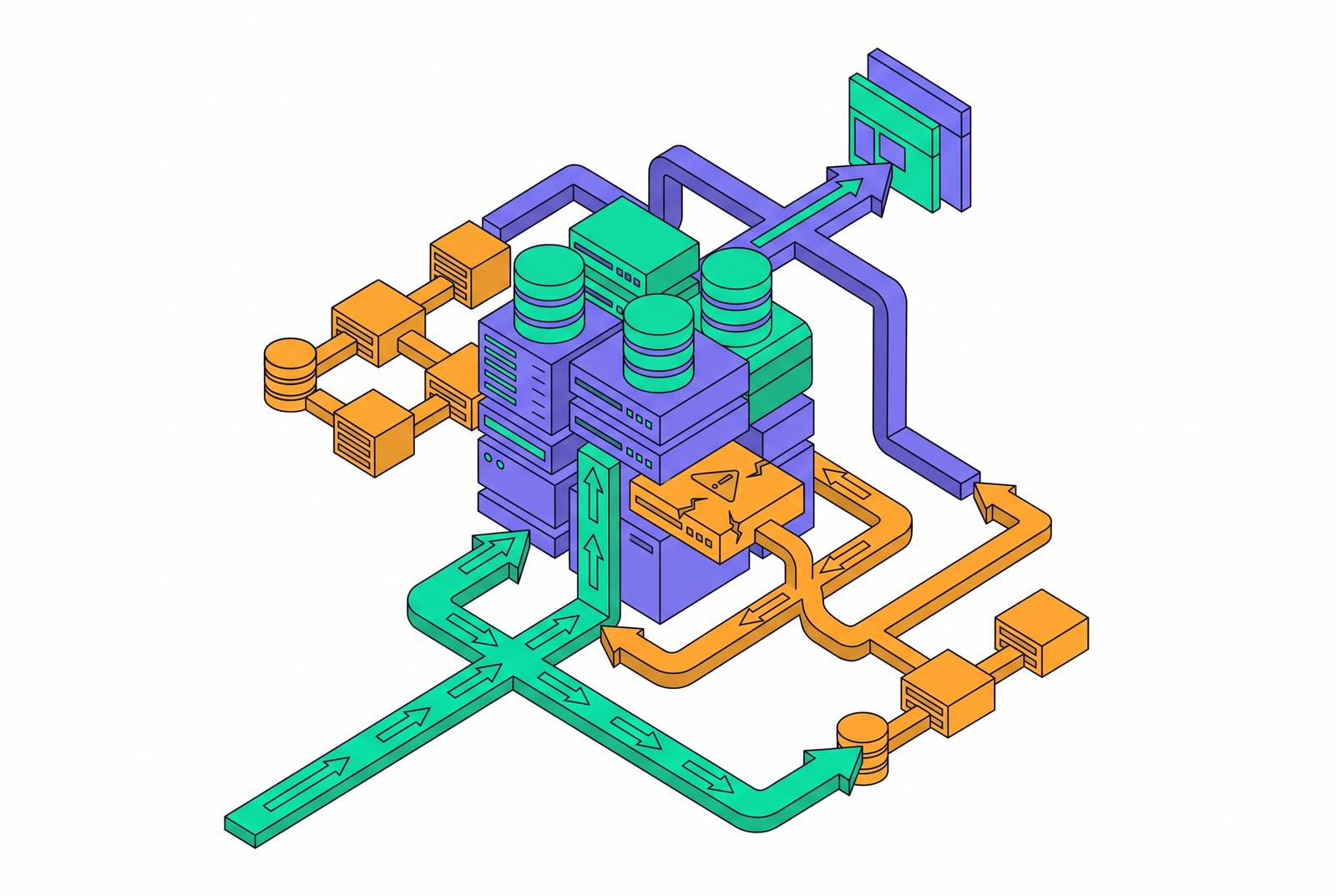
Production retrieval needs a fallback stack. Transient errors, sustained outages, quality failures, and irrecoverable tasks require different responses at different failure timescales. Retries address a temporary interruption, while circuit breakers stop repeated work against a failing path. Provider fallbacks offer another route, and dead letter queues preserve irrecoverable work, with all these patterns working together to cover the full set of failures.
The first pattern is exponential backoff with jitter for transient failures such as rate limits and network timeouts. Backoff spaces retries. Jitter prevents multiple agent instances from synchronizing their retries into a thundering herd. This distinction matters under burst traffic, where identical retry behavior can amplify the original interruption. Because retries consume time, their place in the stack must also respect the retrieval budget.
The second pattern is a circuit breaker that recognizes failures beyond HTTP status. Cox Automotive implemented cost and conversation-turn circuit breakers that stop an agent and hand off to a human when a conversation hits the P95 cost threshold or exceeds around twenty back-and-forth turns. A 200 OK response that violates schema, fails a semantic invariant, or produces an unsafe downstream action is a failure. The classic closed, open, and half-open circuit breaker needs to see quality signals as well as transport errors.
The third pattern is a multi-provider fallback chain for sustained primary failures. Retries try to get the current path working again, while fallback changes the path when the primary is still unavailable or unreliable. But sending every failed request straight to a backup can overwhelm it when an outage affects the whole system. Circuit breakers must therefore gate fallback traffic. The fourth pattern, a dead letter queue, captures irrecoverably failed retrieval tasks for human review instead of silently dropping them or allowing bad state to enter the agent’s reasoning.
Content quality as a reliability property and why successful calls can still fail
A retrieval system fails the AI task when it returns content the model cannot reason soundly from, even if uptime and latency are within acceptable limits. Content fitness must therefore be engineered into retrieval. Filtering, ranking, and shaping evidence for LLM consumption are part of that engineering work. Raw HTML and SERP snippets are not substitutes for prepared context. Treating them as finished input moves an unresolved retrieval problem into the model.
For indexed RAG, the reliable flow begins with chunking and indexing documents offline. Search then returns already-chunked content, which is ranked or filtered before the top chunks reach the model with citations. Freshness filtering belongs in this flow, but recency alone does not establish quality. A recently available document can still be the wrong evidence for the question.
Relying on a single top-ranked list brings systematic bias and can cause correlated errors. Preserving citations and favoring APIs that expose source diversity make retrieval more auditable while reducing that dependence. Provenance also keeps synthesis connected to evidence rather than allowing a polished answer to conceal the source of its claims.
Domain depth sets a further limit on what open-web retrieval can establish. Professional work in finance, medicine, and research depends on sources including regulatory filings, clinical trial databases, and structured economic data that are not reliably crawlable from the open web. An open-web-only agent cannot factually answer questions that depend on unavailable domain evidence. As with the earlier freshness failure, the API call can succeed while the agent lacks the premises it needs to reason soundly. If an index is not synchronized with its source systems, even relevant domain material can become outdated in a way that is indistinguishable from correctness without systematic evaluation.
Enterprise retrieval infrastructure and the requirements for ownership, access, and audit
Enterprise retrieval operates within governance constraints that performance improvements cannot override. Data ownership, access control, and audit coverage determine which architectures are usable in the first place. A fast retrieval path is not acceptable if it turns the AI platform into a channel for data leakage. A reliable fallback also fails the organization if the services it depends on break its rules for data ownership. These constraints belong in infrastructure design.
Enterprise-scale RAG has three baseline needs, namely real-time access across live platforms without ingestion delays, a semantic layer for correctly retrieving relationally interconnected data, and granular access controls. These needs address different parts of the same problem. Current data is insufficient if retrieval loses the relationships that give it meaning. Correctly connected data is still unsuitable if the platform exposes it beyond the permitted access boundary. Organizational reliability requires both useful evidence and control over who can retrieve it.
SOC 2 Type II auditors now scrutinize AI-specific controls under existing Trust Services Criteria, extending examination to model versioning, training data governance, and drift monitoring. This scrutiny requires evidence that controls operated effectively over an extended period. Access logs alone therefore do not establish how an AI system is built, monitored, and maintained. When infrastructure wraps third-party retrieval services, its governance and audit guarantees depend on how those services are run, while owning the pipeline end-to-end gives it control over those guarantees. Enterprise teams should not have to choose between retrieval speed and data ownership, because both are baseline design requirements.
What should a web search API for AI agents and RAG pipelines provide
The provider standard follows from the full path between a query and trustworthy evidence. Content must arrive machine-ready, already extracted, filtered, ranked, and shaped for LLM consumption rather than requiring another system to process raw HTML or snippets. Latency must be predictable under concurrent agent load as well as acceptable on a demo request. Response schemas must be stable because downstream ranking, chunking, and citation logic depend on them.
Freshness must also be verifiable through information about when content was indexed. Full-pipeline ownership is necessary to avoid assembling critical guarantees from third-party wrappers with uncontrollable failure points and governance gaps. Security and data ownership must be first-class properties. These provider responsibilities establish the conditions under which the application’s fallback stack and latency budget can work predictably.
Within this standard, Seltz is a purpose-built Web Search API that owns its data pipeline end-to-end and delivers context-engineered web content with sources for real-time AI reasoning. Its design targets the depth, speed, and reliability needed by autonomous agents and production LLM systems. That makes it a relevant option for teams seeking a web knowledge infrastructure layer. The distinction is architectural, but a product category is not itself proof that a deployment’s requirements are met. Engineers should use machine-ready delivery, predictable latency, verifiable freshness, schema stability, pipeline ownership, and security as an acceptance checklist.