Rate Limiting and Cost Management for Agent Web Search at Scale
One query fans out into dozens of API calls, turning cost control into a core engineering challenge.
Rate Limiting and Cost Management for Agent Web Search at Scale.
Why a single query becomes dozens of API calls in an agent system
A single question typed into an agent product does not map to a single API call anymore, and that gap is the whole story of why cost control at scale has become its own engineering discipline. What looks like one request on the front end triggers a reasoning loop on the back end: the system breaks the question into smaller sub-questions, pulls in context, calls out to tools, checks whether the answers hold up, and retries the parts that don't.
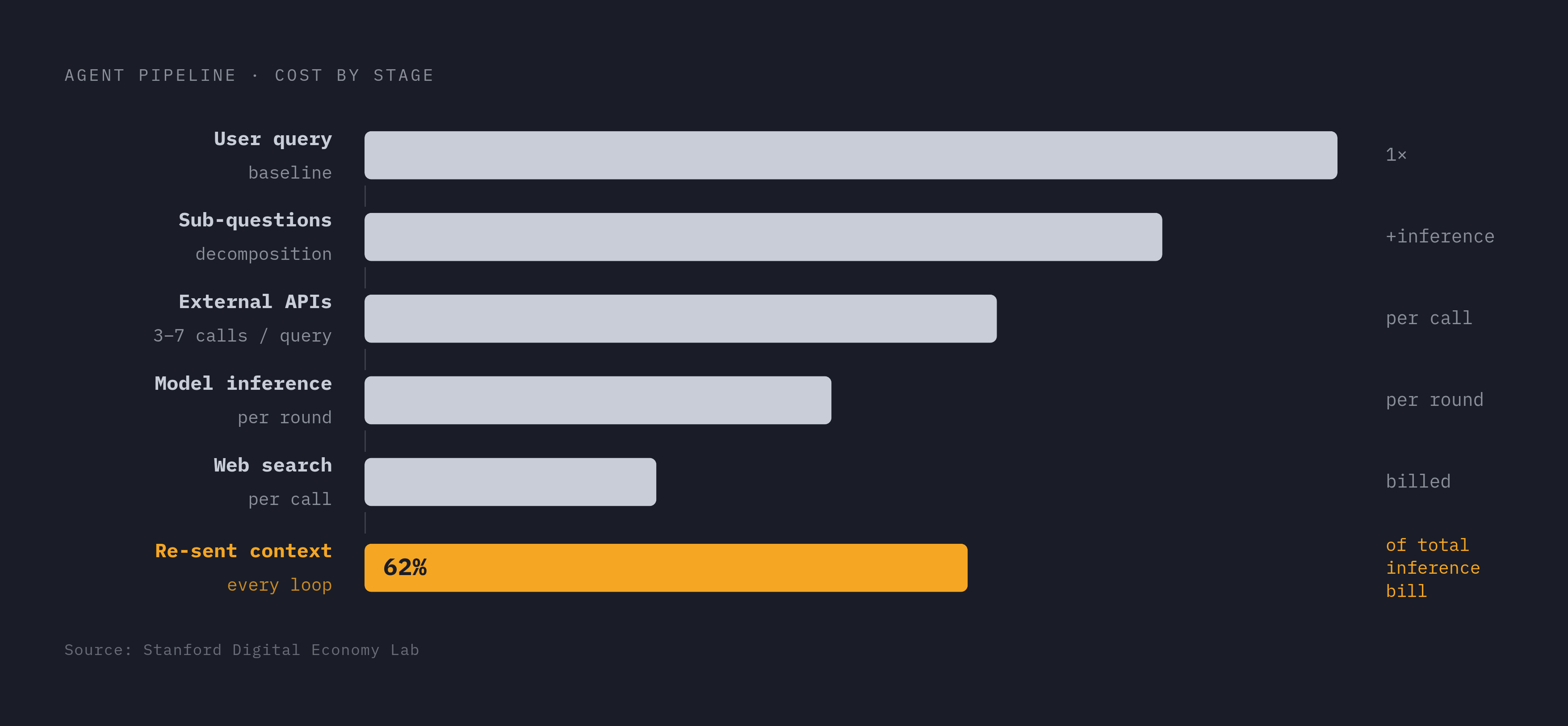
Each of those hops carries its own bill. Inference from the language model costs money, the web search call costs money, memory and embedding lookups burn compute, and every state write adds its own small tax. None of this is exotic; it's just what agentic retrieval looks like in practice. The model decides which sub-queries to ask, chooses which retrieval tools to fire, sometimes runs several in parallel, checks the results, and loops again if something doesn't check out. Every one of those loops is another round of inference and another round of search calls, and none of it appears as a line item until the bill arrives. In the concrete fanout anatomy from the.xyz source, a single query can fan out into 3–7 external API calls, and a complex multi-step query involving flights, hotels, visa, and weather hits 5–7 operations.
Agent workload economics versus falling token prices
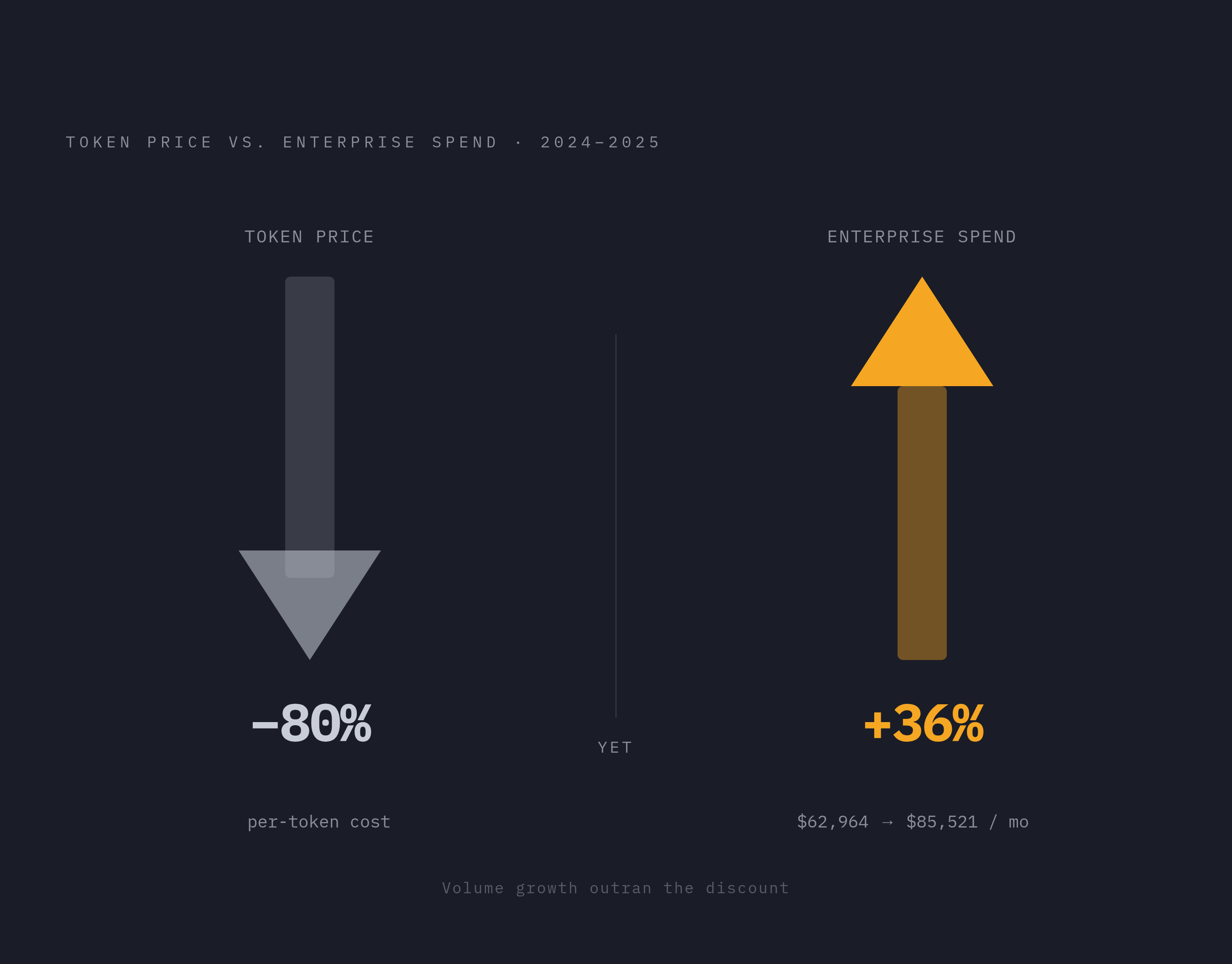
The assumption that cheaper tokens will eventually solve agent cost growth doesn't survive contact with the data. Token prices fell by roughly 80% year over year across 2024 and 2025, and enterprise AI spend rose anyway https://fast.io/resources/ai-agent-rate-limiting-strategies/. Average monthly enterprise AI spend hit $85,521 in 2025, up 36% from $62,964 the year before https://fast.io/resources/ai-agent-rate-limiting-strategies/. Model API costs and experimentation alone eat up 30 to 40% of the total AI budget at most organizations https://fast.io/resources/ai-agent-rate-limiting-strategies/.
Uber's Claude Code rollout is the clearest illustration of what that curve looks like inside a real company. Adoption went from 32% to 84% of its 5,000-engineer organization between December 2025 and March 2026, and by April the entire annual AI budget was gone https://fast.io/resources/ai-agent-rate-limiting-strategies/. Monthly API costs for power users ran between $500 and $2,000, with the average engineer at $150–$250. Nobody set out to overspend; the tool simply got good enough that engineers used it constantly, and usage at that density adds up fast.
Part of what makes agent spend so much harder to forecast than plain chatbot spend is what gets sent back to the model on every single call. Stanford's Digital Economy Lab found that re-sent context, meaning system prompts, tool definitions, and state history retransmitted across repeated model calls, accounts for 62% of total agent inference bills. That's the invisible cost driver most teams miss when they budget off token price alone: the price per token fell, but the number of tokens re-sent per task climbed faster than the discount.
Why request-count rate limits fail on agent web search traffic
Traditional rate limiting counts requests inside a time window and cuts a client off with an HTTP 429 once it crosses the line. That model was built for REST APIs doing CRUD operations, where one request costs roughly the same as the next. Agent traffic breaks that assumption in three distinct ways.
First, request cost varies wildly. A 50-token prompt and a 10,000-token prompt both register as exactly one request under a count-based limiter, even though their compute cost, latency, and provider charges can differ by orders of magnitude. A consumer can therefore blow through an entire budget while staying comfortably under a requests-per-minute cap. Second, agent traffic is bursty and hard to predict. Third, agents and attackers can look identical to a blunt limiter. High-volume, bursty, automated traffic from a legitimate agent resembles a DDoS pattern or scraping bot closely enough that a request-count limiter may block the agent while letting a slow, low-volume abuser through untouched.
Retry behavior compounds all of this. When an agent hits a 429 and fires the same request again immediately, with no delay, it adds load to an already-strained system and often produces another 429, and in the worst case a misbehaving agent gets stuck in an infinite retry loop until the provider bans its IP entirely. Layer on the fact that most production agent stacks call multiple models and multiple search providers at once, each with its own rate limit and its own pricing, and a single "requests per minute" number stops meaning anything useful across the whole system.
Token-aware rate limiting as the foundation of agent cost control
Fixing this starts with changing what gets counted. Token-based rate limiting tracks actual resource consumption, meaning tokens processed, compute time used, and dollar cost incurred, rather than the raw number of requests that came in. A consumer gets a token budget instead of a request quota, and that budget reflects what the work actually costs rather than how many envelopes it came in.
The mechanics are simpler than they sound. Prompt tokens cover the user's message, the system prompt, tool definitions, and any retrieved context. Completion tokens cover what the model generates back. Most LLM providers hand back token counts directly in the response, OpenAI's usage.total_tokens field being one common example, and a rate limiter reads that number after each call and subtracts it from whatever allowance the consumer has left.
This also opens the door to tiering that actually matches how organizations use these systems. A free-tier developer gets a small daily token allowance, while an enterprise customer running production agents gets an allowance orders of magnitude larger, and the whole thing gets enforced automatically by tying limits to metadata already attached to the API key.
Per-tool budgets and cost-aware throttling for web search specifically
Not every tool call costs the same, and treating them as if they did is where a lot of budgets quietly leak. A file read is close to free. A web search call is billed. Lumping all of that under one token budget hides the actual shape of spend, because the agent has no signal telling it that one tool is cheap to call ten times and another is expensive to call even once.
The fix is to give each tool category its own quota: file reads stay effectively unlimited, web search gets a defined cap, embedding lookups get a separate cap of their own, so the agent can't burn through its entire web search allowance chasing low-value exploratory queries. That structure works even better when it's paired with cost awareness baked directly into the system prompt: check cached knowledge first because it's free, escalate to a cheap API next, and only call the expensive web search tool once the user has shown real task intent. A travel-agent implementation from nowah.xyz embeds exactly this logic in its model instructions.
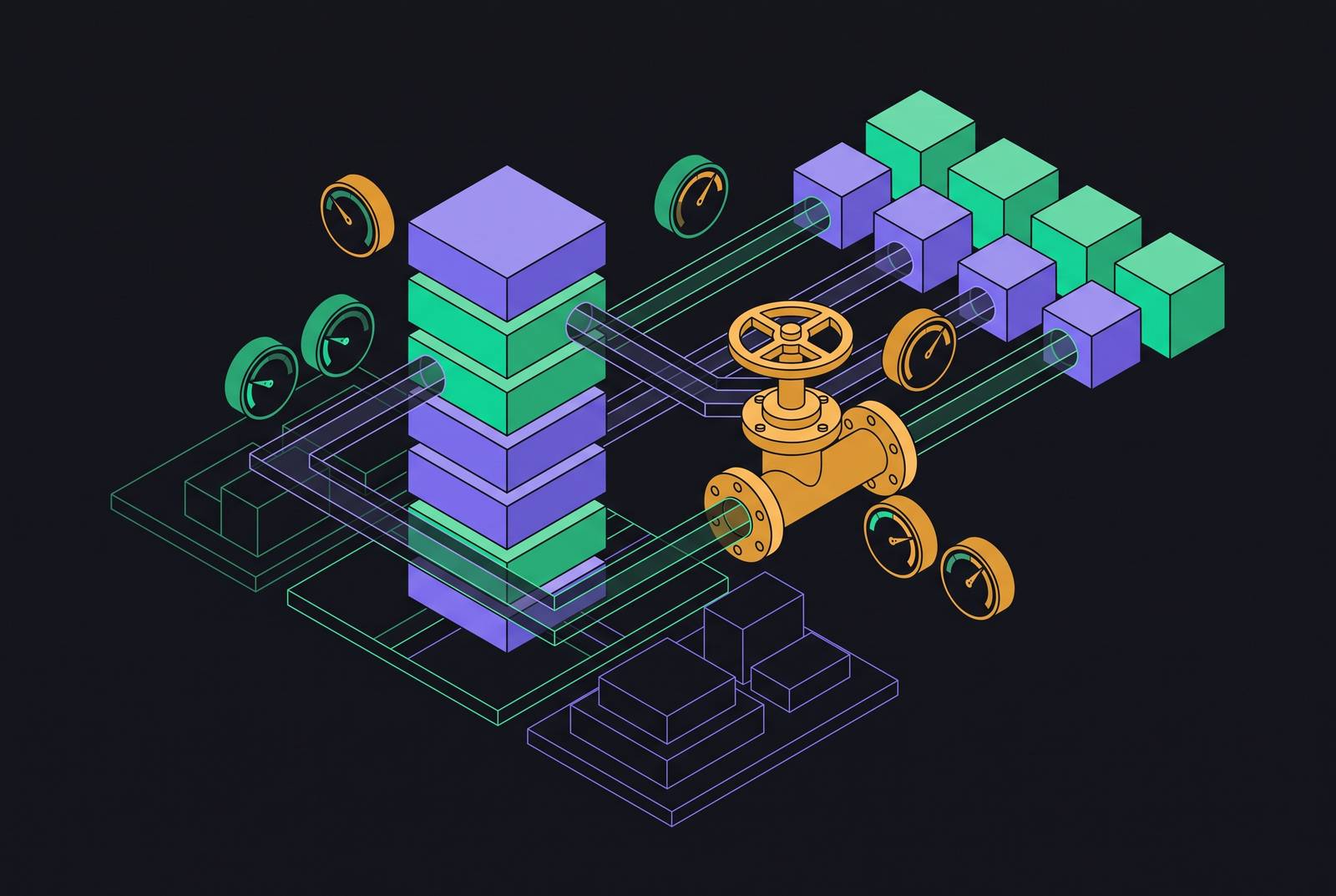
Managing web search specifically also means watching more than one provider at once. A well-built system tracks current usage against each provider's rate limit and checks accumulated cost against a budget threshold in parallel. When one provider starts approaching its limit, traffic routes automatically to an alternative, and the user never sees the handoff. Response quality gets monitored the same way: if a provider starts returning degraded results, traffic routes away from it regardless of how much quota headroom is left, because a cheap, bad answer isn't actually cheap once it triggers a retry.
Budget guards: enforcing per-task spending limits before cost accumulates
Rate limits and budget guards solve different problems and both are necessary. A rate limit controls how fast calls come in; a budget guard controls the total dollar cost of a task no matter how that cost accumulates across many small calls that each individually stayed under the rate limit.
The pattern is straightforward to describe, if not always straightforward to build correctly: assign a dollar budget to a task the moment it's created, compute cost incrementally after every single call since token counts come back in every API response, multiply by the provider's price, and add the running total to the task record. Once that running total hits the budget, the system halts the task or escalates it for a human decision, rather than letting it keep going.
Checking spend only at the end of a task catches nothing, because by the time the task finishes, whatever damage it did is already done. The a16z infrastructure survey puts hard numbers on exactly this failure: the median runaway-cost incident cost an organization $1,100, and the worst recorded case ran up $34,000 in a single weekend https://fast.io/resources/ai-agent-rate-limiting-strategies/. Neither number moves if the check only happens after the fact.
Setting cost targets up front changes the design conversation. A target of under $0.05 for a simple support query and under $0.20 for a more complex analytical one forces explicit decisions about which model handles which step and how deep the retrieval goes, made at design time rather than discovered on the invoice https://fast.io/resources/ai-agent-rate-limiting-strategies/.
Caching and model routing as structural cost reducers
A meaningful chunk of agent spend disappears through caching without touching quality. Anthropic and OpenAI both cache the static prefix of a prompt, meaning the system message, tool definitions, and few-shot examples that repeat identically on every call. Anthropic charges cached input tokens at 10% of the normal rate with a five-minute time-to-live, and OpenAI applies a 50% discount automatically. The savings compound fastest for agents that send the same long system prompt on every iteration of a loop, which is exactly the pattern agentic RAG produces.
Application-level caching of search results adds a second layer on top of that. Slower-moving information, like weather patterns, visa requirements, or general reference facts, can run in a cache for a full 24 hours with no live search call needed at all. Caching repeated searches this way cuts API costs by 30 to 40%, and for high-frequency query patterns, popular routes or common topics that get asked constantly, the hit rate climbs even higher.
Model routing also matters just as much. A healthy production stack runs roughly 60% of its calls through cheap models, 30% through medium-tier models, and only 10% through premium models, routing by what the task actually needs rather than defaulting every call to the most capable (and most expensive) option available https://fast.io/resources/ai-agent-rate-limiting-strategies/. Cheap models handle classification, routing decisions, and simple extraction just fine. Premium models get reserved for multi-hop reasoning and final synthesis, the steps where capability actually matters. Caching and routing are both achievable inside a single sprint of engineering work, and together they routinely cut cost by 70 to 85% against an unoptimized baseline https://fast.io/resources/ai-agent-rate-limiting-strategies/. A route-level cache stores web search results for the same query for a defined window, such as 60 minutes for flight routes, so any agent or user hitting the same query within that window gets cached results instantly, marked with a freshness timestamp.
Exponential backoff, jitter, and circuit breakers for external search provider limits
Retrying immediately after a 429 is the worst response: it worsens the overload, triggers further 429s, and, when multiple agents retry simultaneously, creates a retry storm that can result in IP bans from the provider.
Exponential backoff is the baseline fix, and it's simple: double the wait time on each successive retry, so the system backs off harder the longer the failure persists rather than hammering the same door faster. Without jitter, agents that all failed at the same moment tend to retry at the same moment too, recreating the exact synchronized burst that caused the throttling. Circuit breakers close the loop: once a provider's failure rate crosses a threshold, the system stops sending it traffic entirely for a cooldown period, rather than letting every new task discover the same outage independently. None of these are exotic techniques. They're the same patterns distributed systems have used against unreliable downstream services for years, just applied here to a provider landscape where the "service" is a search API charging by the call and the "failure" is a rate limit protecting its own infrastructure from exactly the kind of bursty, high-fanout traffic that agentic web search produces by design. Gartner projects that more than 30% of the increase in demand for APIs will come from AI and LLM tools by 2026 https://zuplo.com/learning-center/token-based-rate-limiting-ai-agents. Gartner projects that 40% of enterprise applications would embed task-specific AI agents by the end of 2026 https://fast.io/resources/ai-agent-rate-limiting-strategies/. Gartner reports that fewer than 5% of enterprise applications embedded task-specific AI agents in 2025 https://fast.io/resources/ai-agent-rate-limiting-strategies/. Fast.io reports that a single user query triggers 3–7 API calls to external providers https://fast.io/resources/ai-agent-rate-limiting-strategies/. Fast.io reports a free tier rate limit of 10 queries per hour for anonymous users https://fast.io/resources/ai-agent-rate-limiting-strategies/. Fast.io reports a free account rate limit of 100 queries per hour https://fast.io/resources/ai-agent-rate-limiting-strategies/. Fast.io sets a target cache hit rate of over 30% for customer support https://fast.io/resources/ai-agent-rate-limiting-strategies/. Fast.io sets a target cache hit rate of over 50% for FAQ-heavy use cases https://fast.io/resources/ai-agent-rate-limiting-strategies/. According to fast.io, a typical RAG pipeline retrieves top-50 candidates with hybrid search https://fast.io/resources/ai-agent-rate-limiting-strategies/. According to fast.io, reranking consistently improves answer quality by 15–30% on standard RAG benchmarks https://fast.io/resources/ai-agent-rate-limiting-strategies/. According to fast.io, reranking adds approximately 50ms latency https://fast.io/resources/ai-agent-rate-limiting-strategies/. A May 2026 MLOps Community benchmark cited by fast.io found that agentic pipelines paired with knowledge graphs reduced hallucination rates by roughly 62% across 47 production deployments versus naive setups https://fast.io/resources/ai-agent-rate-limiting-strategies/.