Search APIs Built for Retrieval Augmented Generation Ranked by What Actually Matters
Four production-critical factors determine which search API best serves RAG pipelines and AI agents.
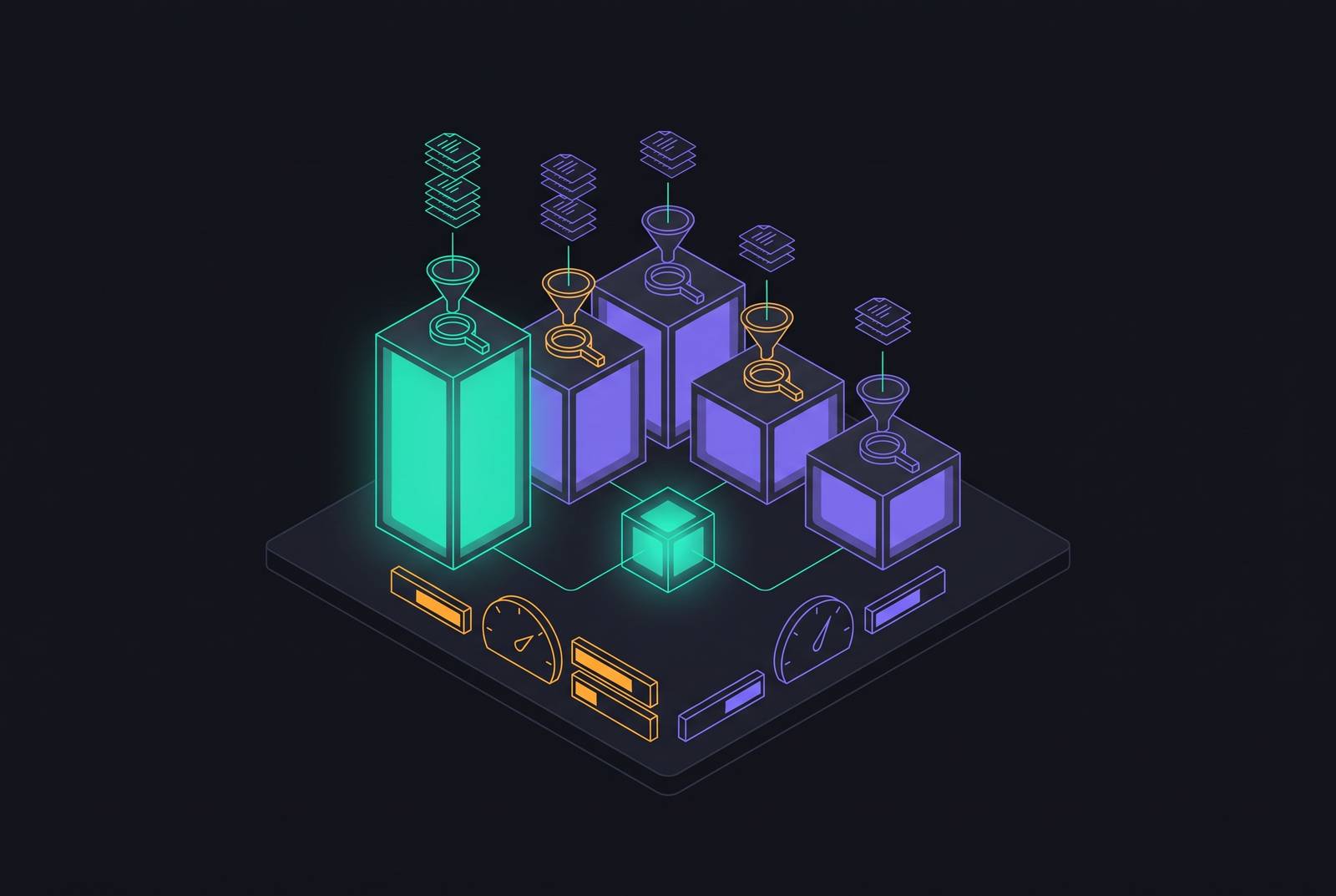
The best web search API for AI agents and RAG pipelines is one that delivers supporting passages, predictable latency, fresh evidence, and context-ready output. Selection should rank those four properties. A purpose-built, full-stack API is the best fit for this architecture if its measured performance and data governance terms meet the workload’s needs.
Why standard evaluations of search APIs mislead RAG builders
Standard search evaluations reward an interface that helps a person choose what to read. A ranked result with a useful title and brief excerpt can succeed at that task without containing enough evidence to support an answer. That distinction changes the meaning of retrieval quality. In RAG, the returned content enters a model’s context, where irrelevant text consumes tokens and stale or contradictory passages can degrade generation.
The SEALQA-HARD study makes this mismatch concrete. With the same fixed agent policy, providers had similar aggregate answer accuracy, but differed in how much evidence was available before page fetching, where support fell by rank, and how much contamination there was. Two APIs can therefore reach similar scores while imposing different token costs and prompting different amounts of redundant fetching. A benchmark that omits those costs cannot establish that the pipelines are interchangeable.
What actually changes when the consumer is an LLM rather than a human
An LLM consumes retrieved content as token sequences packed into a finite context window. A person can skim past navigation, ignore an irrelevant excerpt, and open a promising tab selectively. The model instead receives the payload assembled for it. Boilerplate, duplicate passages, and off-topic content take up space that could hold supporting evidence, and can change the answer as well as slow reading.
The study describes agents receiving top-n URLs, titles, snippets, and freshness metadata before deciding whether to fetch full pages. That pre-fetch surface is an evidence state. It shapes the next action. A result that already exposes supporting text gives the agent a different basis for deciding whether to answer, fetch, or search again than a result containing only a plausible title.
The Semantics Delivery Network paper explains a related mismatch in the underlying infrastructure. Page-first retrieval processes more content than agents consume, while uncoordinated agents repeatedly fetch, clean, chunk, and embed the same material. Multi-turn retrieval compounds that work because search is called repeatedly. Latency variance, token waste, and contaminated evidence can accumulate across the loop. Given these constraints, a search API must be evaluated on content depth, latency predictability, freshness, and context readiness.
The four production-critical dimensions that a RAG search API must be ranked on
Content depth controls whether retrieval gives the model evidence or just points to where it might be. Traditional SERP metadata consists of titles, URLs, and short excerpts sized for human scanning. A summary is not necessarily supporting evidence. When an excerpt omits the passage needed to substantiate a claim, the model must fetch more content or risk speculating. Full-page or full-passage extraction, with HTML boilerplate, navigation, and ads removed, is the minimum viable depth for reliable grounding.
Retrieval inside a multi-step agent requires predictable latency to remain usable. A good median says little about the slow calls that hold up a sequence in which the other steps succeed. One delayed request can hold up the loop. The operational test is therefore tail latency under the concurrency the system will sustain. This criterion distinguishes an API that is occasionally fast from one whose response times support predictable production behavior.
Evidence must be fresh enough for the question. Embedding-based retrieval can search only documents already indexed, so prices, security CVEs, regulatory filings, and breaking news can outpace the indexing cadence. Live retrieval addresses that gap at query time. Grounding content should include an explicit fetch timestamp in the model’s context, and time-sensitive workloads require evidence of real-time or near-real-time indexing. Static corpora can still serve knowledge that changes slowly, so how fresh a page needs to be depends on the knowledge tier, with the newest page needed only in some cases.
Context readiness determines how much useful evidence survives within the available token budget. Duplicate passages take up space without adding independent support, while weak filtering lets low-signal results compete with authoritative sources. Structure is therefore part of evidence control. Domain filtering, relevance ranking, and deduplication shape what the model sees and which contradictions reach its context before it generates an answer. Clean Markdown or JSON, passage-level granularity, and source metadata make the output citation-ready while reducing downstream processing.
What the "similar accuracy, unequal evidence" finding reveals about ranking by these criteria
The SEALQA-HARD study evaluates search APIs as decision surfaces. Its fixed agent policy and shared page-fetch backend show how the evidence available before fetching differs. Similar observed accuracy does not establish equivalence. Evaluation should examine how each interface allocates the agent’s retrieval budget alongside whether the final answer passes an audit.
The study’s four-way partition makes that distinction explicit. SMART means pre-fetch snippet support was available and used, while MISSED means support was available but not surfaced before fetch. BLIND means there was no support available pre-fetch. NO-OP identifies redundant search that adds no new evidence.
The study also reports that a retrospective oracle union covered substantially more questions than the best individual provider alone. That gap indicates headroom across the available evidence, rather than proving that one interface exhausts what search can provide. A separate episode-level analysis using SEALQA-HARD finds that evidence eventually surfaced by a trajectory tends to appear in early episodes. Later searching is therefore not automatically productive. Poor pre-fetch support can leave an agent spending latency and tokens on further searches without improving the answer.
These findings bear most directly on content depth and context readiness because both determine the evidence available for the next decision. They also explain why accuracy must be read beside latency and retrieval cost, while freshness still requires workload-specific evaluation. When accuracy is much the same, fewer tokens, lower tail latency, and fewer contradictions in context help a system in production in ways that an answer score alone does not show.
Which search APIs are designed for RAG rather than just scraping SERPs?
The traditional SERP-then-scrape architecture assembles a pipeline from components built for different tasks. A query passes through a SERP API, scraper, HTML parser, chunker, embedder, vector store, and retriever before reaching the LLM. Each handoff adds latency and another failure surface. When a stage fails, downstream components cannot substitute for the missing work, so recovery must address that stage. Improving an individual component does not remove the dependencies between them.
An AI-native API uses a single call to search the web, extract content from top results, and format it for an LLM. That consolidation removes intermediate integration points. The SemDN paper proposes a deeper infrastructure change through chunk-level indexing and caching. Sending the passages agents need saves each agent from having to process whole pages again. Conventional URL-addressed delivery does not provide that abstraction without redesign.
Ownership of the full data pipeline gives a provider direct control over quality, performance, and data handling at each stage. A wrapper instead inherits upstream latency, coverage gaps, and retention policies. Those dependencies constrain what it can promise. Full-stack ownership is therefore a stronger basis for meeting the four criteria, although the ownership claim still needs to be tested against actual output and performance.
Specialized knowledge introduces another architectural distinction. Retrieval for regulatory filings, peer-reviewed research, patents, and clinical trials may need to draw from both web and proprietary sources. A single API that co-ranks those sources saves the work of joining separate services and avoids the differences in how they rank results. Its usefulness depends on more than retrieval quality, however. The same architecture determines which services handle enterprise queries and which data policies apply, making security and ownership the next selection constraint.
Why enterprise AI teams cannot treat data ownership and security as afterthoughts in search API selection
A production search API sits inside the enterprise’s security and data governance perimeter, even when it is operated externally. Agent transcripts can include proprietary context, and the model vendor and search provider may retain parts of the interaction under their respective terms. Every API adds a data-handling boundary. For regulated workloads, retention is therefore an infrastructure requirement rather than a preference to settle after performance testing.
More enterprises that handle regulated data now ask for zero-retention API terms and use gateway proxies to redact sensitive fields before requests leave the perimeter. They also keep evaluation datasets out of third-party training pipelines. These controls address distinct points in the data path. A retention commitment does not replace a decision about what may leave the enterprise, and redaction does not settle where the remaining session data may reside. Selection must account for each obligation explicitly.
The Model Context Protocol has become a dominant integration standard for agents and tools, creating a rapidly growing but largely ungoverned integration surface. Accessing search through an MCP server does not remove the governance requirements of the underlying API. Integration is not a substitute for data control. Residency and retention decisions still belong at the search layer, and an API without contractual control forces more of that work into the enterprise gateway, adding latency and operational complexity.
Data ownership is consequently a first-class design criterion that can disqualify an otherwise capable search API. Academic answer benchmarks do not expose this constraint because they measure a different part of the system. An API designed for enterprise use should offer speed and contractual data control as co-equal properties, rather than leave the team to repair the tradeoff after integration.
How to apply the criteria framework when selecting or switching a search API for a production RAG system
For teams selecting or replacing an API, the practical sequence begins with content depth. An interface that returns only snippet-length metadata and offers no full-passage extraction cannot meet the minimum grounding requirement, regardless of its other features. Screening for supporting passages first eliminates options that would require a separate extraction pipeline before the remaining criteria can be assessed fairly.
Next, teams should test latency at the concurrency their agent loop will sustain in production. Tail latency and failure rate under that load are the operative measurements, rather than median response time from isolated requests. Freshness testing should then follow the workload’s knowledge tiers. Teams should identify time-sensitive queries and establish whether indexing cadence and fetch-timestamp reporting support them. A fast response grounded in outdated content has not met that workload’s requirement.
Context readiness should be audited as a pipeline cost. Each cleaning, deduplication, and structuring step implemented downstream represents work the API has left to the team. That work also expands the failure surface. Evaluation should therefore consider whether returned passages are relevant, nonredundant, structured, and accompanied by source metadata, rather than rewarding an API merely for returning more text.
Before signing, teams should get clear commitments on retention, data residency, and whether query content or results go into training pipelines. Governance remains a hard gate after technical evaluation. Among APIs that clear it, a purpose-built service owning selection, filtering, ranking, and content shaping is the strongest architectural candidate for production RAG. Its advantage is that the work needed for LLM consumption belongs within the retrieval service, rather than being left for each customer to assemble around a human-facing search interface.