Metadata Filtering in Vector Databases for RAG
Filtering metadata before vector search prevents irrelevant results from reaching your model.
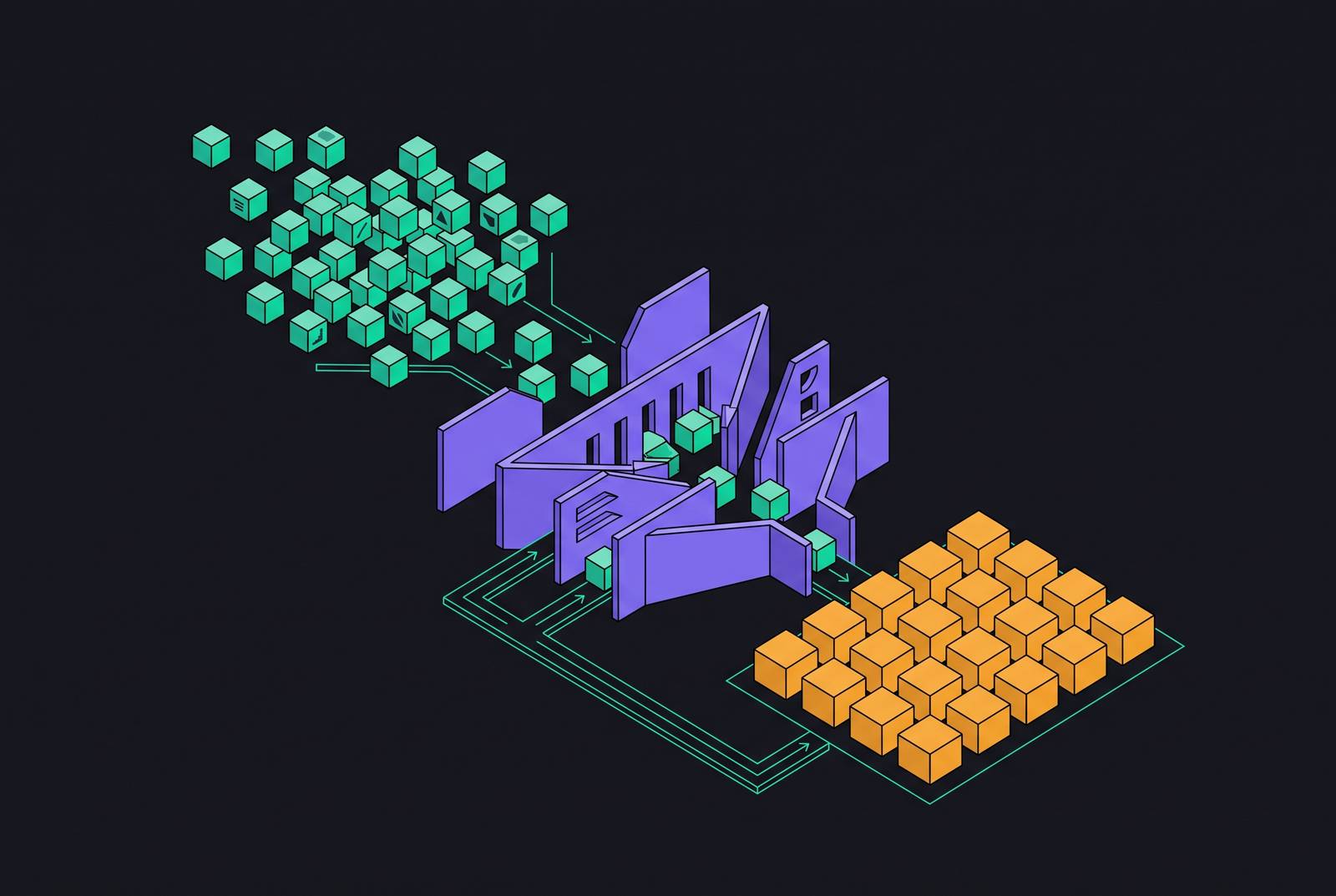
Metadata filtering is what turns a vector database from a similarity engine into something that actually knows what it's looking at. Without it, retrieval-augmented generation systems return whatever scores closest in embedding space, regardless of whether that document is current, permitted, or from the right source. Most teams treat filtering as an afterthought, something to bolt on once the demo breaks. That ordering is backwards: filtering is a load-bearing piece of any RAG system meant to survive contact with production traffic, and it belongs in the design from day one.
Start with the basics. A vector database stores documents as high-dimensional embeddings, numeric representations of meaning, and answers queries by finding the nearest neighbors to a query embedding. Turn text into points in space, then find the points closest to each other. That trick works well for surfacing text that means something similar to the query.
Similar is not the same as correct, though. A question about current company policy can pull up a memo from three years ago that uses nearly identical language to the live version, because the embedding model has no concept of "this got superseded." The vectors sit close together in space; the documents are not interchangeable. When enough of these near-miss chunks pile into the context window, the model receives text that's semantically adjacent but factually irrelevant, and its reasoning degrades accordingly. Asked to summarize the current policy, it may blend the old and new versions without any signal that something's wrong, because nothing in the retrieval step told it otherwise.
Metadata is the fix, and it needs to sit at the front of the pipeline, not the back. Alongside each embedding, a vector database can store structured attributes: document type, publication date, author, source name, category, language, access level. Metadata filtering applies constraints on those attributes to narrow or reorder the candidate set before it reaches the model. A query about "current policy" can be scoped to documents tagged after a certain date, or to a specific document type, cutting off stale matches at the source instead of hoping the model catches them later. It won't catch them later. That's the case this piece makes: metadata filtering is the precision layer that makes vector retrieval usable once real users, real permissions, and real deadlines enter the picture.
How metadata filtering fits into the RAG pipeline
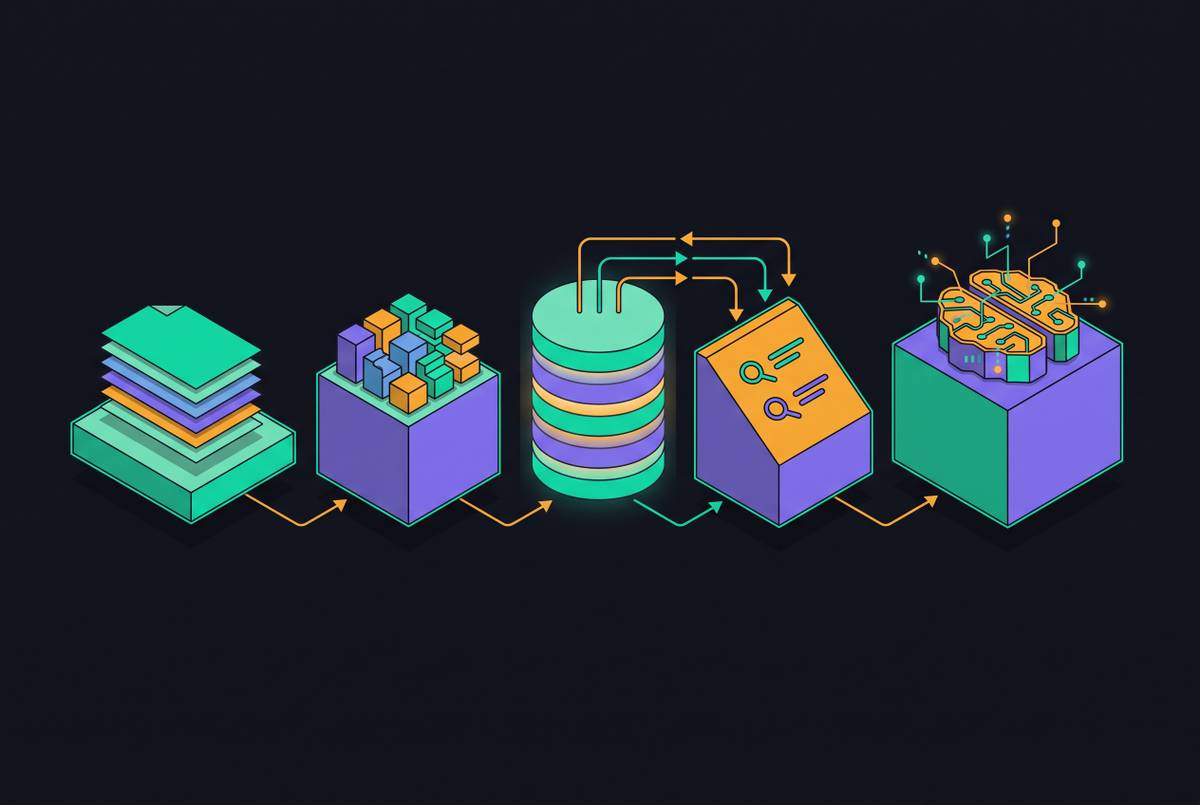
The pipeline runs in a fairly fixed order. Source documents get split into chunks, each chunk gets embedded, and those embeddings are stored in a vector database alongside their metadata. At query time, the incoming query gets embedded the same way, the database finds the nearest chunks, filtering and ranking get applied to that candidate set, and the surviving chunks get handed to the LLM as context for generation.
Filtering happens during or right around the vector search step, before anything reaches the model. That boundary matters: the database's job ends at retrieval. Whether the generated answer is correct is a separate question, evaluated downstream, and no amount of database tuning fixes a bad prompt or a weak model on the other side of that boundary.
Filtering prevents specific, concrete outcomes. Without it, the LLM gets whatever similarity search hands over, with no tenant boundary, no date constraint, no permission check. If nothing at the database layer stops it, one customer's documents can appear in another customer's query results, and the model has no way to catch that after the fact. It just sees text and reasons over it, mistakes included.
Most mature RAG pipelines by 2026 don't rely on vector search alone. They pair dense vector search with sparse keyword search, commonly BM25, and merge the two result sets, often with Reciprocal Rank Fusion. Metadata filtering runs alongside this stack, not instead of it, and it's a mistake to think a good reranker makes filtering optional. A cross-encoder only improves the ordering of whatever candidates the database handed it. If the database already returned last year's document, or another tenant's document, the reranker has nothing to correct: it will rank the wrong document highly if the wrong document reads convincingly. Filtering and reranking solve different problems, and neither substitutes for the other.
Pre-filter, post-filter, and the selectivity threshold that determines which to use
The central engineering decision is when filtering happens relative to the approximate nearest-neighbor search. Get this wrong and query latency or infrastructure cost increases in production, not just in theory.
Pre-filtering applies the metadata constraint first, then runs the ANN search only over what survives. This guarantees correctness: every result that comes back satisfies the filter, because nothing that didn't survive ever entered the search. When the filter is selective, cutting the candidate pool down sharply, this can also be fast, since the ANN search now runs over a much smaller set. Pushing pre-filtering over a large dataset breaks too many of the graph's links, since the surviving points may no longer form a well-connected structure, so search accuracy degrades. That's a named failure mode specific to how graph-based indexes like HNSW work.
Post-filtering flips the order. It runs the ANN search first, pulls back some number of candidates (call it k'), and then applies the metadata constraint to that result set. The trouble is guessing k' correctly. If the filter's pass rate is low, an initial k' of 50 might yield three usable results after filtering, forcing another round with a larger k', then possibly another. Nobody knows in advance how many candidates will survive the filter, so k' becomes a guess that often needs correcting mid-query, a challenge known as cardinality estimation.
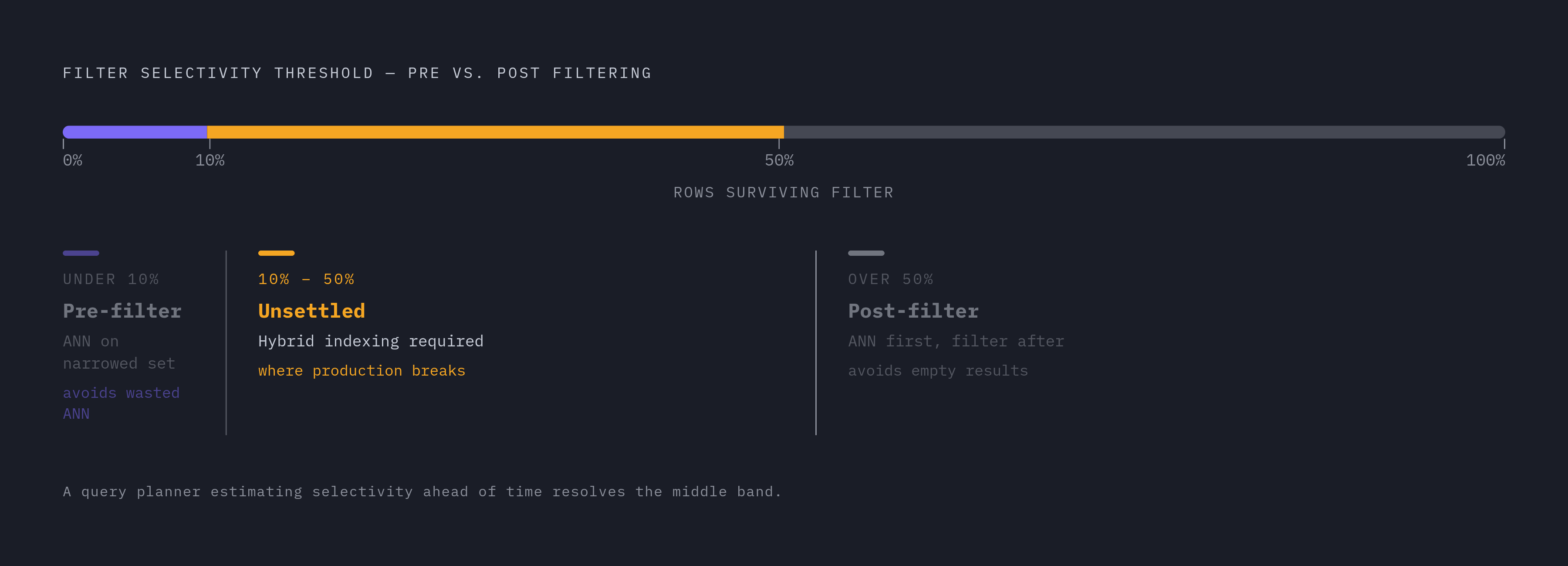
Current practice offers a rough decision rule, and it's worth committing to memory rather than treating as a footnote. When a filter is highly selective, under 10% of the data surviving, pre-filtering wins. When it's not very selective, over half the data surviving, post-filtering wins. The middle band is where things get genuinely unsettled: the valid subset is too small to search efficiently after the fact but too large to pre-filter without damaging the index structure. Researchers have proposed specialized graph traversal methods and hybrid indexing structures to handle that zone, and how well those hold up depends on whether the filter is a simple label match or a range condition, and exactly where selectivity falls within the band.
For a team building a production system, this isn't an academic footnote. A query planner that estimates selectivity ahead of time and routes each query to the right strategy, pre-filter here, post-filter there, is what separates a system that holds up under load from one that only performs well in a demo running against a clean, favorable dataset.
What metadata filtering gains in retrieval quality (evidence from multi-hop queries)
Multi-hop queries, ones that need evidence pulled from more than one source to answer fully, are where naive RAG falls apart most visibly. A vector search has no concept of "this chunk is from Engadget" versus "this chunk merely discusses the same topic Engadget covers." Semantic similarity flattens that distinction, and the pipeline ends up pulling chunks from the wrong sources.
Poliakov and Shvai's Multi-Meta-RAG, published at ICTERI 2024 and later through Springer in 2025, tested a direct fix. The method uses an LLM to pull metadata constraints straight out of the query itself, things like a source name or a date range, and applies those as database filters before retrieval runs. According to the paper (arXiv:2406.13213), this produced a 17.2% increase in Hits@4 for the voyage-02 embedding model over the unfiltered baseline, and gains of up to 25.6% in accuracy with models such as Google's PaLM.
That gain didn't come from a better embedding model or a smarter downstream LLM. It came from shrinking the candidate pool to documents that actually matched the query, before the similarity search ever had a chance to wander toward the wrong source.
None of this is free, and pretending otherwise would undersell the engineering cost. Extracting metadata from a query reliably tends to require queries that fit a fairly specific domain and format, a hand-built prompt template to guide the extraction, and an added inference call that adds latency before retrieval even starts. But the broader point holds regardless of that cost: this is evidence that metadata filtering earns its place as a retrieval discipline in its own right, not a nice-to-have layered on top of a good embedding model. The open question for engineering teams is how to build metadata extraction and query-time filtering reliable enough to trust. Whether to filter at all isn't the question anymore.
How agentic RAG changes the demands on metadata filtering
By 2026, the dominant pattern for serious RAG deployments is agentic. An LLM plans a sequence of actions, orchestrates retrieval calls, inspects what comes back, and decides whether it needs to retrieve something else before answering. Retrieval becomes one step in a longer reasoning loop rather than the whole pipeline, and that shift raises the stakes on getting filtering right at every step.
Multi-agent frameworks built for this pattern include Microsoft's Agent Framework, the successor to AutoGen, along with CrewAI and LangGraph. AutoGen's RetrieveChat specializes in retrieval-driven agent behavior specifically, and DSPy has become a common choice for building programmable, optimizable pipelines around all of this.
Filtering precision matters more once an agent is making a chain of decisions, because errors compound instead of staying isolated. An agent that retrieves a superseded document in its first step builds every later reasoning step on that wrong premise. The similarity score was high; the answer built on top of it is wrong, and nothing downstream flags the mistake, because the reasoning that follows treats the bad retrieval as settled fact.
The ContextBench study (arXiv:2602.05892), which tested 1,136 tasks across 66 repositories, tested retrieval behavior across a large and varied task set, and the results argue for aggressive, upfront filtering rather than trusting the model to sort good from bad after the fact.
One engineering pattern that's gained traction is progressive disclosure: give the agent a pointer to where information lives rather than dumping the information itself into context right away. Metadata filtering is what makes that kind of targeted follow-up retrieval possible, since the agent can issue a second, narrower query once it knows roughly where to look. Memory layers in agent architectures (short-term conversational state, longer-term knowledge storage, episodic memory tagged with timestamps) all depend on accurate metadata to pull the right tier at the right moment. None of it works if the timestamps and session IDs attached to stored memory are sloppy or missing.
Agentic systems surface a requirement that a purely semantic system can't meet on its own. Permission boundaries, tenant isolation, and time constraints have to be enforced at the database layer. Leaving that enforcement to the model's judgment is a gap, and a dangerous one once an agent is chaining decisions autonomously. It's a gap, and a dangerous one once an agent is chaining decisions autonomously.
Context engineering as the discipline that makes filtering useful
The bottleneck in 2026 isn't model capability. Context windows are large, and models handle them competently. The bottleneck sits upstream, in what gets fed into that window in the first place, and that's a retrieval problem before it's ever a modeling problem.
Research into large context windows has found that reasoning quality can degrade as context grows very large. Retrieval's job, then, is to hand the model only what it needs to answer the question in front of it, nothing more, and every extra irrelevant chunk is a small tax on the model's attention.
Two failure modes appear when filtering is missing or too loose. Context distraction is when irrelevant material crowds out the parts that matter, diluting the model's attention across text it didn't need. Context confusion runs deeper: conflicting signals from different chunks pull the model toward contradictory conclusions, and it has no clean way to decide which source to trust.
Context engineering treats the model's input as a structured assembly, built on purpose from filtering, ranking, pruning, and summarization working in concert rather than as separate afterthoughts bolted onto the pipeline at different stages.
Query expansion sits upstream of filtering and does complementary work. Most weak answers from a RAG system trace back to a retrieval failure, not a reasoning failure: the model answered badly because it was given the wrong material. Query reformulation techniques that expand or reframe the original query before retrieval improve the odds that the right documents get retrieved before any filter is applied. Better query formulation means the filter has less work to do correcting a bad starting point.
None of this works in isolation. Filtering only pays off when the metadata was clean at ingest time, when selectivity gets estimated accurately at query time, and when the query itself was well-formed before search ever started.
Choosing a vector database with filtering capabilities that match your workload
There's no single best vector database in 2026, and any list that claims otherwise is selling something. The right choice depends on filtering requirements, scale, the rest of the stack already in place, and how much operational overhead a team can absorb, a framing echoed in Braintrust's 2026 guide and in Intuz's account of deployments across more than 100 enterprise clients.
Qdrant, written in a systems programming language, supports payload filtering that narrows results by metadata condition during the search itself, and payload indexes speed up filtered queries specifically. It fits filter-heavy RAG well: tenant isolation, permission boundaries, date ranges, document type constraints. It can be self-hosted or run on managed cloud, and while the self-hosted version doesn't generate embeddings natively (a separate embedding model is needed), Qdrant Cloud Inference adds built-in embedding generation on the managed side. As of February 2026, sources confirm this at version 1.17.
Weaviate builds hybrid search in natively, combining vector search with BM25 and letting teams configure how the two result sets get fused. It supports multi-tenant data isolation directly, which makes it a strong fit for multi-tenant SaaS products where hybrid retrieval and filtering both need to work at once. It can run self-hosted or managed, though it asks for more operational configuration than a managed-only option would.
Pinecone is fully managed, handling filtering and hybrid search through its API with the least operational overhead of the group. Billing rises with query volume and storage, and because it's managed-only, teams in regulated industries needing data sovereignty will find that a hard constraint regardless of price. It fits best for early-stage teams prioritizing speed of shipping over infrastructure control, and worse for anyone who'll need to move data behind a specific border later.
pgvector is a Postgres extension, supporting similarity search, hybrid retrieval, and metadata filtering inside a database many teams already run. Research from Exqutor, accepted at ICDE 2026, showed cardinality estimation improvements that boosted performance by up to four orders of magnitude on vector-augmented analytical queries in pgvector, addressing the inaccurate cardinality estimation that causes the pre-filter/post-filter decision covered earlier. For teams already on Postgres, pgvector should be the default choice, not an also-ran: no new database system to run, and a straightforward install.
Chroma is lightweight and quick to set up, well suited to local development, prototypes, and smaller applications. It's not built for filtering performance at production scale, and it doesn't pretend to be.
As a rough heuristic: filter-heavy workloads with tenant boundaries and permission constraints at scale point toward Qdrant. Hybrid search combined with multi-tenancy points toward Weaviate. Teams already running Postgres should look at pgvector before adding a new system, full stop. Early-stage teams optimizing for shipping speed, eyes open about cost growth and data sovereignty limits, should look at Pinecone. Local prototyping points toward Chroma, and nowhere past that stage.
Filtering strategy interacts with index choice in ways vendor feature lists rarely make obvious. Whatever the shortlist looks like, test filtering performance against the actual metadata distribution and query patterns a system will see in production. Vendor benchmarks almost never reflect the selectivity profile of any one specific workload, and trusting them at face value is how teams end up re-architecting six months in.
Production-grade web knowledge retrieval on top of the vector database layer
A vector database solves retrieval over a corpus that's already indexed and owned. Plenty of production RAG and agentic systems also need something outside that corpus: recent events, time-sensitive facts, external sources that were never part of the index to begin with.
The model's training data can't substitute for this, and treating it as a substitute is a common, costly mistake. Every model has a knowledge cutoff, and a system relying only on embedded documents will answer confidently and wrongly on anything that's moved since that cutoff. It's the same temporal correctness problem that date-based metadata filtering solves inside the vector database, applied now to knowledge the database never had.
Generic tools built for other purposes tend to fail here in ways that echo the difficulty of filtering directly. Search APIs built around search-engine result pages return shallow snippets, structurally similar to pulling back a raw top-k list with no filtering applied, leaving the model to work with thin, decontextualized fragments. General-purpose scraping tools break under real page structures. They were never built for the depth, speed, or reliability an autonomous agent or a production LLM system actually needs from a web fetch.
Neither kind of tool applies the filtering, ranking, and shaping logic that makes retrieved content usable for a model doing real reasoning. Production systems need web content that arrives already filtered for relevance, ranked, and shaped for machine consumption, not raw HTML or a snippet list the application has to parse and clean at query time. A web search API purpose-built for AI systems closes that gap by owning the data pipeline end to end, so what reaches the retrieval layer is already context-engineered, rather than leaving that discipline for the application to reinvent on every call.
The throughline holds across both layers. Selectivity, freshness, relevance ranking, and context discipline are what make metadata filtering valuable inside a vector database, and those same principles should govern whatever web retrieval layer feeds into it.