Web Grounding to Reduce LLM Hallucination in Agentic Tasks
Connecting AI agents to live web data cuts hallucinations where prompt engineering can't.

Industry forecasts put a number on how fast this is scaling: a large share of enterprise applications are expected to ship task-specific AI agents by the end of 2026, up from a small fraction in 2025. The same forecast carries a warning: a substantial share of agentic projects are expected to be canceled by the end of 2027, with reliability deficits cited as a primary cause. That's the number worth sitting with, more than the growth curve. Enterprises are abandoning agents because the reasoning happens over the wrong material, and no amount of model capability fixes an input problem. The industry keeps treating hallucination as a defect to be trained out of the model, when the more accurate framing is an infrastructure failure wearing a model's face: the model does exactly what it was built to do, and what it was given to work with is the question most teams never think to ask.
What hallucination actually is and where it comes from in parametric models
Large language models don't store facts the way a database stores rows. Training compresses enormous amounts of text into statistical patterns embedded in the model's weights, a form of memory researchers call parametric. Nothing inside a model says "this claim is true, here is its source." There's only a distribution over likely next words, shaped by everything the model saw during training.
That has a specific consequence when a model gets asked about something outside its training distribution, or something it saw only thinly and inconsistently. It generates the most statistically plausible continuation of the prompt, and that continuation reads exactly as confidently as a verified answer would, because fluency and accuracy come out of the same mechanism. The model carries no internal flag separating the two. A 2025 survey of hallucination causes, detection, and mitigation strategies, and separately, Kalai et al.'s "Why Language Models Hallucinate" (OpenAI, 2025), trace the root cause to the same structural fact: knowledge stored parametrically carries no built-in citation, no confidence signal that tracks truth, and no mechanism for the model to notice the edge of what it actually knows.
The knowledge cutoff problem follows directly, and no clever prompt fixes it. A model trained on data through a given date has no way to know what happened after that date, but nothing stops it from answering a question about a post-cutoff event anyway, with the same fluent confidence it applies to everything else. For agentic work involving current pricing, live regulatory status, breaking news, or documentation for a library that shipped last month, this isn't an edge case. It's closer to the default condition.
Telling a model to "only answer what you're sure of" or "cite your sources" barely moves the needle. The model isn't withholding information it has access to; instruction tuning shapes tone and format, but it cannot manufacture evidence that was never in the training data. The problem is an absence, and absences don't respond to prompting, no matter how the prompt is worded. Addressing the underlying cause means giving the model access to current, verifiable material at the moment it needs to answer, instead of asking it to somehow do better with what it already lacks.
How web grounding works as an architectural intervention
Web grounding changes the model's job description. Instead of asking it to generate knowledge from memory, the system retrieves documents relevant to the query, places them directly in the context window, and instructs the model to answer using only that material. The model shifts from oracle to reader: it summarizes text sitting in front of it rather than recalling facts from compressed training data. Because that source text is present, citation becomes possible in a way it never was before. The model can point to the specific passage a claim came from, grounded in real material rather than gesturing at some vague, unverifiable internal certainty.
Grounding beats prompt-level fixes, and it isn't close. Telling a model to be careful is an instruction about behavior; grounding is a change to what the model has access to. Supplying accurate, current, retrieved evidence cuts hallucination more than any amount of prompt engineering, because the model has real information in front of it instead of being asked to compensate for missing information through better manners. Anyone still trying to prompt their way out of a hallucination problem is solving the wrong layer of the stack, and no amount of clever phrasing changes that.
Grounding and Retrieval-Augmented Generation get used interchangeably, but they aren't the same thing, and the conflation causes real confusion. RAG is one architecture for implementing grounding; grounding is the underlying principle, and there's more than one way to build it. Web grounding specifically means the retrieval source is the live web rather than a fixed internal document store, which matters enormously for any agentic task that depends on information that changes: prices, availability, regulatory status, breaking developments. A static corpus, however well curated, starts aging the moment it's built.
This isn't a complete fix on its own, and pretending otherwise is where things go wrong. RAG cuts down on factuality hallucinations by putting real sources in the context window, but it does little to stop a model from misreading those sources, cherry-picking a detail out of context, or drifting back into unsupported generalization mid-answer. Keeping retrieved context tight and explicitly instructing the model to stay inside it are necessary disciplines, not optional polish. For agent decisions with real stakes attached, a verification step that checks the output against the retrieved content afterward adds a layer grounding alone doesn't provide. Grounding solves the evidence problem more than the reading comprehension problem, and treating it as a fix for both is exactly where production systems get overconfident.
The harder question, and the one that actually determines whether any of this works at scale, is what gets retrieved and how it's prepared before the model ever sees it.
Where grounding fits in the anatomy of an AI agent
Most agent architectures follow a recognizable five-layer structure: perception and input, memory, planning and reasoning, tool execution, and orchestration tying the layers together. Web retrieval lives in the tool execution layer. The agent decides it needs information, invokes a search or fetch tool, gets content back, and hands that content to the reasoning layer. Memory systems cover short-term conversational context, longer-term stored knowledge, and episodic history from past interactions; web grounding supplements all three, supplying live evidence none of those memory types can provide on their own, no matter how well they're maintained.
The tool execution layer is where grounding quality actually gets decided, and it's easy to underrate how much rides on it. Tool calls need reliable error handling, input validation, and retry logic, because a tool failure doesn't stay contained; it cascades straight into the reasoning layer above it. A search tool that returns shallow, malformed, or incomplete content hands the model bad evidence, and the model reasons over that evidence with exactly the same confidence it would apply to good evidence. The agent has almost no independent ability to tell a clean, well-sourced retrieval from a broken one. That discrimination has to happen before the content reaches the context window, because once it's there, the model treats it as ground truth by default.
Model Context Protocol, introduced by Anthropic in late 2024 and handed off to the Agentic AI Foundation in December 2025, has become the standard way agents connect to tools and outside data. Rather than every integration being a custom, one-off build, MCP gives developers a shared contract for reading files, calling functions, and passing contextual information into a model. By April 2026 the spec had passed 110 million monthly downloads, a fairly clear signal that the industry settled on one way of doing tool-calling instead of a dozen competing ones. For web grounding specifically, this means retrieval tools increasingly need to speak MCP to plug into agent frameworks cleanly. The retrieval API is turning into a native part of the tool layer, more than a bolted-on afterthought.
The more advanced version of this pattern is agentic RAG, where the agent itself decides when to retrieve, what query to run, and whether what came back is good enough to answer with, rather than retrieval being one fixed step that always runs the same way. Seltz, for instance, is a real-time web grounding platform built specifically to feed that kind of agent pipeline with context-engineered content. Haystack's ecosystem illustrates this well: a query that can't be answered from an internal knowledge base falls back automatically to web search, and the agent works through iterative rounds of retrieval and reasoning until it has enough to answer. That flexibility raises the stakes on retrieval quality rather than lowering them, because the agent is now trusting retrieved content not just to answer a question but to decide its own next move.
Why the standard retrieval stack — SERP APIs and scraping tools — fails at this job
Traditional search APIs return search-results metadata: a title, a URL, and a snippet running somewhere between 150 and 300 characters. Fine for a human scanning a results page and deciding which link to click. Weak as evidence for a model, and this is where most agent-building teams get tripped up without realizing it. A 200-character snippet carries no surrounding context, no supporting detail, none of the evidence chain a model needs to answer correctly. It carries just enough to tempt the model into filling in the rest from memory, which is precisely the behavior grounding was supposed to eliminate. An agent working from search snippets reasons over the same fragment a human sees in a results preview, except nobody's there to click through and check it before the agent acts.
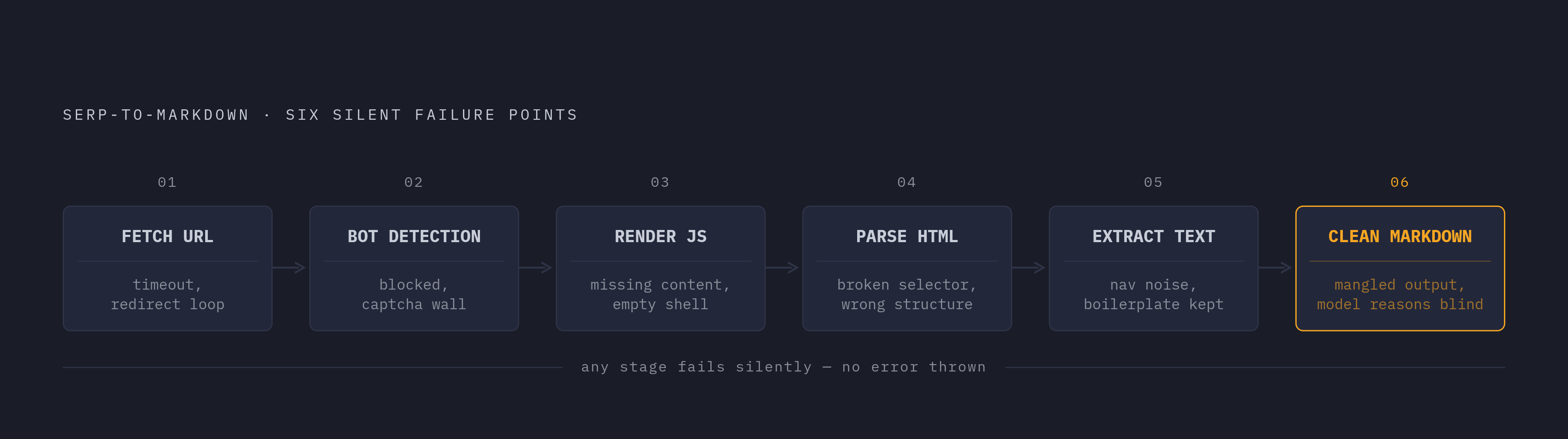
Getting to full page content from there means building an entire pipeline: fetch the URL, get past bot detection, render whatever JavaScript the page needs to display its real content, parse the resulting HTML, extract the readable text, convert it into something like clean Markdown. Six separate points of failure sit in that chain, and any one of them can degrade silently. A parser that mishandles one common page layout doesn't throw an error; it quietly hands the model a mangled version of the page, and the model reasons over it anyway, with no idea anything went wrong. Scraping tools run into the same walls real users hit: anti-bot measures, dynamic rendering that hides content until a script runs, login gates, CAPTCHAs. This infrastructure was never built with automated retrieval at production volume in mind, and pretending otherwise is how teams end up debugging a "model problem" that was never in the model at all.
Search APIs were built to help developers reconstruct a results page for a human reader. Scraping tools were built to pull structured data out of web pages for human-readable datasets. Neither one asks the question that actually matters here: what does the content need to look like for a model to reason over it correctly? Ranking, filtering, and formatting all get left to whoever builds the pipeline, which means every team using these tools is separately solving the same problem, usually not particularly well.
That gap shows up hardest in production, not in a demo. Agentic systems run continuously and often at real volume, under latency limits that leave no room for graceful failure. A pipeline that looks solid in testing can quietly degrade the moment a target site restructures its layout, tightens its bot detection, or just goes down for maintenance. The agent has almost no way to know the content it received was incomplete, truncated, or malformed, so it reasons over whatever arrived, with the same confidence either way.
What purpose-built web knowledge infrastructure actually does differently
The alternative collapses the entire pipeline, query, fetch, parse, chunk, rank, deliver, into a single call that returns content already shaped for a model to work with. That reflects a different starting premise: the job of the API is to maximize how useful the returned content is for AI reasoning, more than to hand a developer raw material and leave the processing to them. Selection, filtering, ranking, and formatting stop being optional cleanup and become the actual product.
The distinction that matters most is between owning a data pipeline and wrapping someone else's, and this is where most vendors in the space quietly cut corners. An API built on top of an existing search engine or scraping service inherits every limitation of that underlying service: how fresh its index is, how deep its snippets go, how fragile it is against anti-bot measures it doesn't control. Owning the crawling, indexing, extraction, and ranking end to end is what actually lets a provider guarantee quality, because there's no third-party layer in between introducing its own failure modes. For an enterprise deploying this, ownership isn't abstract. Routing every retrieval query through a wrapped third-party service means limited visibility into where that data travels, what gets logged along the way, and how the underlying content was sourced in the first place.
Filtering strips out the noise that misleads a model: ad copy, navigation menus, boilerplate, duplicate content scraped from mirrored pages. Ranking orders what's left by relevance to the actual query, rather than by whatever a search engine's ranking algorithm optimized for, which is human click behavior more than machine reasoning. Shaping delivers the surviving content in a format, structured Markdown or clean prose broken into coherent passages, that fits inside a context window and matches how the model expects to receive instructions. Skip any one of these steps and the failure shows up downstream: a model handed noisy content reasons over the noise; a model handed badly ranked content weights the wrong passage as if it were the most important one.
Freshness sits underneath all of it as a structural requirement, not a nice-to-have. Agentic tasks are frequently time-sensitive: current prices, live regulatory status, this week's news, documentation for a tool that shipped days ago. A cached index or a fixed knowledge base decays the moment it's built, the same way a model's training data is always some fixed distance behind the present. Live web grounding keeps pace with that by design, instead of relying on someone remembering to run a refresh job on schedule. Web content has to be selected, filtered, ranked, and shaped specifically for AI reasoning; leftover search metadata built for a human's eyes was never going to be enough. Security posture and clear data ownership belong in that same category: core design requirements, not something bolted on after a customer asks about it.
How retrieval pipeline design determines whether grounding succeeds or introduces new failure modes
Chunking is the variable that gets the least attention and does some of the most damage when it's wrong. How a document gets split up before retrieval determines exactly what the model ends up seeing. Chunks that run too large overwhelm the context window with material irrelevant to the query; chunks that run too small strip away the surrounding reasoning a passage needs to make sense. Much of production RAG work settles around 512 tokens as a workable balance point, though the right number always depends on the content involved. Semantic chunking, splitting text along meaning boundaries instead of counting out a fixed number of tokens, improves recall by as much as 9% over fixed-size splitting, according to research on the approach. That's a meaningful gain for what looks, from the outside, like a minor formatting decision, and it's exactly the kind of decision most teams skip past on the way to shipping.
Embedding choice compounds on top of that. The quality of the embedding model determines whether retrieval surfaces content genuinely relevant to the question being asked, or content that merely shares surface keywords with it, a distinction that matters enormously once a query gets even slightly more complex than a simple factual lookup. Voyage-3-large has shown stronger retrieval performance than several comparable embedding models in published benchmarking, a reminder that choices happening well beneath the model's visible output, chunk size, embedding architecture, ranking method, do as much work as the grounding concept itself. Grounding is the principle. Getting it right in production is an engineering discipline made of decisions exactly like these, and each one either sharpens the evidence the model reasons over, or quietly hands back the noise grounding was supposed to eliminate in the first place.