Temporal Ranking of Web Results for Time-Sensitive LLM Tasks
Temporal ranking ensures LLMs retrieve current documents, not outdated ones matching the topic.

A large language model asked who holds a given office this week, what a company's stock did yesterday, or whether a regulation changed last month will often answer anyway. Every LLM carries a training cutoff, a point past which it has no internal knowledge of the world, and time-sensitive questions expose that boundary immediately. The model doesn't know it has crossed into territory it can't see, so it doesn't hedge, it simply generates the most statistically plausible answer, which for a time-sensitive query is often an answer that was true months or years ago.
The scale of this failure can now be measured directly, with benchmark results to back it up. The results are stark: models that post strong accuracy on earlier time-sensitive benchmarks, such as Gemini 3 Pro's high accuracy on FreshQA without search, drop to roughly a quarter of that accuracy on LiveNewsBench. That collapse says something uncomfortable about how the field has been measuring progress. LiveNewsBench was built specifically to strip that overlap out, and the gap it reveals is the gap that matters in production.
None of this is specific to one model family or one architecture choice. Live retrieval from the web is the only practical mechanism for keeping an LLM grounded in current information, and that single fact changes how teams building on these models should think about their architecture. Retrieval quality is a load-bearing component of the whole system, not a nice-to-have layered on top of a capable model, and if it's weak, the system is weak in exactly the places where users are likely to notice.
Semantic Similarity and Wrong Answers for Time-Sensitive Queries
The standard fix for the knowledge-cutoff problem is retrieval: pull relevant documents from the live web and feed them to the model as context. A dense retriever trained on semantic similarity will reliably surface the passage that discusses the same topic as the query. It has no built-in notion of whether that passage describes the world as it was six months ago or as it is today, and for a large share of time-sensitive queries, those are two different documents.
Left uncontrolled, that signal produces arbitrary outcomes rather than correct ones, favoring whichever document happens to carry a later date regardless of which document is actually true.
The research community has stopped treating this as a side issue. The tutorial traces this concern from early rule-based time extraction through to transformer-based architectures, and it treats time-aware ranking and temporal reasoning in retrieval-augmented generation as one coherent pipeline rather than two separate research problems that happen to share a citation list. That framing matters because it tells you where the fix has to live: as part of how relevance gets scored in the first place, not as a patch applied after retrieval.
None of this means semantic retrievers are poorly built for the job they were given. A dense retriever optimized purely for topical closeness has no term in its scoring function that tells it whether a passage is topically on-point but expired or both on-point and current. A separate discipline, built around temporal ranking rather than similarity ranking, has to close that gap.
Temporal Ranking
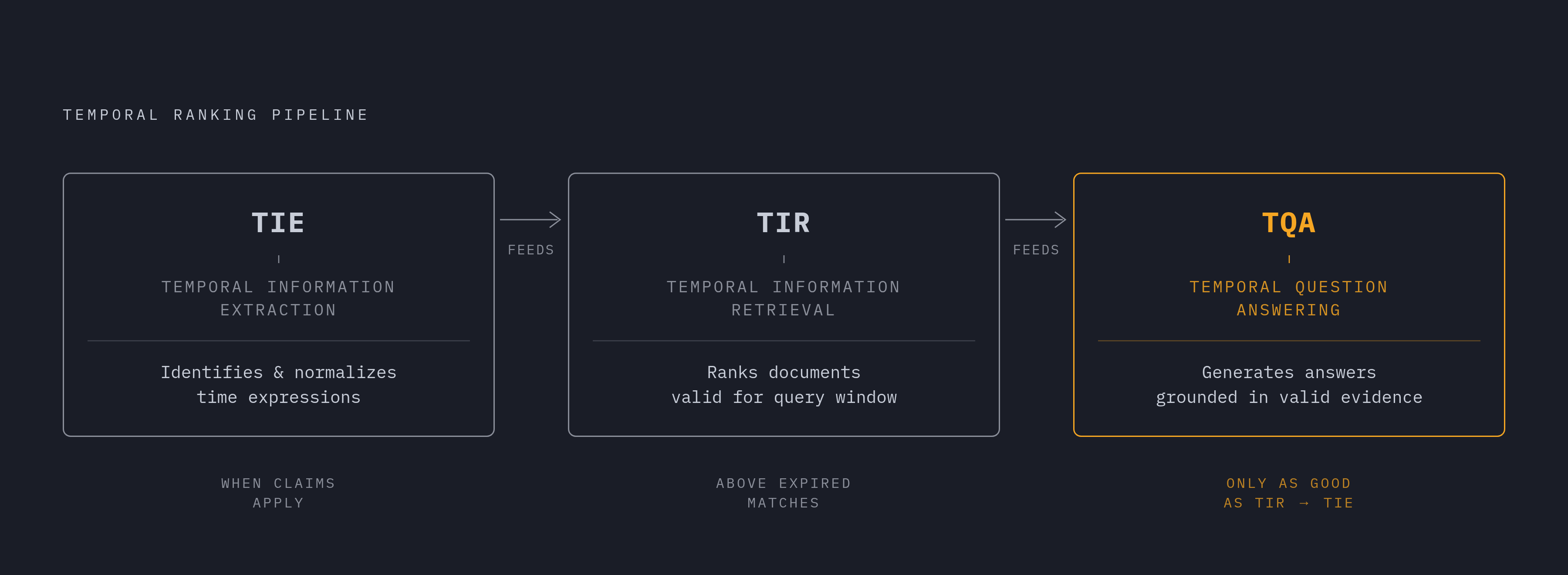
Temporal ranking is not the same thing as sorting search results by date. Temporal ranking is the deliberate combination of the two: a scoring approach that accounts for both how closely a document matches the query's meaning and whether the document's content holds true for the time period the query actually cares about.
The research literature breaks this into three connected stages. Temporal Information Extraction, or TIE, identifies and normalizes the time expressions inside a document. This allows a system to reason about when its claims apply, treating the text as time-bound evidence. Temporal Information Retrieval, or TIR, uses that extracted temporal scope to rank documents so that ones valid for the query's time window score above documents that are topically similar but have expired. Temporal Question Answering, or TQA, then generates answers grounded in evidence that is both relevant and temporally sound, rather than evidence that merely resembles the question. The ACM SIGIR tutorial presents these three stages as a single pipeline rather than a set of modules a team can mix and match, with each stage depending on the output of the one before it: extraction has to happen before retrieval can use it, and retrieval has to work before question answering can trust its inputs.
The clearest demonstration of what this looks like in a working system comes from TempRetriever, presented by Abdallah, Piryani, Wallat, Anand, and Jatowt at WSDM '26. The paper evaluates four ways of fusing semantic and temporal signals, feature stacking, vector summation, relative embeddings, and element-wise interaction, and pairs that fusion work with a learned temporal encoder trained using time-based negative sampling, which teaches the model to tell apart passages that look alike semantically but differ in when their claims were true. The approach is built to be modular, meaning its fusion techniques can sit on top of existing temporal retrieval systems and improve them without a full rebuild, which matters a great deal for teams trying to adopt this incrementally.
This two-part view, relevance on one axis and validity or freshness on the other, has a longer history than the current wave of transformer-based work. Separate work on temporal ranking of search engine results analyzed archived versions of web pages to estimate both general freshness and topical relevance over specific time windows, recognizing early on that a page can be current without being on-topic, or on-topic without being current. That two-dimensional framing, freshness crossed with relevance, is the foundation modern temporal retrieval work still builds on. What it leaves open, and what any production system still has to decide for itself, is when recency should dominate the ranking outright and when it should only nudge it: a breaking-news query and a query about a stable technical standard don't call for the same temporal weighting, and no universal formula tells you which is which.
How temporal misalignment propagates through a RAG pipeline
The most dangerous failure in a retrieval-augmented pipeline is a grounded hallucination. The answer will still be wrong, because the thing it's grounded in no longer describes the world accurately. That mismatch is hard to catch precisely because the system is behaving correctly by every internal measure it has.
The architecture of the pipeline makes this almost inevitable without deliberate design against it. Temporal validity isn't something a model can infer from the text alone; it has to be supplied as a signal, or it isn't there.
The architectural response that's gained ground is a shift from batch re-indexing toward streaming re-indexing, where only documents that actually change get re-embedded, as soon as they change. In a streaming setup, a document change event, captured through Change Data Capture, triggers re-embedding of just that document and an update to the vector index, leaving the rest of the corpus untouched. That design yields embedding freshness measured in sub-second terms, with cost tied to how much content changes rather than to the size of the whole corpus, which makes continuous freshness something a team can actually afford to run rather than something reserved for a nightly batch job.
Freshness at the corpus level solves part of the problem but not all of it. Temporal ranking has to operate at query time too: the retriever needs to weigh when a document's claims were actually true relative to what the query is asking about, not just how recently that document was last touched by the indexing pipeline.
Agentic RAG patterns raise the stakes further. When specialized agents split the work across query decomposition, retrieval, validation, and synthesis, a single stale retrieval result can move through several reasoning steps before it ever surfaces in a final answer, which makes the original error much harder to trace back and fix. More retrieval calls without temporal awareness just means more chances to retrieve the wrong time-slice, repeatedly.
How Agents Consume Web Knowledge and Reason with Temporal Context
Agents don't read the web the way a static RAG pipeline does, and that difference changes what temporal ranking has to deliver. If that snippet carries no temporal signal, no publication date, no indication of the time period its claims apply to, no flag that it's been superseded, the agent has nothing to work with when deciding which of several similar-looking sources to trust.
Deciding what actually enters an agent's context window has become, by most accounts from people building these systems, the majority of the real engineering work in agentic search. Temporal ranking is a direct lever on that context quality: surfacing the right time-slice of content means the agent is reasoning over information that's actually still true, rather than over whatever happened to score highest on topical similarity regardless of when it was accurate.
Time-sensitive tasks rarely resolve in a single retrieval call. A retriever that applies one uniform recency filter, say, limiting results to the last 30 days, will miss documents that are still valid but fall outside that arbitrary window. Neither failure mode is rare, and both point toward the same conclusion: the infrastructure doing the retrieving has to carry temporal signal all the way through, not just at the moment of indexing.
Why Generic Search APIs Cannot Meet Temporal Ranking Requirements
Everything the preceding sections establish, that temporal signal has to be encoded into the ranking score itself, that corpora need to update on a streaming basis, that snippets need to carry enough temporal context for an agent to act on, adds up to a specific list of infrastructure requirements. Generic search APIs, built originally to serve human users clicking through a results page, were not designed against that list, and that mismatch appears in production the moment the task becomes time-sensitive.
Production-grade temporal ranking requires timestamps to be part of the relevance score itself, not a boolean filter applied after retrieval has already happened. And because time-sensitive agentic tasks tend to make several retrieval calls in sequence, it requires predictable latency, since variance at each step compounds across the whole chain and drags down end-to-end task performance.
SERP-style APIs fall short of this at the level of what they fundamentally return, not merely in which features they happen to expose. Assembling real temporal ranking on top of that output costs real engineering effort: the agent gets a snippet, has to fetch the full page (risking scraper latency and outright failure on dynamically rendered sites), has to parse and clean what comes back, has to extract temporal signals from that cleaned text, and only then can apply any ranking logic at all, a chain with a failure point at every link.
Scraping tools run into a related but distinct problem. Neither SERP-style APIs nor general scraping tools were built with the depth, speed, and reliability that autonomous agents and production LLM systems now require. Closing that gap is what purpose-built web knowledge infrastructure for AI is for: selecting, filtering, ranking, and shaping web content specifically for AI reasoning, with temporal validity treated as a first-class property of the pipeline rather than something reconstructed after the fact from whatever metadata happened to survive.
Designing Temporal Ranking into a Retrieval Pipeline in Practice
Temporal ranking works only when it's built into every stage of a retrieval pipeline, not added as a single post-processing step at the end. Each design decision along the way either preserves temporal information or quietly discards it, and the system's final behavior is the sum of those choices.
At ingestion, temporal signals, publication date, last-modified date, the specific time scope of claims within a document (a line reading "as of Q3 2026," for instance), and any supersession notices, need to be extracted and stored as structured metadata the moment content enters the system, not inferred later from unstructured text. Change Data Capture pipelines that re-embed only the documents that changed can reach sub-second freshness with costs tied to the rate of change rather than the size of the whole corpus, which is what makes running this continuously, rather than on a schedule, affordable at scale.
At retrieval, temporal relevance belongs inside the score itself as a scoring factor, not as a filter applied afterward. The TempRetriever approach, fusing semantic embeddings with learned temporal representations, is the direction the research points to for dense retrieval. A hybrid setup combining sparse and dense retrieval with temporal weighting lets a system treat a query with an explicit time window ("what changed in the last 90 days") differently from a query with an implicit one ("what is the current regulatory position"), adjusting how heavily recency factors into the score case by case. Whether recency should override topical relevance outright or merely weight it has to be decided by classifying the query type, not by setting one global recency parameter for every request: a fast-moving news query and a question about a stable technical standard don't belong on the same curve.
At the point where snippets get assembled into an agent's context, each one needs to carry enough temporal metadata for the agent to judge when its claim was valid before committing to a full-page fetch. The pattern that works in practice is a two-step call: the first returns temporally annotated snippets, and the second fetches a full document only for sources the agent has already judged temporally appropriate based on that first pass.
Two further requirements belong in any enterprise deployment of this kind of system. Infrastructure that discards version metadata at ingestion makes that kind of audit trail impossible to reconstruct later, no matter how good the ranking logic built on top of it turns out to be.