Evaluating Web-Augmented Agent Performance on Time-Sensitive Tasks
Current evaluation metrics miss stale retrieval errors cascading through multi-step agent reasoning.
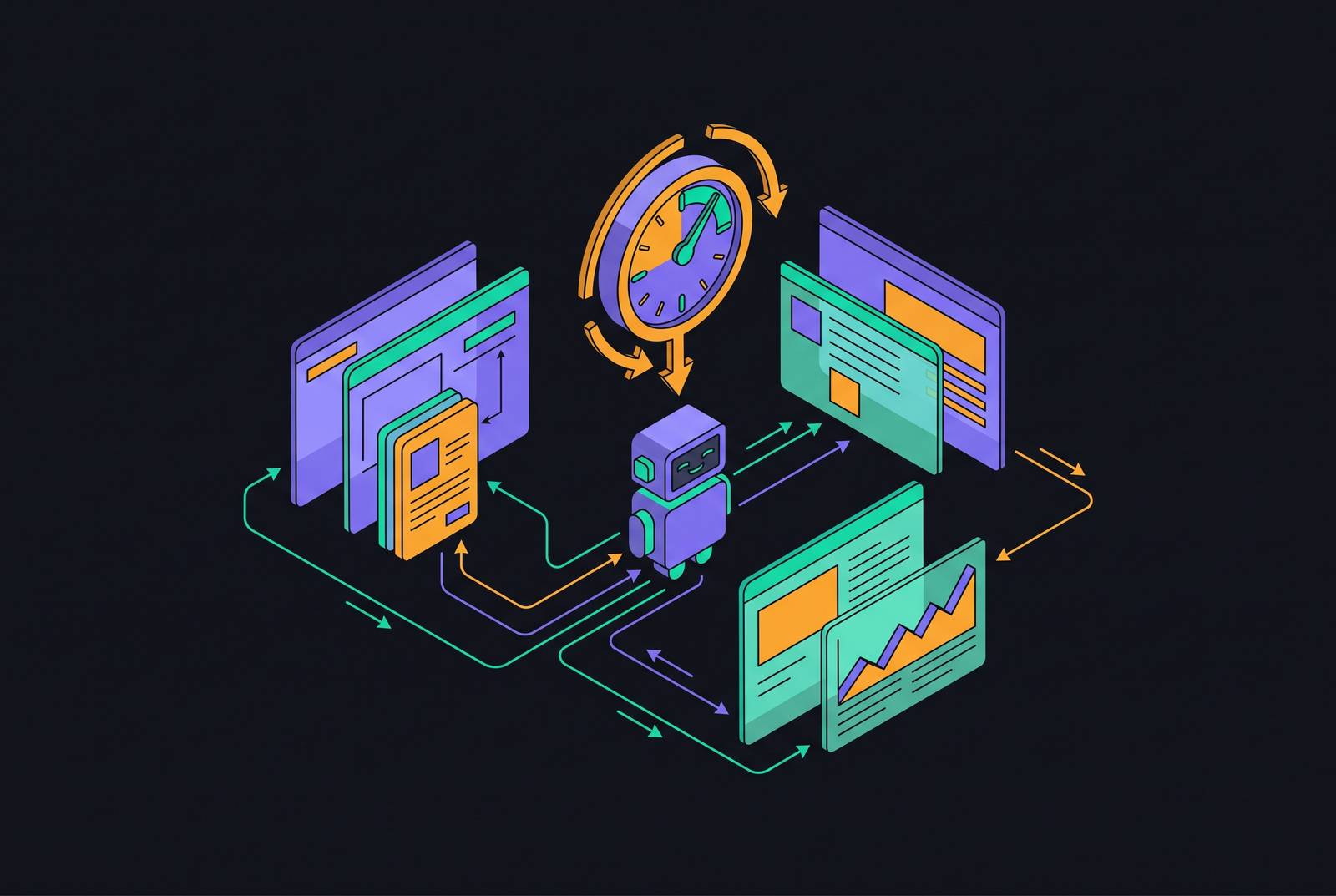
Web-augmented agents built for time-sensitive tasks fail in a way that general agent evaluation was never designed to catch. Most teams now grade agents on trajectory accuracy, tool-call correctness, and completion rate, treating retrieval as a solved input rather than a variable worth scoring on its own. That's a reasonable starting point for an agent editing code or filling out a form, but it leaves a hole exactly where time-sensitive tasks live: the freshness and fidelity of what got retrieved before any reasoning happened.
Agentic RAG makes the stakes higher than they look. Retrieval in this setup isn't a single fetch-then-generate step, it's a chain of decisions: the agent plans a query, orchestrates the retrieval, inspects what came back, and decides if it needs to go fetch more. A stale or degraded result at any one of those decision points doesn't just introduce a local error, it can redirect everything downstream. The agent doesn't know it's working from bad premises, so it keeps building on them.
That's the failure mode specific to this category of task. If the page an agent pulls is six months old and nothing in the pipeline flags the age, the model reasons from it with the same confidence it would apply to something published an hour ago. Answer-correctness scoring, the metric most teams default to, cannot see this failure unless the evaluator already knows what the current correct answer is supposed to be. Which means the entire failure mode is invisible to the exact scoring method most production teams already trust.
Benchmark saturation and the obscured failure modes of time-sensitive web tasks
Public benchmarks are the natural place teams look first, and they're increasingly saturated, gameable, and disconnected from what actually breaks in production. That gap widens specifically for tasks tied to current information, because of a structural mismatch: public benchmarks work from fixed corpora with ground truth fixed at construction time, while time-sensitive tasks need ground truth that moves and must be checked against a specific point in time.
SWE-bench Verified and ARC-AGI-2 are useful surfaces for what they measure, abstraction, planning, code correctness, but none of them apply any pressure to the retrieval-freshness dimension. None of them tell a team whether an agent gives a correct answer about a live price, a current event, or a policy that changed last weekc3. A model can score well on every benchmark a team throws at it and still hand a user last quarter's tax rate with total confidence.
Even the framing that's replaced simple answer scoring doesn't close the gap. OpenAI's shift toward asking which step failed, under which tool call, with what retrieval context, latency, and cost, is a real improvement over binary correctness. But it still stops short of answering what time-sensitive tasks actually need answered: as of when was the retrieved content current? Without that timestamp, the more granular framing just produces a more granular version of the same blind spot. That's the case for building a purpose-specific evaluation layer instead of stretching general-purpose benchmarks to cover a job they were never built for.
The four dimensions a time-sensitive evaluation framework must instrument
A framework adequate to this problem needs four distinct measurement dimensions, and none of the four substitutes for another: retrieval freshness, tool-call trajectory quality, answer correctness relative to a time-anchored ground truth, and downstream reasoning coherence.
Retrieval freshness measures whether the content the agent pulled in reflects the state of the world at the moment the question was asked. Search APIs increasingly expose page-age parameters and live-fetch options built for this purpose, but this dimension is measurable only if the agent's retrieval layer actually uses them and an evaluator checks that it did.
Tool-call trajectory quality asks a narrower question: did the agent call the right tools, in the right order, with the right parameters, regardless of whether the final answer happened to land correctly? Platforms such as Maxim AI and LangSmith expose trace-level and span-level instrumentation that lets a team inspect each tool call, its inputs and outputs, and the decision that followed it. That level of detail matters because a preprint from Salman, Halgamuge, and Susnjak comparing OpenClaw and NanoBot found that outcome labels diverge across evidence layers: a system can pass capability scoring and still fail on resource use or trajectory provenance. Capability scores and execution records are not interchangeable, and treating them as such hides exactly the failures a time-sensitive framework exists to catch.
Answer correctness relative to a time-anchored ground truth is the dimension that finally gives freshness scoring something to compare against. The RAGAS framework has become something like a default metric suite for RAG evaluation, but its core metrics, faithfulness, answer relevance, context precision, were never built with temporal validity in mind. Teams working on time-sensitive tasks have to extend it, because a static golden dataset simply can't hold a moving target.
Downstream reasoning coherence after degraded retrieval is the dimension most teams skip entirely, and it's arguably the one that matters most. FutureAGI finds that multi-step agent workflows hallucinate on 20–40% of tool-call chains, well above single-turn extractive QA, and an early retrieval error compounding through that chain is the key risk surface for time-sensitive tasks. A framework that stops at the first three dimensions has measured the ingredients without ever checking if the dish came out edible.
Stale web content cascading into downstream reasoning failures in practice
Stale retrieval doesn't stay contained to the step where it happened. In a multi-step workflow, an outdated fact pulled at step one becomes a premise, and every tool call, synthesis step, and conclusion that follows gets built on top of it.
The mechanism is straightforward once you trace it. The agent treats whatever it retrieved as verified, current context, folds it into its working state, generates its next query from that false premise, and eventually produces a confident answer grounded in something that was true six months ago and isn't anymore. Nothing in that chain produces a visible uncertainty signal, not to the user, not to an evaluator, unless someone instrumented the trajectory ahead of time to catch it.
This is the same trap that produces training-cutoff hallucination, just wearing a different disguise. A vector store lags behind the live web the same way a frozen training set lags behind the present, and the resulting error looks identical from the outside: the model sounds authoritative because the retrieved text it's quoting sounds authoritative. Confidence in the output has nothing to do with accuracy in the input.
Web grounding adds a second, uglier version of the same risk. An agent can pull a low-authority or outright malicious page and cite it as though it were a trusted source. The failure isn't just staleness anymore, it's adversarial content sitting inside the reasoning chain. Answer-correctness scoring alone will never catch this, because the answer can be phrased perfectly while resting on a source that should never have been trusted.
Scale makes the risk concrete. The Stanford AI Playground deployment built on Firecrawl processes something like 800 real-time sources a day across a wide spread of domains. At that volume, one category going bad, a news outlet that quietly stops updating, a government database running on a lagged feed, can degrade an entire class of queries with no obvious signal that anything broke. And the most common production RAG failure is a stale index, where the underlying documents change but the index doesn't, so a user gets last quarter's policy delivered with a citation that looks completely current.
Production instrumentation requirements for catching these failures before they compound
Catching this before it reaches a user means instrumenting four levels, and none of them work in isolation: the retrieval layer, the tool-call trace, the reasoning chain, and the output. Siloed logging at just one level tells a team that something failed, not why, and not where to fix it.
At the retrieval layer, every document pulled needs its publication or last-modified timestamp logged next to the content itself, because without that timestamp, freshness scoring downstream simply has nothing to compute against. Teams also need to record whether the agent actually used the freshness controls available to it, page-age filters, live-fetch flags, or just defaulted to whatever was cached. The absence of those controls is itself worth an alert. And source tracking has to run over time, spanning each query, because a domain that was reliable half a year ago may since have gone stale, slipped behind a paywall, or been quietly compromised.
At the tool-call trace, platforms like Maxim AI expose session-, trace-, and span-level visibility into individual tool calls, and LangSmith offers equivalent trace-level instrumentation that isn't locked to LangChain-native stacks, as it is framework-agnostic and supports many other frameworks. What matters operationally is connecting each tool call back to the specific retrieved content that triggered it, so that when an answer downstream is wrong, someone can trace the error to its origin instead of re-running the whole workflow from scratch. The Salman et al. preprint makes the underlying point directly: outcome labels differ across evidence layers, so evaluation has to link every result to the execution record that produced it, not just to whatever label the final output carries.
At the reasoning chain, the useful test is adversarial: inject deliberately stale or degraded content in pre-deployment simulation and watch what the agent does with it. Does it flag uncertainty? Ask for re-retrieval? Or does it just fold the bad content in and keep going? Only the third response is dangerous, and instrumented testing reveals it. RAGAS still supplies a workable baseline here, but time-sensitive tasks need a freshness-validity score layered on top, one that grades retrieved context against the task's temporal window rather than its topical relevance. Anthropic's Model Context Protocol, now at version 2025-11-25 and pulling a large volume of monthly downloads as of early 2026, has become something close to the standard mechanism for how agents negotiate access to tools and context, and hooking instrumentation into MCP handshakes lets a team capture what context an agent accepted, and from where, at each decision point.
At the output, hallucination detection and confidence scoring, both flagged by Master of Code Global's evaluation framework as core metrics for LLM-powered agents, need calibration specific to time-sensitive tasks. A confident answer built on a six-month-old source should never score the same as an equally confident answer built on a live fetch, even though both look identical on the page. And the loop only closes if production failures feed back into the datasets used for pre-deployment simulation, which is the approach Maxim AI's Data Engine takes: turning real stale-source failures and adversarial retrieval cases into evaluation data prevents the same failure from recurring.
The retrieval infrastructure's role in determining how much of this is measurable
The instrumentation above is impossible if the retrieval layer itself doesn't expose the right signals. A search API that returns a snippet with no timestamp, no freshness metadata, and no provenance chain makes the entire four-dimension framework structurally impossible to build, no matter how sophisticated the evaluation tooling on top of it is, and that search API is the ceiling on evaluation quality.
Traditional search APIs were built for a different job. They return structured JSON stuffed with short teaser snippets designed to get a human to click through, not machine-readable content carrying provenance metadata. Developers end up bolting on their own scraping, parsing, chunking, and re-ranking steps to compensate, and every one of those added steps introduces latency, a new failure point, and one more place where the original freshness signal gets stripped out before evaluation ever sees it.
AI-native search APIs built specifically for LLM pipelines close a lot of this gap by delivering clean, structured content with the source metadata still attached. That machine-ready format isn't a nicety, it's a prerequisite: freshness-aware evaluation only works if the timestamp and provenance signals survive all the way from the original page to the evaluator's dashboard.
Authorization-aware filtering follows the same logic from a different angle. The filter has to sit inside the search query itself, applied by the store before similarity scoring runs, not bolted on after the fact. Filtering after retrieval carries two failure modes that hit freshness scoring just as hard as they hit access control: restricted or stale items can exhaust the result set before anything useful appears, and every extra code path added to patch around it is one more place where provenance quietly disappears. Infrastructure decisions made years before anyone thought about time-sensitive evaluation end up deciding, in practice, whether that evaluation is even possible to run.
Building an evaluation loop that improves over time rather than auditing after the fact
None of the four dimensions, and none of the instrumentation built to serve them, does much good as a one-time audit. The web changes daily, sources go stale on their own schedules, and an agent's tool-selection habits drift as models get updated underneath it.
The loop has to run the other direction: production failures, the stale-source hit, the adversarial page an agent cited without flinching, the tool call that silently defaulted to a cached result, get captured and fed back into the simulation datasets used before the next deployment. This is the same logic behind treating evaluation datasets as living artifacts rather than fixed golden sets, because a golden set frozen in place fails time-sensitive tasks.
A team that's auditing changes nothing after yesterday's failure; a team that's actually improving lets yesterday's failure change tomorrow's test suite. If it does, freshness checks get stricter as new failure categories appear, trajectory scoring adapts as agents adopt new tool-calling patterns, and the four dimensions stop being a checklist and start behaving like an instrument that tightens with every cycle. If it doesn't, the framework is measuring a version of the problem that stopped existing months ago.