Metadata Enrichment of Web Documents for Downstream LLM Reasoning
Enriching documents with metadata lets agents reason over credible sources instead of noise.

Metadata enrichment of web documents is not a preprocessing convenience. It decides whether a large language model reasons over structured, vetted signal or over undifferentiated noise pulled from the open web. A document stripped of authorship, publication date, domain authority, content type, and provenance gives a model no way to distinguish a peer-reviewed source from a scraped comment thread. No amount of clever prompting restores that missing structure, because the failure happens before reasoning starts; it is epistemic, and it determines what the model is even capable of knowing about what it has been given.
The missing metadata appears in the model's answers in a particular way. The model does not typically hallucinate in the classic sense, where it fabricates facts from nothing. It produces answers that are faithful to bad inputs, scoring well on faithfulness while scoring poorly on correctness, and that gap is dangerous precisely because it is invisible until the answer turns out to be wrong. Autonomous agents make this worse than it would be for a human reader. A human analyst skimming an unlabeled document fills in context instinctively, guessing at a source's credibility from tone or formatting. An agent has no such instinct. It reasons only over what it receives, so the absence of metadata is not a soft degradation in quality but a hard failure in the chain of reasoning.
AI agents, web document consumption, and metadata budgeting
Agents that draw on web knowledge operate inside a fixed context budget, and deciding which metadata to surface at the moment of retrieval, versus which to hold in reserve for later use, is an engineering decision with direct consequences for reasoning quality, not a cataloging afterthought. The typical pattern of consumption is a reasoning loop: the agent forms a thought, calls a retrieval tool, reads the result, and loops again. Each retrieval result becomes an input to the next step of reasoning, so any weakness in the metadata attached to that result propagates forward and compounds across the loop.
Context in these systems is layered: system context, session context, memory, artifacts, and on-demand retrieval all coexist, and metadata enrichment has to serve each layer differently. A document's authority signal belongs in retrieval ranking. Its provenance belongs in the artifact layer. Its freshness belongs in the decision about what memory to keep or discard. Enterprises run into this constantly in a narrower form: the gap between a system's technical schema and the business semantics analysts actually need is a primary blocker to reliable context quality, and governed metadata, meaning lineage, quality scoring, and classification, has to exist before a context layer can work at all rather than being treated as an output the system produces later.
A research team at Google built the Metadata Reasoner because this problem is real enough that it needs dedicated infrastructure. The system makes explicit the choice, at the moment of retrieval, between feeding a given piece of metadata directly into the agent's active context or leaving it available only on demand. Feeding everything at once dilutes attention across the extra tokens, degrading the model's ability to weigh what matters. If you feed too little, the agent picks wrong, because it lacks the signal it needs to choose between candidate sources. Performance commonly degrades as context length grows, because attention spreads thin across an extended context and the model starts missing constraints it would have caught in a shorter one. More metadata is not automatically better. The right metadata, placed where the agent can actually use it, is what moves the outcome.
Metadata fields that move retrieval quality, and the limits of content-only embeddings
Content-only embeddings systematically underperform metadata-enriched embeddings in retrieval tasks. The MetaRAG framework demonstrates a 13.7% improvement in NDCG for metadata-enriched configurations over content-only retrieval, and the design of the experiment ties that gap specifically to the structured annotations. MetaRAG isolates the effect through a controlled 3×3 experimental matrix spanning three chunking strategies and three embedding techniques, with statistical significance confirmed via a standard correction for multiple paired comparisons, making it one of the more rigorous comparisons available between metadata-enriched and content-only retrieval.
The enrichment module behind those numbers generates three categories of annotation for each document chunk. Semantic annotations capture topic, intent, and conceptual scope, so the retrieval system gets a sense of what a passage is actually about beyond its literal wording. Technical annotations capture document type, structure, and format signals, so a query can match content of the right kind, not just the right subject. Content annotations capture key entities, claims, and relationships, so the retrieval system has something to match against when a query names a specific fact or actor. Each category addresses a different dimension of retrieval failure, and dropping any one of them reopens the failure mode it was built to close.
Two strategies integrate these annotations into the retrieval stack. TF-IDF weighted embeddings weight metadata tokens to amplify their influence inside the vector space. Prefix-fusion embeddings prepend a structured metadata header to the chunk before encoding. The choice between the two trades precision for ranking quality depending on what the retrieval objective actually is, and neither is a strictly superior default. Beyond MetaRAG's own categories, certain fields carry outsized weight in enterprise web document retrieval specifically: subject and keyword tags surface topical relevance that a document's body text may bury under boilerplate; provenance and source authority filter noise at the moment of ranking; document type lets a query reach the appropriate content modality instead of a mismatched one; and recency or date prevents stale material from outranking content that is actually current. The well-known "lost in the middle" problem, where a model attends to the beginning and end of a retrieved context and ignores material in between, is a direct consequence of passages that look structurally identical to the model. Well-ranked, metadata-differentiated passages reduce how much positional bias can distort reasoning, because the model has something other than position to use as a signal of relevance.
How LLMs can generate missing metadata at scale
Traditional metadata curation does not scale to the volume of unstructured web documents that production AI pipelines ingest, and the practical answer has turned out to be using LLMs as the enrichment layer itself, closing a loop in which AI infrastructure improves the very retrieval quality it depends on. A cross-model benchmark processed real open datasets through a five-stage workflow: data loading, preprocessing, profiling, LLM enrichment, and evaluation. Every tested model exceeded a 0.6 semantic similarity threshold when its enriched descriptions were measured against reference dictionaries, a result that validates the basic feasibility of using LLMs to automate metadata enrichment with meaningful savings in time and resources. Open-source models performed competitively against proprietary ones in that same benchmark, particularly in domains with standardized terminology, and that matters directly if your team faces data-privacy or licensing constraints that rule out sending documents to a closed API.
A hybrid pipeline built for long-text documents, specifically theses and dissertations drawn from HathiTrust, shows how this plays out in a working system, not just a benchmark. Structured fields such as advisor, committee, degree, and department were manually curated and normalized to the Dublin Core standard, while subject keywords were generated by an LLM from titles and abstracts were generated through a retrieval-augmented process working from the full text. A 10% random manual review served as the accuracy gate on the automated portion. Dublin Core also lets enriched metadata align across documents pulled from heterogeneous sources, the same alignment challenge an enterprise RAG pipeline faces when it ingests from many different web domains at once.
None of this works without the profiling step that precedes enrichment. You turn LLM output into accurate, document-specific metadata, rather than generic boilerplate description, when you extract statistical properties and representative examples from each document segment before generation. An LLM asked to enrich a document with no structured evidence about what that document actually contains will produce plausible-sounding annotations that misrepresent the document. Automated enrichment is only as good as the profiling and prompting that feed it, so a strong model given weak input structure still produces weak metadata.
The stages of a production-grade metadata enrichment pipeline
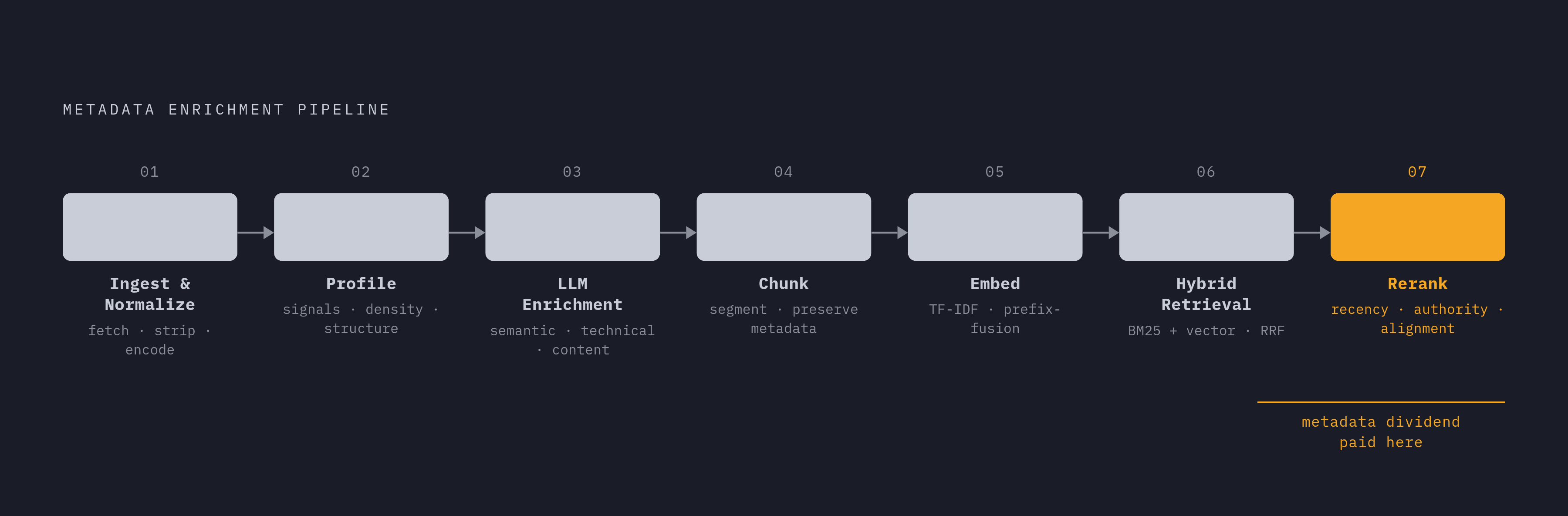
A production metadata enrichment pipeline for web documents follows a canonical shape, and skipping any one of its stages, whether that means omitting profiling, dropping the reranking step, or ignoring governance fields, predictably degrades the reasoning quality an LLM can reach downstream. The first stage ingests and normalizes the raw document: fetching it, stripping boilerplate and formatting artifacts, and standardizing encoding and text structure. This stage is the prerequisite for everything that follows, and scraping instability here does the most compounding damage to overall pipeline reliability. The second stage profiles the normalized document, extracting structural properties such as content type signals, entity density, structural markers, and length and format characteristics, then converting those properties into structured prompts the enrichment model can treat as evidence. Profiling is what separates enrichment that is targeted to a specific document from enrichment that is merely generic.
The third stage runs the LLM enrichment module itself, and it generates structured annotations across the semantic, technical, and content dimensions described earlier. Where a web document's original metadata is sparse or missing, which is common for pages built for human readers rather than machine consumption, the model fills that gap against Dublin Core or another schema suited to the domain. The fourth stage chunks the enriched document into semantically meaningful segments while preserving document-level metadata as inherited context for every chunk; naive chunking that discards that document-level metadata at this point throws away the authority and provenance signals the enrichment stage worked to generate. The fifth stage embeds each chunk using one of the two integration strategies already described, TF-IDF weighting to amplify metadata token influence or prefix-fusion to prepend a structured metadata header before encoding, with the choice governed by whether the retrieval objective calls for precision or for ranking quality.
The sixth stage runs hybrid retrieval, executing BM25 keyword search and vector search in parallel and fusing the two result sets through Reciprocal Rank Fusion. Metadata contributes to both halves of that fusion: keyword metadata improves BM25 recall, while semantic annotations improve vector precision, making hybrid search a natural complement to an enrichment pipeline. The seventh and final stage reranks the fused results using a cross-encoder that scores candidates on metadata signals, including recency, authority, and content type alignment, alongside raw semantic relevance. Reranking is where all the metadata investment made in the earlier stages pays its most direct dividend, because it is the last point at which the pipeline can correct the order of what the LLM is about to receive. MetaRAG confirms that a pipeline built this way can maintain sub-30 millisecond P95 latency in enterprise settings, showing that metadata enrichment can be achieved affordably when performance is treated as a constraint from the first stage. Throughout all seven stages, the Metadata Reasoner determines what reaches the agent's active context directly and what stays available only on demand.
Web-native metadata enrichment and ownership of the full data pipeline
Metadata enrichment quality gets set upstream of the enrichment step itself, at the fetch and normalization layer, so if a pipeline is built on top of an unreliable web access layer, it cannot produce consistent metadata no matter how sophisticated its enrichment model is. SERP snippet APIs return fragments that are too short to profile meaningfully, too shallow to yield real subject terms, and missing the document-level signals, full body structure, internal link density, authorship blocks, that the enrichment stage depends on as evidence. A pipeline built on that kind of input receives noise before enrichment has even had a chance to start.
Scraping infrastructure introduces its own instability on top of that. Anti-bot defenses, JavaScript rendering failures, and proxy-rotation overhead all produce inconsistent versions of the same document, so a page fetched twice may return different text both times. That inconsistency makes enriched metadata non-reproducible across pipeline runs, breaking the determinism production AI systems depend on to behave predictably. Data ownership becomes a live concern at this point too. When fetch, normalization, and enrichment pass through third-party services, the enriched metadata the pipeline produces, including proprietary annotations, authority scores, or domain classifications, can fall under third-party data retention or usage terms, creating exposure that enterprise security and compliance teams have to account for.
The governance fields that matter most for enterprise RAG, lineage, quality scores, classification, sensitivity, cannot be generated reliably when the pipeline has no way to trace a document back to a confirmed source fetch. Provenance needs a chain of custody that runs from the original crawl through to the index, and only a pipeline that owns every step end to end can keep that chain intact. The Metadata Reasoner's reported 99% success rate at avoiding low-quality data sources in noisy environments is only achievable when the quality and recency signals feeding that judgment are themselves trustworthy, which presupposes a data pipeline that is reliable and governed rather than a layer wrapped around someone else's scrape. For teams moving from a demo to a production system, the enrichment pipeline and the fetch infrastructure underneath it form a single system to design and own, a decision made as one, not two separate vendor choices made independently of each other.
Metadata enrichment as a continuous discipline, not a one-time indexing step
A metadata-enriched index that stops being refreshed turns from an asset into a liability over time. Authority scores grow stale, subject terms drift out of date, and recency signals go missing, and an LLM drawing on that index reasons confidently from information that has already been superseded. That failure mode is harder to catch than a missing document, because nothing about the retrieval looks broken; the system returns a well-ranked, well-annotated result that simply happens to be wrong about the present. Everything the preceding stages build, the fields, the enrichment models, the fetch infrastructure, the governance layer, only holds up if it keeps running against the live web rather than against a snapshot taken once and left in place.
Sources
- An Agentic Approach to Metadata Reasoning
- Enriching Dataset Metadata with LLMs to Unlock Semantic Meaning
- A Systematic Framework for Enterprise Knowledge Retrieval: Leveraging LLM-Generated Metadata to Enhance RAG Systems
- A Systematic Framework for Enterprise Knowledge Retrieval: Leveraging LLM-Generated Metadata to Enhance RAG Systems