Graph-Enhanced RAG for Multi-Hop Web Knowledge Retrieval
Graph-enhanced retrieval chains evidence across documents instead of ranking isolated chunks.
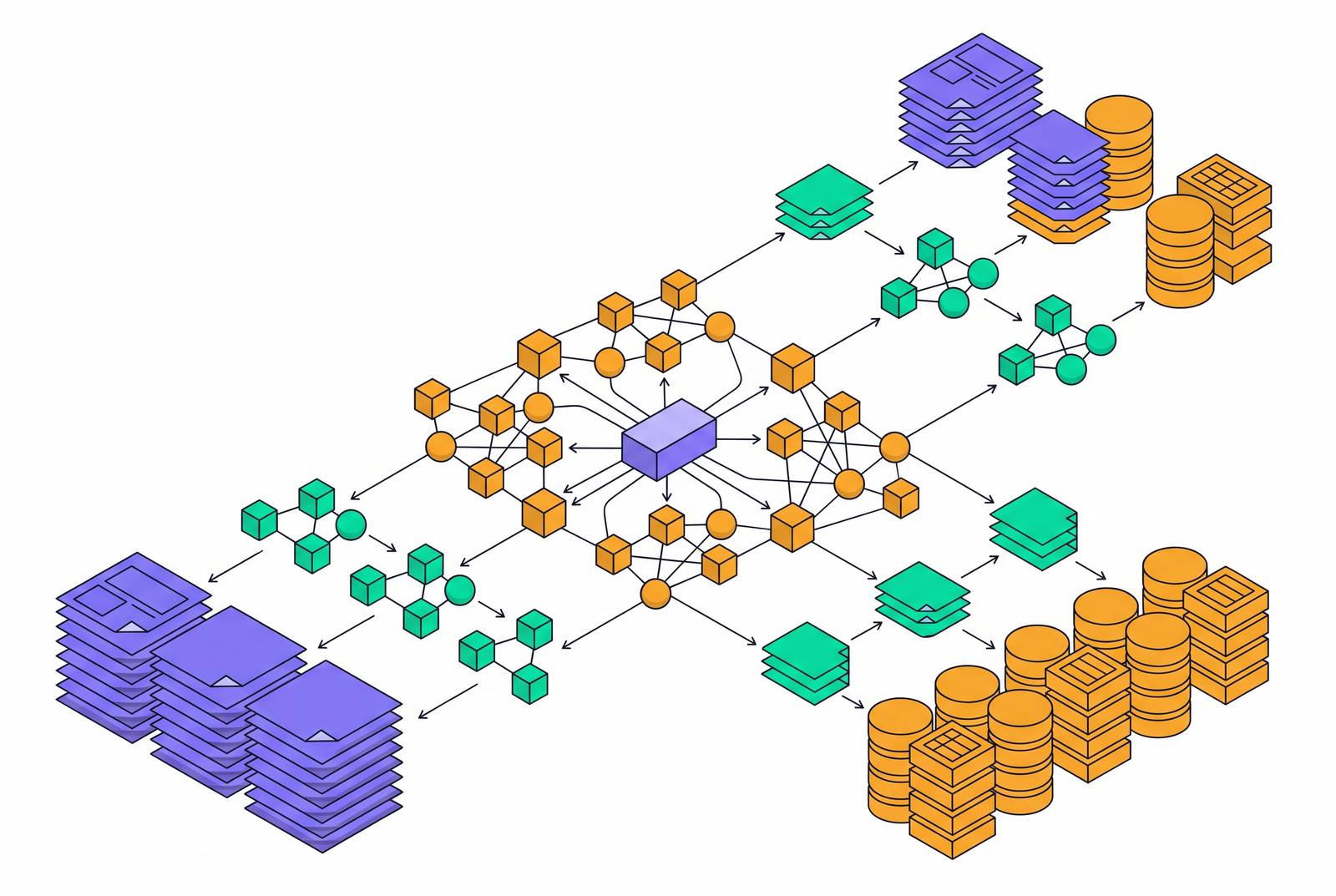
Standard RAG chops documents into fixed-length blocks, embeds them, and pulls back whatever chunk sits closest to the query in vector space. That works fine when one passage holds the whole answer. It falls apart on multi-hop questions, the kind where no single document is enough and the answer only comes together once you've chained evidence across two or more sources. Graph-enhanced RAG fixes this by making the relationships between pieces of evidence explicit, instead of leaving the model to guess at them from a flat list of retrieved text. The real dividing line is a system that finds text sounding like the question, versus one that finds the actual chain of facts leading to the answer.
The "self-contained answer unit" assumption is where flat retrieval breaks. A dense retriever ranks chunks by how closely their wording matches the query. But the intermediate fact connecting your question to the actual answer may share little vocabulary with either one, making it easy for similarity-based ranking to miss it entirely. Two chunks that look irrelevant sitting alone become decisive only when read in sequence, and flat vector search has no way to know that.
Researchers name two specific failure modes here. One failure mode is when the facts you need sit scattered across documents with no shared vocabulary to signal they belong together. Long-context multi-document reasoning is the other: even when the right chunks do get retrieved, the model receives them as an undifferentiated pile, with nothing marking which passage supports which claim or how they connect. When retrieval can't produce a coherent chain, the model fills the gap itself, often by inventing a plausible-sounding connection that isn't in any source document. That is part of the retrieval problem itself, not a separate hallucination problem sitting downstream of it. It's the direct consequence of retrieval failing to do its job.
What graph-enhanced RAG does differently: the three-stage architecture
Instead of retrieving isolated chunks, Graph RAG retrieves subgraphs: structured selections of nodes, edges, and paths that lay relationships out in the open rather than leaving them implicit.
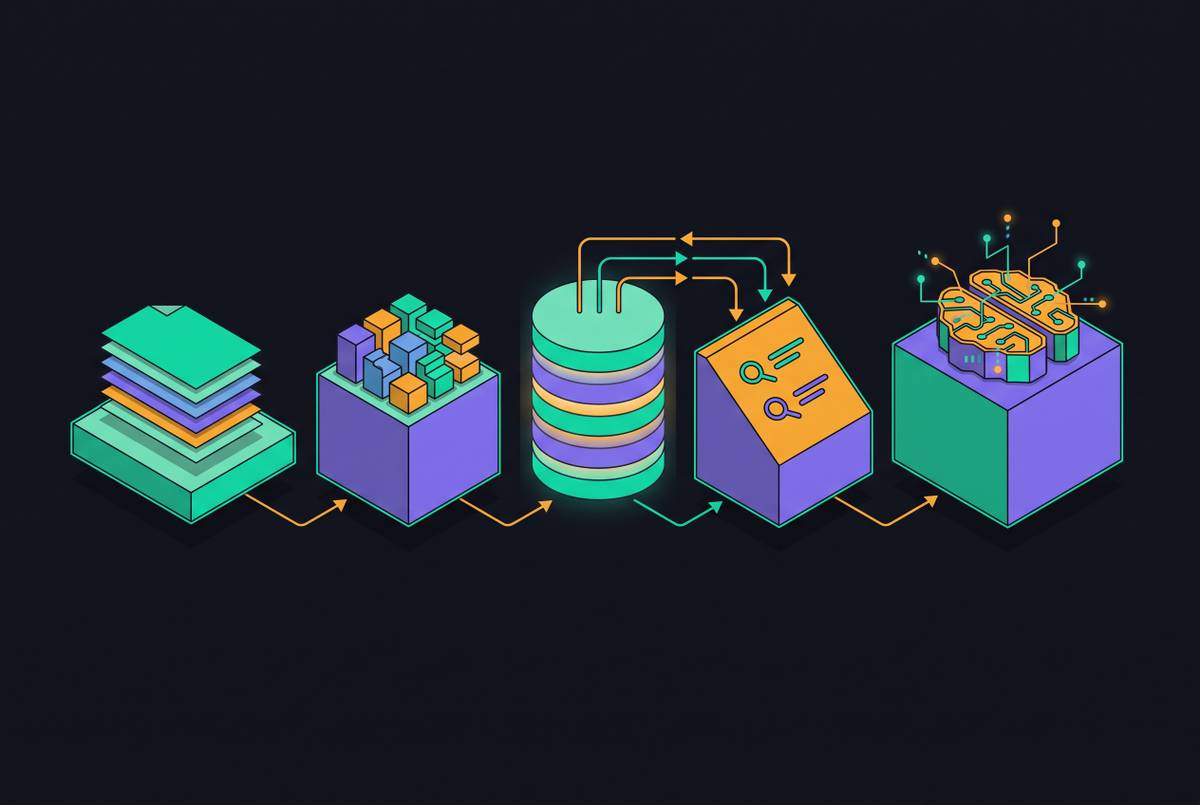
The pipeline breaks into three stages. Graph-Based Indexing builds the actual index, over nodes, over edges, or over whole subgraphs, and supports retrieval by structure, by text, or by learned embeddings depending on the design. Graph-Guided Retrieval then picks the subgraph that best answers the query by reasoning over relational structure, a meaningfully different task than nearest-neighbor lookup on flat text. Graph-Enhanced Generation comes last, where the model's input gets built from linearized triples, edge tables, community summaries, or pooled graph embeddings, so the generator sees path-ordered evidence rather than a flat stack of passages.
Two things fall out of this directly. Multi-hop reasoning gets easier, since the relationships between facts sit right there in the open instead of buried in context clues the model has to infer. And hallucination drops, because the output anchors to a coherent evidence path instead of facts that would otherwise look sparse and disconnected.
Microsoft's GraphRAG (Edge et al., 2024) put this approach on the map. It uses large language models to induce graph structure from a corpus, then builds community-level summaries that let the system answer broad, corpus-spanning questions, the kind that need sensemaking across many documents rather than a single lookup.
Accuracy isn't the only payoff. Graph nodes and edges carry human-legible text, so you can trace the path the system followed to reach an answer. Embedding-only approaches bury that reasoning in vector arithmetic nobody can inspect afterward. In any enterprise setting where an answer has to survive an audit, that traceability counts for as much as the accuracy gain, maybe more.
None of this comes free, and the cost deserves more than a passing mention. Graph retrieval burns more compute than plain text retrieval at every stage: building the index, running the traversal, serializing the output. It shapes nearly every design decision covered below.
How the graph gets built: indexing strategies and what each trades away
Graph construction isn't one method with minor variations. The different paradigms produce graphs with genuinely different properties, and whichever one a team picks constrains everything downstream. Pick wrong here and no amount of clever retrieval logic fixes it later. Teams that treat indexing as a solved, interchangeable step are the ones who end up rebuilding the whole system six months in.
Knowledge graph triples are the most familiar approach: entities become nodes, extracted relations become labeled edges. This gets high precision when the relation extraction is right, but it's brittle when it isn't. AtomicRAG (arXiv:2604.20844) lays out a concrete failure case: a host attribute gets mistyped as a disease symptom during extraction, and that single error propagates into a reasoning path that looks structurally sound but is factually wrong.
Chunk-level index graphs take a different route, treating text chunks as vertices and drawing edges based on semantic or structural closeness between them. This keeps more context intact than triples do, but it inherits the same rigidity that comes from cutting text into fixed segments in the first place.
Query-centric graphs, the approach behind QCG-RAG, build a two-layer structure: one layer holds the chunk set, the other holds query nodes generated through LLM prompting, with edges running both within and across layers to control retrieval granularity. Because construction ties to the distribution of queries the system expects, this design buys precision on those queries at the cost of generalizing less well outside that distribution.
Hierarchical or community graphs, as in LEGO-GraphRAG, run multi-level community detection using both graph topology and semantic similarity, producing meta-nodes, community keywords, and attribute hierarchies. That structure suits pulling together evidence spread across many documents, but it's heavier to build and heavier to keep current.
The Tri-Graph approach behind LinearRAG (Zhuang et al., October 2025) is the one worth taking most seriously of the bunch. It segments passages down to sentences and entities, forming a three-level graph running entities to sentences to passages, and it skips explicit relation extraction entirely. That sidesteps the brittleness triple extraction carries, and it scales linearly as the corpus grows, splitting the difference between a knowledge graph's precision and a chunk graph's simplicity.
Indexing is expensive to build no matter which paradigm you pick, and that cost is still an open engineering problem. KET-RAG (Huang et al., 2025) tackles it with a multi-granular scheme: a lightweight knowledge graph skeleton paired with a cheaper, text-based graph layered on top, aiming to capture most of the benefit of full graph construction without paying the full cost.
AtomicRAG takes a different unit altogether. Rather than chunks, it decomposes the corpus into knowledge atoms, individual self-contained units of factual information, linked by co-occurrence edges (relevance), containment edges (linking atoms to their contained entities), and synonymy edges (linking equivalent representations). Finer granularity lets the system reassemble evidence flexibly across very different query types without one query's structure interfering with another's.
The construction paradigm chosen sets a hard limit on which kinds of multi-hop questions the retriever can actually answer, and that limit gets re-tested with every new corpus, not settled once at build time. It runs through every later stage of the pipeline.
Path-based retrieval: how the system finds and ranks chains of evidence
Once the graph exists, the retrieval task changes shape entirely. Instead of nearest-neighbor search, the system has to find paths connecting query-relevant seed nodes to answer nodes, often across several hops, a structurally different search problem than anything vector similarity does.
S-Path-RAG (Fu et al., arXiv:2603.23512, March 2026) shows what path retrieval actually involves in practice. It enumerates bounded-length candidate paths using a mix of weighted k-shortest-path search, beam search, and constrained random walks, then ranks those paths on structural plausibility, relation priors, and learned semantic alignment rather than raw topological distance. A differentiable path scorer trains alongside a contrastive path encoder and a lightweight verifier, and the selected paths get compressed into a soft mixture of latents injected into the language model through cross-attention. That interface choice, cross-attention over raw text concatenation, has real consequences for token cost and for how tightly retrieval and generation can be optimized together. The approach is reported to improve over strong graph- and LLM-based baselines across multiple dimensions of retrieval quality.
HippoRAG (Gutierrez et al., 2024/2025) takes a different tack, using personalized PageRank propagating outward from query seed nodes across the graph. That lets the system pull multi-hop information together in one pass rather than chasing hops one at a time in sequence.
HopRAG (submitted February 2025, revised May 2025) builds a passage graph where text chunks are the vertices, working from a blunt observation: traditional retrievers chase lexical or semantic similarity when what actually matters is logical relevance. HopRAG folds logical reasoning into the retrieval step itself through graph-structured exploration, rather than treating reasoning as something that only happens after retrieval finishes.
AtomicRAG's retrieval side pairs personalized PageRank with relevance-based filtering over what it calls the Atom-Entity Graph, and it decomposes complex queries into atom-aligned sub-questions before traversal even starts, keeping the reasoning step separate from the retrieval step rather than fusing them.
Most of these systems share a weak spot worth naming directly: they retrieve in a single pass and have no way to go back and refine the evidence once the language model signals it's uncertain. S-Path-RAG addresses this with what it calls a Neural-Socratic Graph Dialogue loop, mapping diagnostic messages from the LLM to targeted edits or seed expansions on the graph. That's active engineering work, not a solved problem, and most production systems still don't have anything close to it.
Token budget is the other constraint shaping all of this. Path enumeration that ignores semantic alignment produces long lists of candidate text that waste tokens or, worse, bury the model in distracting noise. Semantic weighting and verifier filtering exist specifically to keep that from happening.
Subgraph selection and pruning: how the system avoids returning too much
Multi-hop traversal over a graph can surface a large number of candidate paths, and not all of them earn their keep. A spurious path misleads the generator just as badly as a missing one, sometimes worse, because a wrong path dresses itself up as evidence.
ReG, or Refined Graph-based RAG (Zou et al., June 2025), refines the retrieved subgraph before passing it to the generator, aiming to surface a coherent, ordered chain of evidence rather than a raw path dump. The model acts as a critic of what the retriever handed it, not a passive consumer of whatever shows up.
GFM-RAG (Luo et al., 2025) brings graph neural networks into multi-hop reasoning, combining structural graph traversal with language model judgment to handle both relational and semantic aspects of the task. Anyone picking one over the other is picking wrong: most of this research is heading toward a hybrid, pairing a GNN's traversal strength with an LLM's semantic judgment.
Query-aware graph neural networks push this further. Query-aware graph attention networks propagate signal from the actual user query across the chunk graph, so pooling and message-passing respond to what's being asked rather than staying fixed to the graph's global shape (Agrawal et al., July 2025; Luo et al., February 2025). The subgraph selected ends up shaped by the specific question in front of it, not by some static property of the graph as a whole.
What actually reaches the generator matters just as much as what gets retrieved in the first place. Linearized triples, edge tables, community summaries, pooled embeddings, each is a legitimate serialization choice, but each trades relational structure against token cost differently. Order matters too: ReG's logically sequenced chains beat a chunk dump with no sequencing every time.
This connects to a bigger point about context engineering, which is not cleanup work tacked onto the end of the pipeline. It's the actual mechanism through which graph structure translates into a better answer, and teams that treat it as an afterthought lose gains they already paid for in the indexing stage. A beautifully indexed graph with sloppy serialization loses to a simpler system that just builds its context with care. Research on domain-specific QA datasets has shown that subgraph selection quality shows up in both accuracy and cost, not just one.
Extending Graph RAG to live web sources: what changes when the graph is not static
Most Graph RAG research assumes a fixed, known document set, built once, offline, over a corpus that doesn't move. The web is the opposite: open-ended, changing by the hour, never pre-indexed in any form a retriever can just use.
That mismatch matters for any production system. A model's training data carries a knowledge cutoff baked in, and live web grounding is the only real way to answer factual, time-sensitive questions. So the graph layer either needs continuous rebuilding, or it needs to get constructed on the fly, at query time, from whatever comes back on that particular search.
Two architectures handle this differently, and neither one wins outright. On-the-fly construction retrieves web documents for a given query, builds a local graph over just that retrieved set, then runs path-based retrieval inside that small graph. It avoids a stale index, but it adds latency, and coverage ends up incomplete if the initial document retrieval missed something important. A continuously maintained web knowledge graph goes the other way, indexing web content into a persistent structure updated incrementally over time. That keeps retrieval fast, but it demands real infrastructure to keep the graph current at any meaningful scale, which is its own ongoing cost.
Agentic retrievers are the pattern gaining ground for web-grounded multi-hop work (Dong et al., August 2025): vertically unified frameworks that break a user query into atomic sub-queries tied to a seed schema, retrieve in parallel across nodes, triples, and community trees, and iterate with reflection built into the loop. In practice this looks like an agent firing off several web searches, assembling a local graph from what comes back, and traversing that graph before it ever generates a final answer.
LightRAG (Guo et al., 2024) introduces graph structures alongside a two-stage retrieval pipeline built to balance coverage against efficiency, and that tension gets sharper once the sources are web documents of wildly uneven quality rather than a curated corpus.
Source heterogeneity sits underneath all of this. Web documents vary enormously in structure, authority, and how densely they pack in actual facts, and graph edges built from co-occurrence or named-entity recognition over noisy web text carry less trust than edges built from a curated document set. Noise that creeps in during construction shows up later as retrieval errors, not construction errors.
What the web retrieval layer needs to hand off, then, is structured, cleaned, machine-ready content, not raw HTML dumped into a graph builder. Teams that skip this step and feed raw scrapes straight into a graph builder are the ones whose "knowledge graph" ends up encoding SEO spam as fact. The quality of that upstream layer decides whether the graph built on top of it is a reliable reasoning substrate or just a noise amplifier with extra steps. And there's real tension here with no clean resolution: production systems increasingly demand latency under 50 milliseconds, while on-the-fly graph construction, by its nature, takes real time to run. Teams shipping this need to reckon with that trade-off honestly instead of assuming it away.
Where Graph RAG performs best and where it still falls short
Graph RAG earns its keep most clearly on long-context QA, where evidence sits scattered across many documents and the graph's job is simply to help the model find its way through that spread without losing the thread. It also does well on compositional multi-hop questions, where each hop across an entity narrows the answer space further, and on domain-specific retrieval in fields like law, medicine, and finance, where relationships between entities run dense and the underlying data is curated rather than scraped off the open web.
QCG-RAG and PathRAG show the clearest gains over LightRAG and GraphRAG baselines specifically on multi-hop reasoning tasks, which lines up with the thesis running through all of this: making relationships explicit helps most exactly where the answer requires chaining evidence, and helps least where a single passage would have sufficed anyway.
None of this comes without cost, and pretending otherwise would be dishonest. Graph construction and path retrieval both add compute and latency that flat vector search skips entirely, overhead that's hardest to justify on simple, single-hop questions where a plain RAG pipeline already lands the right answer, and bolting a graph onto that kind of workload is wasted engineering effort, not a safety margin. Extraction errors during graph construction, a mistyped relation, a missed entity, still propagate into reasoning paths that look confident and turn out wrong. The web-grounded setting adds a layer of difficulty static-corpus research hasn't fully worked through: freshness, source quality, and latency all pull against each other, and no architecture reviewed here resolves that tension cleanly. Graph RAG is a real, structural improvement for the specific problem of multi-hop reasoning. It is not a universal upgrade over every retrieval task a system might face, and treating it as one is the mistake teams keep making.
Sources
- Graph Retrieval-Augmented Generation
- AtomicRAG: Atom-Entity Graphs for Retrieval-Augmented Generation
- S-Path-RAG: Semantic-Aware Shortest-Path Retrieval Augmented Generation for Multi-Hop Knowledge Graph Question Answering
- HopRAG: Multi-Hop Reasoning for Logic-Aware Retrieval-Augmented Generation | Request PDF
- Graph-Based RAG for Enhanced Multi-Hop Reasoning
- arxiv.org
- arxiv.org
- aclanthology.org